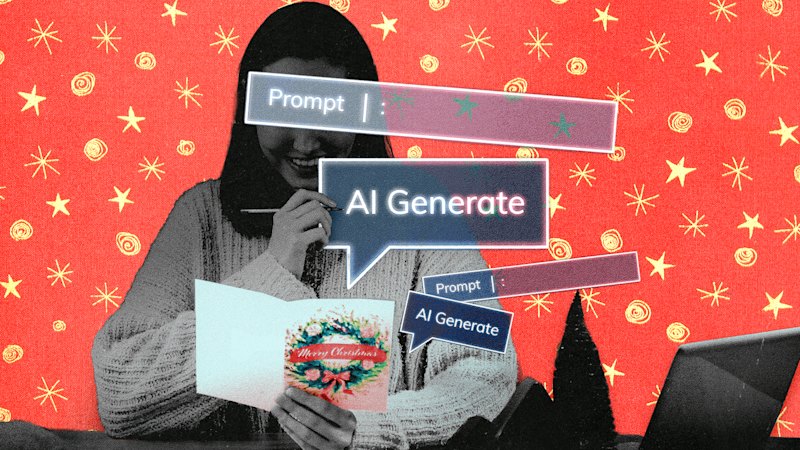
“Personally, I didn’t care that my card had AI used on it because I knew it was one of those ‘obligations’ he had to do,” says Scott. “But it did feel like a cop-out because he was too lazy to write something [and] pretend to care.”
Loading
Nick, a Sydney man who wishes to be identified by his first name only due to privacy reasons, uses ChatGPT for help writing birthday and wedding cards.
That doesn’t mean they don’t come from the heart – Nick says the messages he writes are mainly his own thoughts, memories and ideas.
“It’s mainly to get inspiration for the body/filler parts because it’s easier to pull from ChatGPT than it is to come up with something witty in the moment,” he says.
“We are usually writing the cards in the car as we are pulling up at the event.”
In theory, it’s akin to hiring a ghostwriter. J.R. Moehringer wrote Spare, but it’s Prince Harry’s face on the cover. That’s why the memoir moved 3.2 million units globally within its first week of release.
What kept people talking about it in the months following – aside from the revelation that he once put Elizabeth Arden lip cream on his frost-nipped penis before Prince William and Catherine, Princess of Wales’ royal wedding – was the fact it was the Duke of Sussex’s voice pouring out from the pages.
That can only come from human connection, argues New Zealand wedding celebrant Melanie Vezey. For the couples she marries, Vezey ghostwrites a love letter to read out on their behalf during the ceremony.
“There are elements of being human that are just not replaceable.”
Melanie Vezey
That involves the couples filling out questionnaires, answering follow-up questions and going back and forth with Vezey, giving feedback and instructions.
“Part of the skill that a human would have would be [being] able to engage their [intuition],” says Vezey. “I’ve usually met them once on Zoom, and I have a feeling of the synergy between them. Is he more funny? Is she more serious? That kind of stuff. So then I can tune in to write the letters based on that.”
Loading
Some letters, for which Vezey charges $NZ90 ($79) each, require more emotional intelligence than others. Vezey once had a client ask her to write a final Christmas letter to her terminally ill mother.
“I said, ‘Oh, that’s wonderful. Tell me about her’,” Vezey recalls.
“She goes: ‘Well, I hated her guts, but I want closure and I want to say some things and I need to say them properly.’”
“You weren’t there for me” and “you ruined my life” became “you showed me how I wanted to be there for my own kids”. The client was paying Vezey for a true understanding of her personal circumstance, not an aggregation of publicly available information (LLMs scrape the internet and produce responses based on existing content, including books, journalism and traditional artworks).
“I do not feel that AI can interview you properly … it can’t extrapolate. It can’t tune in to your feelings,” says Vezey. “There are elements of being human that are just not replaceable.”
Sydney copywriter Krisinda Merhi, who charges $300 an hour, has ghostwritten her fair share of letters of wishes, wedding speeches and birthday cards. She “can understand how people might sit down and really struggle to write” longer-form projects that require more depth, tact or a sounding board.
“I’m almost inclined to say that it feels less OK if it’s something shorter-form, like a birthday card,” says Merhi. “Surely you can f—ing write a birthday card.”
The Morning Edition newsletter is our guide to the day’s most important and interesting stories, analysis and insights. Sign up here.