

I was once in the Irish town of Kilkenny on a Monday night, generally the quietest night for live music. Yet of the dozen pubs I chanced upon, only two didn’t have people playing, with the music always Irish traditional. The good burghers of Kilkenny saw no point staying home and watching screens when they could be out enjoying music, conviviality and a pint.
When I relate this to Martin Hayes, doyen of traditional Irish fiddlers, he says it was the same in his village in County Clare, and is simply the norm. He agrees it tightly bonds musicians’ community, although he’s less convinced it bonds the wider community.
Hayes can still hear differences in the tradition in various parts of Ireland but an increased homogeneity is the inevitable result of people’s wider musical exposure.
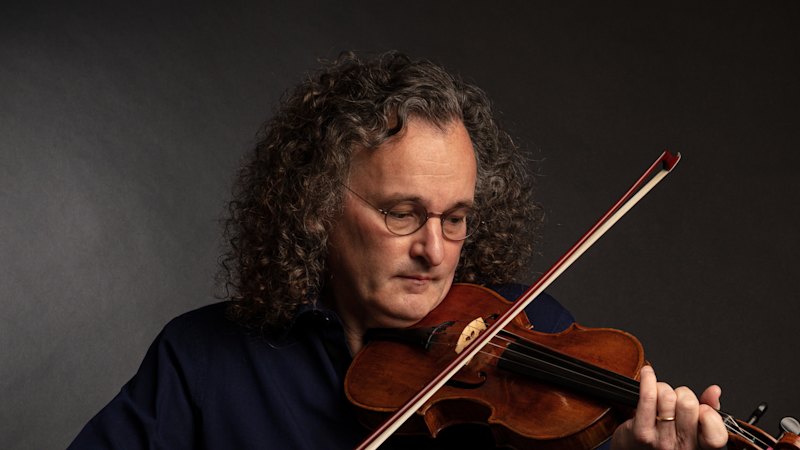
Fiddler Martin Hayes says tradition adapts and evolves. Credit:
“The previous regional styles were a measure of relative isolation, in one sense,” he says. “A deeper examination of regional styles always finds that they were never absolute, and were often influenced by one or two musicians of significant quality who made everybody else want to play this way. So at the core of regionalism in music were often unique, creative individuals.
“So instead of trying to emulate or salvage these things in some artificial way, I’ve always felt there is a unique opportunity for the individual to find creative possibilities. You can be open to all of it, and then, if you can internalise it, you can maybe let yourself go a little bit and see what voice begins to emerge.”
Reverence for the tradition, therefore, must be balanced with keeping the music living in the present tense.
“We tend to imagine tradition as a set thing,” says Hayes. “You think they’ve been doing this for hundreds of years, and actually, they haven’t. If you look at it carefully you’ll see enormous development, change and evolution even in the recorded history of the music through the 20th century. The tradition has continually adapted and responded to the world around it and has attempted to be relevant, to survive in an evolving musical and cultural world.”
‘The [regional Irish music] tradition has continually adapted and responded to the world around it and has attempted to be relevant.’
Martin Hayes
Hayes can still gain new insights into a tune he may have known for 50 years. “It could reveal itself to me in a new way at any moment,” he says. “And of course people are writing great traditional Irish music at the moment as well.