

In the annals of television history, medical dramas have always been shot from the bed up. That is to say, the camera prefers to capture the doctors (and nurses) peering down at their patients, a kind of in-universe logic never made clearer than in the iconic image of the ER cast peering down at the camera.
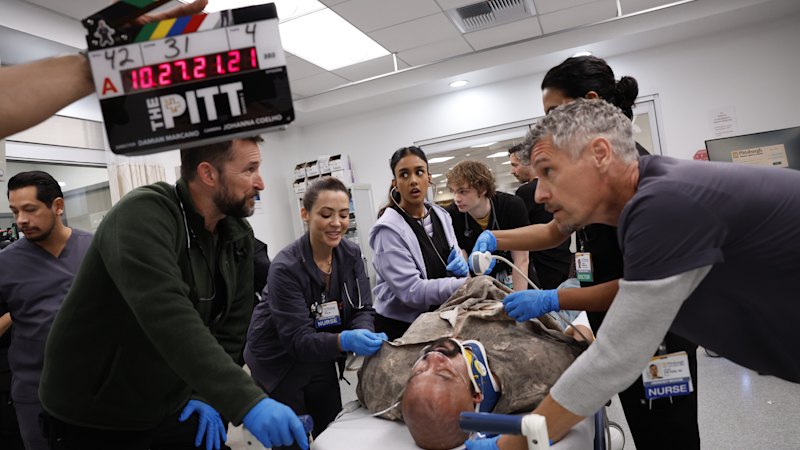
The Pitt, the critically acclaimed medical drama which is launching its second season this week, flips that script – literally, in a way – by turning the camera around to look instead at the patient’s injuries from a doctor’s perspective. The effect is powerful, giving the series an almost-documentary tone.
“The biggest difference, stylistically, is everything,” actor and executive producer Noah Wyle says of the show’s reinvention of the medical drama camera frame.
“There are no lights on our set, there are no C-stands [the grip stands used to support lights, reflectors, backdrops and other equipment], there are no camera tracks, none of the traditional filmmaking tools.”
Instead, there are more than 200 individual lights in the hospital ceiling, remotely controlled for brightness and temperature. “And those are calibrated in real time as we move through the space, so as actors we’re free; they never put down marks on the floor, the [camera] focus puller is never trying to gauge the distance, we’re never asked to accommodate the framing of the camera,” Wyle says.
“It’s intentionally sloppy,” the 54-year-old actor adds, with a wry smile. “It’s intentionally, slightly off-perfect because you want it to be grounded in the perspective of a voyeur, analogous to being in the back seat of a squad car on a ride-along, or maybe being embedded with a combat unit … You can’t leave, you can turn your head, but you can’t escape this experience.”
And that famous ER photo, the one with Wyle and his co-stars Sherry Stringfield, George Clooney, Anthony Edwards and Eriq La Salle? “It is my least favourite photograph,” Wyle says. “We all have double chins and all the blood is rushing to our faces; [it’s] very unflattering.”

But back to The Pitt. The series, filmed primarily on the Warner Bros lot in Los Angeles, uses a huge linear set that blends corridors, surgical suites, the hospital emergency department and offices. Its exterior imagery is filmed in Pittsburgh, Pennsylvania – the show’s setting – for authenticity, notably Allegheny General Hospital.
The series explodes the medical genre in several interesting ways. Its medical realism is almost unmatched in Hollywood storytelling: bloody surgery, horrific injuries, left in the camera frame with 360-degree gory realism. It also taps into the darker underlying issues of American medicine: hospital overcrowding, staff shortages and burnout.
But the secret sauce may be the ticking clock: each episode of a 15-episode season covers one hour of real time. Which means each season covers a single continuous 15-hour emergency department shift, from 7am to 10pm.
‘[It’s like] being in the back seat of a squad car on a ride-along … You can’t leave, you can turn your head, but you can’t escape.’
Noah Wyle
Walking onto the set, our tour guide is the show’s star, Wyle. The crew is filming the final third of the second season, and it was at this point in the show’s first instalment that things got a little crazy.
“There was blood everywhere and all over all of us, and at that point in the season we were all fairly well exhausted and really immersed in what we were doing,” Wyle recalls. “We’re getting to those championship rounds right now in this season.”
The logistics of The Pitt are formidable. The main set is a near-functional 2200-square-metre emergency department, built with a little excess space to allow for free camera movement, and staffed by extras who have, for the most part, worked previously in various aspects of hospital medicine. The result is background nurses and other staff aides who know what they’re doing.

There are also complex diagrams – and a second filming unit which follows the show’s background patients through a real-world-accurate journey in the hospital. Which is to say, in the 15 hours of an entire season, the patients will deal with doctors, be taken for X-rays, and even visit the toilet. Even as a journalist, visiting the set on a filming day means I am dressed in green hospital scrubs so that if the camera should accidentally catch me in the frame, there is no risk of ruining the shot.
The first season of The Pitt was an astonishing success. It drew almost universal acclaim and became compelling viewing, partly because of its innovative point of view. A second season surely brings with it pressure to match the first, but perhaps also some confident swagger?
“It’s a little bit of both,” says Wyle. “There was an incredible sense of validation that came from the acknowledgement that this speculative thing that we hoped would work not only worked but was recognised as being high achievement. That carries with it the loss of being an underdog show.

“When we came on last year there were low expectations, and we were sort of a discovered treasure. That’s a really wonderful place to be,” he adds.
“We do feel a pressure, but the pressure is really to be as authentic and honest to the intention of the first season as we can be and not try to outdo ourselves or make it bigger or splashier or bloodier.”
Contrary to the notion that an actor’s life is one of random jobs, distant stages and long weeks on the road, for the past three decades – give or take a gap here or there – Wyle has been an employee of Warner Bros. He did ER, playing Dr John Carter, followed by Falling Skies, The Librarian and The Pirates of Silicon Valley. The broadcasters changed, but the studio stayed the same and home remained the Warner studio in Burbank.

“I grew up in Hollywood, and Warner Bros always loomed large in my imagination because I loved the movies so much,” he says. “It was the gangster studio, it was the cowboy studio, it was Bogart’s studio, it was Bette Davis’ studio. So many of the great old Hollywood movies were made in those large cathedral-like sound stages, and even when I was on ER, I would get giddy thinking about all the things that had been shot on that stage before I stood on it.”
ER‘s main sound stage – stage 11 – was home to Yankee Doodle Dandy (1942), Mildred Pierce (1945), All the President’s Men (1976) and Batman Returns (1992). The series also filmed on stage 26, stage 2, stage 3, and stage 7. The last of those housed Rick’s Cafe from Casablanca (1942). The Pitt’s stages – 21 and 22 – are similarly storied. They were used to film A Streetcar Named Desire (1951), A Star is Born (1954) and, later, Batman Returns (1992), Batman Forever (1995) and Ocean’s Twelve (2004).
“When [I was on ER, and] they told me that it had been the interior for Rick’s American Cafe in Casablanca, that it was the inside of The Washington Post office in All The President’s Men, I was like, ‘Oh my god’; I felt it was hallowed ground,” Wyle says.
“All of that art, all those players, all those people treading those boards and that history which exists in each one of those sound stages … to feel like you’re a link in a chain in that lineage is kind of aspirational.”

That sense of history creates a complicated context around Warner Bros, which is now the target of a US$82.7 billion ($123 billion) takeover bid by streaming giant Netflix. The proposed deal has transfixed Hollywood analysts, and brought the movie (and TV) making business to a dramatic evolutionary crossroads.
“We’re witnessing the end of a significant era; the one that’s most recognisable is the movie business is ending,” Wyle says. “It has been ending for a while in that sense. It’s no longer centralised in Hollywood. Hollywood is not where content is exclusively made any longer.
“It’s been democratised, it’s metastasised, it’s globalised,” he says. “And now the viewing population accepts content from that global participation in a larger way. American content is less significant; foreign content is more significant. The ability to play overseas to a global market is more important. The ability to have an international feel is also significant.
“These changes have been coming for a long time. Some of them are creative, some of them are economic, some of them are technological. I’m such a romantic and such a sentimentalist that I can’t help feel like I’m watching something that I really love kind of go away.
“But change is inevitable. Whatever’s going to come in will be just as exciting.”