Opinion
Here we go again. Three men in their 30s, two of them childless, pondering – in public – whether the drop in the fertility rate could be due to the sheer selfishness of women.
“I mean, they get jobs and then don’t want to procreate,” says one.
“Should we … put systems in place to do something about it?” says another.
Yes, this brilliant suggestion for coercing women to marry and/or breed was actually said out loud in the globally popular podcast Diary of a CEO, hosted by entrepreneur Steven Bartlett. As you can imagine, it’s gone down extremely well with the ladies of the internet who very much appreciate being blamed for any broad and complex social problem. If indeed a declining birth rate is only ever a problem.
Bartlett has had two conversations about this on his pod recently – one with Chris Williamson, a former contestant on Love Island UK (a show renowned for its considered insights into relationships), and another with psychiatrist Alok Kanojia.
It is well established that there has been a decline in birth rates in Western countries. It’s now about 1.48 births per woman in Australia, 1.6 in the US, and 1.41 in the UK, significantly lower than the replacement level of 2.1. Williamson said: “It’s a function of a lot of things. Specifically, women’s socioeconomic emancipation into the workforce and higher education means that at 18, the first thing you [women] do isn’t get married [sic].”
This is true – but the horse has kinda bolted on this one, old chap. In Australia alone, women have been attending universities for almost 150 years.
Showing a remarkable ignorance of history, Williamson also blamed a new “anti-family” message among women, citing one TikTok creator with 1.4 million followers as proof. This creator, The Girl With the List, was delighted. She describes herself as “a childfree reproductive rights advocate who spends her free time curing the internet’s baby fever”. The list she has been compiling is a crowd-sourced file titled “Pros and Cons List of Having Children”, mostly comprising cons. Some are silly – “everyone will know you did the nasty” – or highly unlikely – “their tiny foot might get stuck in your ribs, and you may crack a rib”. Many are just to do with the passing physical discomfort of pregnancy and the pain and potential horrors of birth.
But Williamson’s take was that these reasons were all daft, from “having a parasite growing inside your body” to giving up heels. He adds that while she is “free” to think what she wants – lucky girl! – that, “by the sound of things, it’s a really good idea that she’s not a mother”.
It’s good to be well-informed. I was so well-informed that I was quite shocked at the bliss I felt holding my baby in my arms for the first time – I strangely hadn’t prepared for it. Women need to talk about how childbearing can blow up their bodies and lives, and be supported while enduring it.
Last year Bartlett said to Kanojia: “A huge amount of men between the age of 15 and 50 will not pass on their genes. They will effectively die out of the gene pool … Many people will go, ‘well that’s evolution’. But I want to understand if there’s a counterpoint to that. Should society intervene?”
First, why do only men speak about passing on genes, and when they do, why do they only refer to male genes? Second, does “society” mean … blokes? Third, is there a touch of entitlement here?
He continued: “In the short term, we’re going to have a lot of men who are disillusioned, that become incels, find themselves in pockets of the internet that are resentful – all those kinds of things. But should society intervene to course-correct that? Should we put systems in place to make sure that those men meet partners?”
Mate. Coercion is not only a bad idea, it is now illegal. Little wonder women immediately flamed, asking if this was “Gilead FM” and if “putting systems in place” is not just a touch draconian but a risibly red-pill simplistic answer to a complex problem.
I’m all for the airing of weird ideas if they are not hateful.
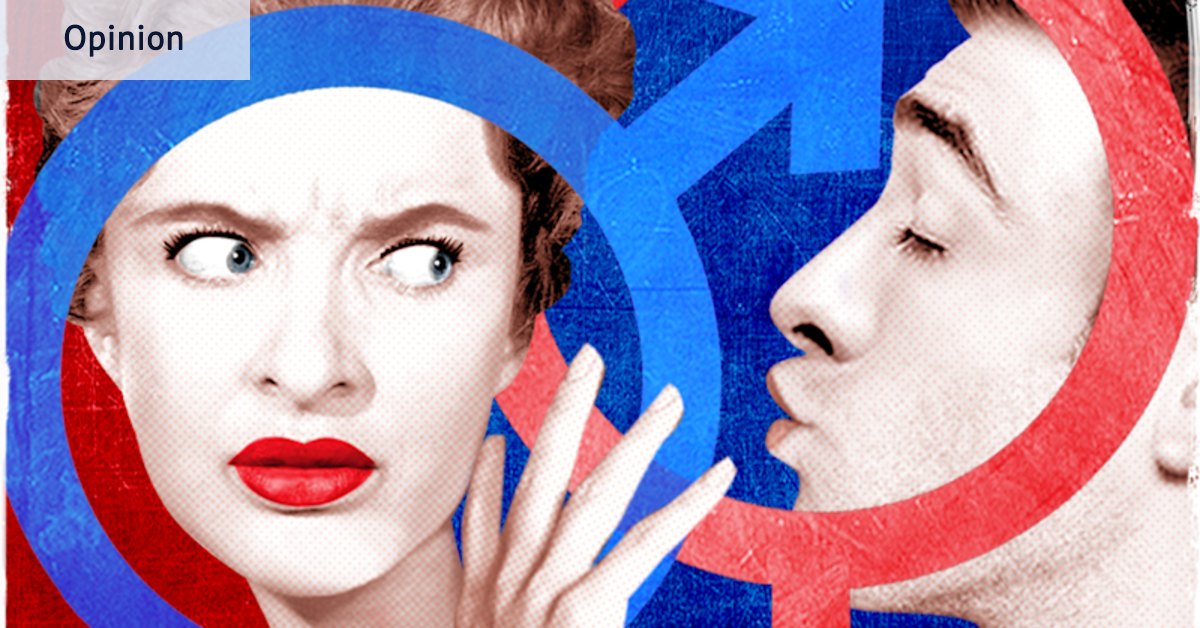
But this stuff is a sideshow. What these blokes fail to address is the yawning, and growing, gap between young men and women, politically and culturally, when it comes to views about sex, US presidents, consent, climate change and love. Men are moving further to the right, women to the left.
The subject they most disagree on is gender equality, with a greater divide than any other generation surveyed. An Ipsos poll of almost 24,000 people across 30 countries in 2025 found: “Gen Z opinion is most divided by gender on whether they define themselves as a feminist, whether a man who stays home to look after his children is less of a man, whether men are being expected to do too much to support equality, and whether we’ve gone so far in promoting women’s equality that we are discriminating against men.”
Could this not be crucial? How can we form relationships if we disagree on this stuff? (Of course, we should continue to discuss practical ways to aid parents, such as childcare, maternity leave, the cost of living, division of labour and how to combat domestic abuse.)
This division has surely contributed to a widespread rejection or sidelining of relationships by young women – often called “decentring men”. There has been open discussion of “heteropessimism”, a term coined by sexuality scholar Asa Seresin in 2019, defining it as publicly bemoaning “regret, embarrassment or hopelessness” about the heterosexual experience.
Stories like The New York Times’ “The Trouble with Wanting Men” quickly go viral.
Seresin now talks about “heterofatalism”, signalling a despair and lack of solutions, or hope.
As put in The Conversation – “Heteropessimism describes something mundane. It’s a pervasive disappointment … It is either unhappily ever after, or living with compromises that are fundamentally unsatisfactory.”
Fundamental disagreements on the role and rights of women are never going to boost birthrates. Men are usually blamed for heteropessimism, especially for lack of domestic work and poor communication. Women are blamed for dipping birthrates and the loneliness of men.
We’re shooting arrows across the battlements, but it is clear that something profound and disturbing is happening, something we need to air and wrestle with if we are to understand it. Until then, many will remain better at expressing despair than desire.
Julia Baird is a journalist, an author and a regular columnist.
Get a weekly wrap of views that will challenge, champion and inform your own. Sign up for our Opinion newsletter.
 Julia Baird is a journalist, author and regular columnist. Her latest book is Bright Shining: how grace changes everything.Connect via X, Facebook or email.