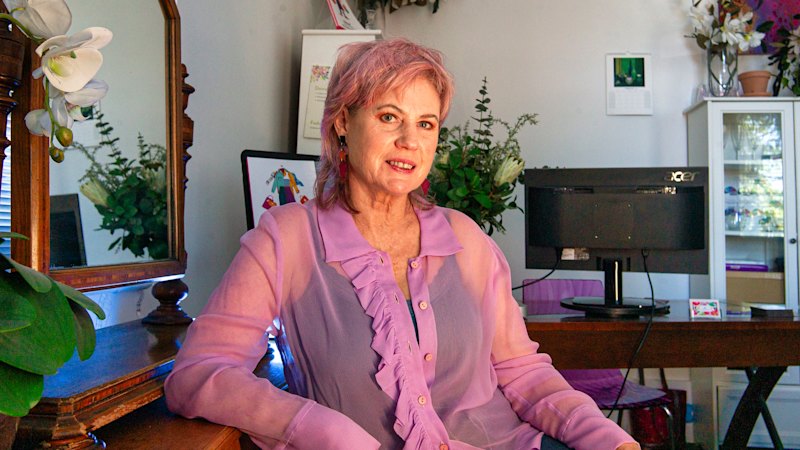
It wasn’t until she was in her 20s that Donna Cameron realised she saw things differently.
“I just assumed everyone saw colour in numbers and letters,” she says.
For the 61-year-old Melburnian, each letter in a word has a colour. “Take your name for example,” she tells me. “‘Gary’ is crimson. Only the dominant letters – the ‘G’ and the ‘r’ of Gary – are crimson, meaning your name looks that shade to me when I hear it.”
The dominant letters and crimson colours are unique to her perception, and will remain crimson to her for decades, maybe for life.
That’s because Donna has synaesthesia – the neurological condition in which senses overlap. The stimulation of one sense triggers automatic, involuntary experiences of another. The opposite of anaesthesia (meaning “no sensation”), synaesthesia literally means joined or coupled sensations.
People with synaesthesia – known as synaesthetes – might smell colours, feel flavour or see music. Each case is unique: for another synaesthete, the word “Gary” might be a different colour to crimson.
The phenomenon is having a cultural moment
Paul Mescal played a synaesthete in the 2025 film The History of Sound, and synaesthesia features as a key plot device in TV thriller All Her Fault.
For singer Pharrell Williams, music is a visual experience – he hears colours. For him, it determines whether the tune is off-key. His 2024 Lego-animated film Piece by Piece helps audiences visualise this. Singers Billie Eilish and Lady Gaga both say the condition inspires their creative process.
Cynthia Erivo also went viral after telling Jennifer Lawrence she had it, naming colours for the sounds Lawrence made. Commenters online were sceptical, some claiming they “call bullshit”, but it’s a verifiable hereditary neurological condition.
It’s no coincidence people with it tend to be in the arts, says Dr Solange Glasser from the University of Melbourne. “It’s far more common for people involved in the creative industries,” the senior lecturer in music psychology and synaesthesia expert says.
About three per cent to 5 per cent of people have it, and that number leaps to a quarter of artists according to studies.
What are the different kinds of synaesthesia?
More than 80 forms of synaesthesia are recognised. Glasser lists “some of the fun ones”, like ticker tape synaesthesia (people see speech literally, like subtitles rolling in front of them when someone speaks), and spatial sequence synaesthesia (the person sees dates, days or months mapped out around them).
If particularly acute, the condition can lead to sensory overload, which is why there is sometimes a strong crossover with autism, Glasser says. She suggests workplaces could make reasonable adjustments to help in such cases.
More commonly, however, synaesthetes say it’s not something that interferes with their daily life.
“It’s only if you ask, they’ll say, ‘Oh yeah, I suppose when I listen to that music, there’s a faint hue of changing colours that surround me’, but it’s not something that influences them,” Glasser says.
Some synaesthetes I spoke to say it’s difficult to describe what colours they see when music plays because they’re so complex, it’s “like trying to describe a sunset or a galaxy photo to someone who has never seen it”. One of them credits fellow synaesthetic artist Melissa McCracken, who paints what she sees when she hears music, with producing “the only thing I’ve ever physically seen that comes close to illustrating how I experience music.”
On the other end of the scale, for some, it’s a “huge part of their identity and measurably helps their cognitive functioning”, Glasser says. “Many describe it as enriching, even joyful – but it isn’t a superpower,” she adds. “It’s simply a difference.”
There are, of course, exceptions. She cites Daniel Tammet, the British savant who perceives numbers up to 10,000 as having unique colours, shapes, textures, and motions. He has used his numerical synaesthesia in remarkable feats of mathematical genius, like memorising pi to 22,514 digits, or learning to speak Icelandic in one week.
What are the benefits of synaesthesia?
For Donna Cameron, the biggest plus is as a memory aid. “Whilst studying history, it was very useful for remembering dates because I’d remember them as a series of colours.” She uses the same colour-coded technique to accurately recall names and phone numbers.
Glasser says aiding memory is the most commonly cited perk among synaesthetes. “They can experience heightened pattern recognition, which provides extra scaffolding for some of those cognitive tasks,” she says.
The condition has also helped Donna find her calling: as a colour analyst. “I never get bored of it – it’s my passion” she says. “I advise what colours people should wear based on what they want to express and what illuminates them best,” she says.
Previously having worked in offices devoid of colour, her productivity dipped. “If offices were monochrome or just fluorescent lighting and beige walls, it sucked my energy and I felt drained,” she says, adding that workplaces could boost office attendance if they had this kind of intel on potential synesthete staff.
Now, she can flood her studio with the colours that engage and enliven her. “If I’m not around colour, I really crave it,” she says.
Fantastical, romantic – and real
For some, this all sounds fantastical. Glasser has sympathy for that view – “it speaks to that romantic, imaginative part of our being, doesn’t it?” – but cites evidence of synaesthesia’s legitimacy as a neurological condition.
“It’s one of the most robust phenomena in perception research,” she says. “Since the 1980s, we’ve been able to compare, through neuroimaging, the brain of a synaesthete and a non-synaesthete, and how they light up differently to certain stimuli.”
Glasser believes the current cultural moment the condition is having is a small part of the wider neurodiversity movement. “Those stories allow us windows into these different forms of perception,” she says. “And illustrate the beauty in the varying ways we all see the world.”
Make the most of your health, relationships, fitness and nutrition with our Live Well newsletter. Get it in your inbox every Monday.