

Those fears were heightened yesterday by a swift outbreak of violence across Mexico.
In states around the country, armed groups blocked roads and set fire to supermarkets, banks and vehicles, in one of the most widespread eruptions of turmoil in the nation’s recent history.
Mexican security forces had captured Oseguera in Tapalpa, a town of about 20,000, in the western coastal state of Jalisco, where his cartel was founded and based, the Government said in a statement.
Oseguera was injured in the operation and died while in transport to Mexico City for medical attention, according to the Government. At least nine other cartel members were killed.
Oseguera’s killing is a major victory in Mexico’s new offensive against drug cartels and it could help reduce pressure from United States President Donald Trump, who has been threatening strikes in Mexico.
The Mexican Government said the US had contributed intelligence that aided the operation against Oseguera. US officials said that it was a Mexican operation and that no US troops were involved.
That was only the start for Mexican security forces yesterday.
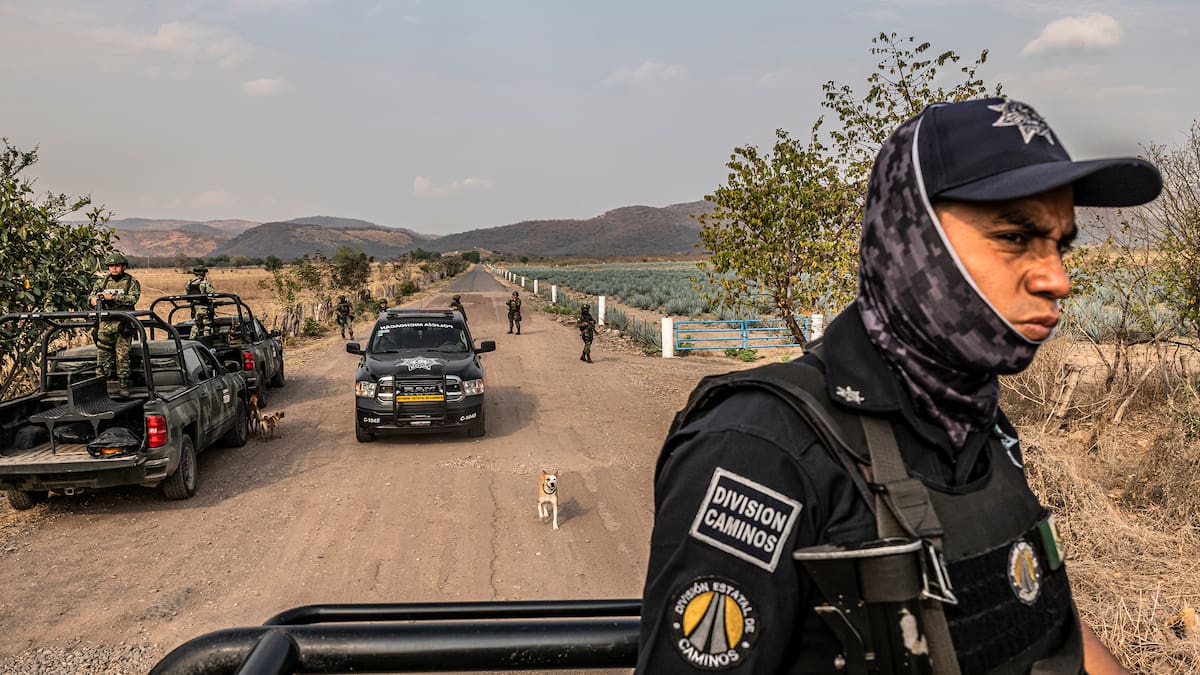
They were deployed nationwide to confront the backlash over Oseguera’s killing.
In at least 13 states, apparent cartel operatives sought to cause havoc by setting fires and blocking roads with burning vehicles.
Cartels have often lashed out following the capture of their top bosses in a bid to show their power and discourage authorities from confronting them again.
In the state of Jalisco, officials said 20 branches of the state-run bank had been set ablaze or damaged, while groups ignited cars to block more than 20 roads.
Jalisco officials said they had suspended public transportation in some areas and warned hotels to instruct their guests to remain inside, including in Puerto Vallarta, the beachside city popular with American and Mexican tourists.
Much of the violence occurred in Guadalajara, Jalisco’s capital, a hub of 1.4 million people that is a host city for this year’s World Cup.
Panic broke out at Guadalajara International Airport, with videos posted on social media showing airport staff and travellers fleeing the building.
The airport and Mexican federal Government said that the airport was operating as normal and that there was no risk to flyers.
Concerts and soccer matches were cancelled. Flights were diverted. And at least one port halted operations.
The unrest also had affected the week ahead, as some states cancelled classes for today, while airlines and bus operators suspended some routes this week.
The US government warned its citizens to “shelter in place until further notice” in parts of five states: Jalisco, Tamaulipas, Michoacan, Guerrero and Nuevo Leon. Various airlines issued travel advisories or halted flights.
President Claudia Sheinbaum urged Mexicans to remain calm. “There is complete co-ordination with all the state governments,” she said online.
“We must stay informed and calm. Activities are proceeding normally across most of the country.”
The impact
Paulina, 32, a Guadalajara resident who asked to be identified by only her first name because she feared for her safety, said she was travelling with her husband and 3-year-old son on a planned outing when they became trapped by one of the cartel’s roadblocks.
As they tried to escape and get home, they saw a wounded family on the side of the road, she said.
“I’m begging people not to go out,” Paulina said.
“After what I saw, I realised these people have no consideration for anyone. I wouldn’t wish what I witnessed on anyone.”
Later, Guadalajara had fallen eerily quiet. Streets were largely deserted, and most businesses, including petrol stations, had closed as residents stayed indoors.
There was similar violence in Puerto Vallarta.
Dalia, 32, a local resident who also requested that her last name be withheld, said she was out getting breakfast when she saw a group of armed men force a driver off a city bus and then light it on fire.
“The cars behind it began frantically reversing, and suddenly I saw there were about 20 people — all hooded and dressed in black — who started dousing the area with gasoline and setting it ablaze,” she said.
“We all started running back home along the avenue, and hooded people on motorcycles just kept passing us.”
The unrest also hit other tourist hubs, such as Cancun and Playa del Carmen, on Mexico’s Yucatan Peninsula, where groups set fires to supermarkets, according to videos posted online and verified by the New York Times.
The fallout
Vanda Felbab-Brown, an expert on non-state armed groups at the Brookings Institution, said the significance of Oseguera’s killing rivalled that of the capture of Sinaloa cartel leader Joaquin Guzman Loera, known as ‘El Chapo’, in 2016, or of his former partner Ismael Zambada Garcia, known as ‘El Mayo’, in 2024.
She said that the early bursts of violence also echoed the fallout in Sinaloa in 2019, when Mexican forces captured Ovidio Guzman Lopez, a son of El Chapo.
Within hours, heavily armed gunmen paralysed Culiacan, unleashing gunfire in broad daylight and forcing the Government to release him.
Whether the turmoil now spreads further, she said, will depend on whether leaders of the Jalisco cartel have established a clear line of succession capable of holding the organisation together.
Otherwise, the vacuum left by Oseguera’s death could trigger a fracturing of the group and new wave of bloodshed, she said.
The cartel
The Jalisco cartel grew into one of Mexico’s dominant trafficking organisations under Oseguera’s command, battling rivals across multiple states while moving synthetic drugs, including cocaine, methamphetamine and, in recent years, fentanyl into the US.
His death is likely to improve the Mexican Government’s relations with Washington. Trump has been pressuring Mexico to combat the cartels more forcefully and threatening military strikes against the groups if he is not satisfied with the results.
As part of the operation, Mexican forces captured two other cartel members, as well as various weapons and armoured vehicles, including what officials described as “rocket launchers capable of downing aircraft and destroying armoured vehicles”.
Three members of the Mexican security forces were injured in the operation, the Government said.
The US State Department had offered up to US$15 million ($25m) for information leading to Oseguera’s arrest or conviction.
He was one of Washington’s most sought-after targets and had been indicted multiple times in the US on federal drug charges.
But for years, he had managed to evade capture and had cemented a reputation as one of the world’s most elusive criminal bosses.
This article originally appeared in The New York Times.
Written by: Jack Nicas and Paulina Villegas
Photographs by: Daniel Berehulak
©2026 THE NEW YORK TIMES


