You have reached your maximum number of saved items.
Remove items from your saved list to add more.
Save this article for later
Add articles to your saved list and come back to them anytime.
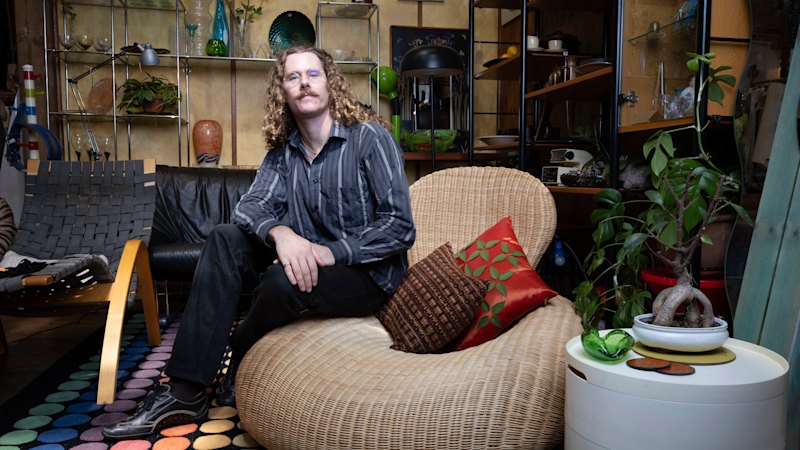
As a child, Jason Mumford, now 30, would spend weekends with his mother trawling through junk piles and op-shops for treasures to decorate their home. “Growing up not so wealthy, we definitely could never afford expensive furniture, so my mum was very good at being resourceful,” Mumford says.
“I remember people coming around, probably judging its tired facade, and then they’d walk in and be shocked because the interiors were full of personality, and very curated with some really lovely, unique pieces.”
For Mumford, a designer who lives in Randwick, his upbringing spurred a lifelong obsession with interiors, and specifically, pieces that sit at the intersection of striking design and accessibility; items others might discard without realising their potential value.
Which is how he found himself preoccupied with vintage IKEA furniture. “It all started with the Niklas shelves, modular shelves I just became really obsessed with. They’re from the ’80s, but they were made up until the late ’90s,” says Mumford.
“They were in the background in Seinfeld episodes and there’s an episode on Friends where they’re literally building the shelves. So they were a bit familiar, and they’re also super practical for apartment living because they’re very adaptable. They’re a bit of a lifetime piece.”
The typical Niklas shelving system will have three “ladders” you then hang shelves on. Mumford estimates since he started collecting vintage IKEA six years ago, he’s amassed as many as 30 ladders. “I probably have the largest collection in Sydney.”
Mumford has since accumulated a number of vintage IKEA finds, even catalogues from his and his partner’s birth years. He’s not the only collector who’s realised the worth of vintage IKEA.
Today, it’s not uncommon to see the Niklas shelves listed for upwards of $2000 (though if you’re lucky, you can find them for free through unsuspecting sellers on Facebook Marketplace).
For the past two decades, mid-century modern furniture has enjoyed a revival, and among valuable pieces designed by Europe’s most recognised designers, vintage IKEA has become highly sought-after.
“For a long time, IKEA was synonymous with poor quality, and when the history of Scandinavian design was discussed, IKEA’s products were simply left out,” explains Andreas Siesing, a Swedish design historian and IKEA expert. “When the enthusiasm for retro and vintage furniture from the 1950s and ’60s grew rapidly in the early 2000s, IKEA’s models followed suit.”
IKEA was founded in 1943 by Ingvar Kamprad, with an ethos of democratising design. In 1948, he launched a furniture range, wanting to make functional, stylish pieces available for everyone.
In the first half-century of IKEA’s existence, the quality and design was impressive. “There was likely greater scope to make purchasing decisions based on pure instinct – Ingvar Kamprad’s own – so the range is more eclectic and, for better and worse, less considered,” Siesing says. As the company grew, except for one-off collaborations with certain designers, the style became simpler and quality waned as pieces were made for the mass market.
Collectors have realised those early items are worth the hunt.
In 2021, a world record was set when the Cavelli armchair from the late 1950s was sold at the Stadsauktion Sundsvall auction for 151,000 SEK ($22,828), making it the most expensive piece of IKEA furniture ever. It’s one of the rarest collector’s items because they were made in very limited numbers, but also due to the chair being constructed with teak (the most popular wood in Scandinavia at the time) and its Italian-style design.
Matthew Sullivan, 53, has been collecting furniture for more than 25 years and runs his own business through Silverfox Vintage in the Blue Mountains. “A few years ago I saw something on Facebook Marketplace and I thought, ‘shit, that’s really interesting’. I looked at it and I realised it was IKEA,’” says Sullivan, who buys and sells mostly ’80s, ’90s and early 2000s IKEA.
Sullivan notes that many people who come to him looking for vintage IKEA are younger generations wanting the pieces they had in their bedrooms as kids, such as the IKEA Skojig Cloud Lamp from the ’90s. “They see and recognise those items from their childhood, so there are all sorts of different eras and layers to it.”
Northcote health worker Con Skordilis, 55, has been collecting vintage IKEA furniture for the past decade and similarly noticed an uptick in interest. “It’s becoming a bit more mainstream now,” says Skordilis, who prefers post-modern pieces of vintage IKEA. “People are realising how important it is and prices have gone up. It’s more difficult to find these days, whereas in the past people just used to throw things out.”
One of his greatest finds – the Moment sofa designed by Niels Gammelgaard – was almost garbage.
“I found it on a street bounty group,” Mumford says. “They weren’t even taking a photo of the lounge, they were just taking a photo of the rubbish pile, and I drove an hour and a half to go and get this thing out of the junk.
“It’s super sleek and sexy by this amazing designer, and it’s quite rare. It wasn’t sold for a very long period in Australia, so there’s not a whole lot of them floating around.”
Every collector has their own white whale of vintage IKEA. Sullivan’s is the 1993 Vilbert chair by Verner Panton. Skordilis and Mumford both love the 1970s Impala sofa by Gillis Lundgren.
Siesing says the ’70s-era pieces are particularly noteworthy because IKEA was “small enough to leave plenty of room for experimentation; the furniture on offer was inventive and remarkably varied”.
For budding collectors, the advice is to hold on to items you have, and keep an eye out for designs that could be worth something in years to come. “Prices will continue to rise for the foreseeable future. Interest is growing at what feels like an explosive rate,” says Siesing.
“Fascinatingly, there is still much left to discover. Many vintage models have yet to appear at auction. Vintage IKEA has a bright future ahead of it.”
Make the most of your health, relationships, fitness and nutrition with our Live Well newsletter. Get it in your inbox every Monday.
You have reached your maximum number of saved items.
Remove items from your saved list to add more.