You have reached your maximum number of saved items.
Remove items from your saved list to add more.
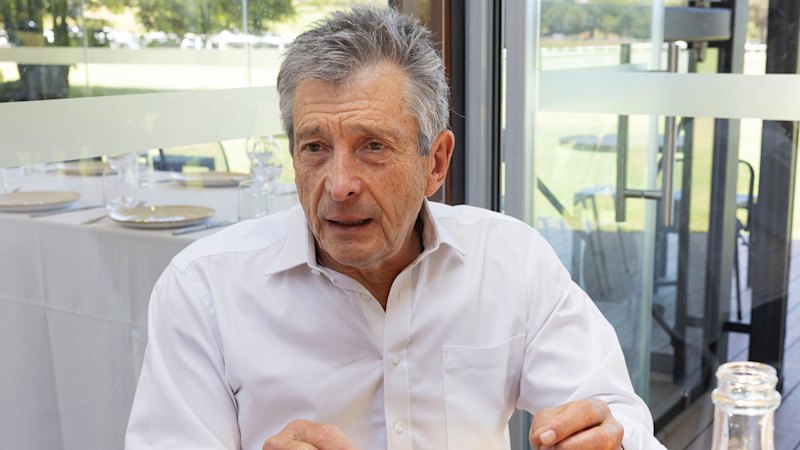
Having lunch with a medical specialist is potentially a nervy affair. And doubly so when that doctor is a senior cardiologist on a mission to prevent more Australians dying at an untimely age from heart attacks.
So I’m already feeling a little judged as I scan the menu at Centennial Park’s Centennial Homestead opposite Dr Stephen Fenton.
Fenton had settled on the venue because of its mostly heart-friendly menu, but even so I have to drag my eyes away from the bacon, hash browns and chorizo (mmm, chorizo) towards something more likely to win approval.
Happily, we both land on the vegetarian nourish bowl, which it turns out is both delicious and healthy. To drink, it’s sparkling water. My days of chips, burgers and maybe a cheeky chardie or two for lunch are now history and, by the look of Fenton, who has just turned 74, were never really part of his story.
Fenton – who is possibly the least judgy doctor I’ve met – has been in the heart game for more than 40 years, witnessing a period of extraordinary advancement in cardiology. Our connection stems from my own near fatal heart emergency last year, which, happily, was fixed by a stenting operation. Fiona Foo, the angel in a mask and gown who operated on me, studied under Fenton and put us in touch to discuss his work and new book, The 5 Ch Lifestyle.
Fenton, a talented amateur musician, begins by telling me about a gig he attended recently at Marrickville’s Lazybones venue. Before the main act, a 10-year-old boy was introduced and stepped up to microphone to sing and play guitar. Not your usual support act.
Then his wife, Helen, got the backstory from her friend, the pianist. “This 10-year-old boy lost his father … three days ago,” Fenton says. “Of a sudden heart attack. And the father was 50.”
For Fenton, that tragic scenario resonated deeply. Not the precise details, but in its contours: a child, a father, a sudden cardiac event and a family tragedy. Fenton’s own father was just 45 when he had his first heart attack. His second, at 65, was fatal.
In Australia, someone dies from a heart attack about every 90 minutes. That’s 18 deaths and 18 families torn apart every day.
It is this silent tragedy that has driven Fenton to write his book in which he argues that, despite spectacular advances in cardiology, too many Australians are still being assessed with population-based screening tools he believes are blunt, incomplete and too often misleading.
Modern medicine can open blocked arteries, dissolve clots, implant stents, replace valves, transplant hearts and pull people back from the brink in myriad other ways. But Fenton’s focus is now on what happens long before that brink is reached.
And his message, flying in the face of the orthodoxy on screening and testing, is a controversial one but at this late stage in his career he’s not looking to win any popularity contests with the establishment.
Fenton had “a pretty normal childhood”, growing up in Bronte, playing soccer and surrounded by music (his mother was a classical pianist and his dad a jazz musician).
However, the event fixed most sharply in childhood memory was not musical. His father, a “typical Aussie guy” born during the Depression, had served in the Army during World War II and later worked in textiles, importing especially from Japan.
In 1962, when Fenton was 10 and his sister three, 45-year-old Frank, suffered a heart attack on the golf course.
The children did what children do when adults use terrifying words they do not understand. “I just remember my sister and I looking up the dictionary for what coronary thrombosis meant because that’s what we were told,” says Fenton.
This was all before coronary care units, monitoring and the battery of interventions that now define cardiac medicine. The best doctors could do for Frank was to immobilise him for weeks.
“They had no treatment, really,” Fenton says. “He probably had at least a 50 per cent chance of not surviving, but he survived.”
Then, 20 years later, when Fenton was himself a cardiology registrar, his father called with chest pain. He was admitted to Royal Prince Alfred Hospital and had another heart attack at a time before clot-dissolving drugs, let alone stents, were part of routine care.
“They did take him to urgent bypass surgery, but he died,” Fenton says. “He was 65. It was a tragedy for us, but I suppose at least I had 20 years from the age of 10 to 30. And that was very precious.”
It would be easy to cast Frank’s heart problems as the catalyst for the young Fenton to pursue a career in medicine, but it was more by chance than design that he ended up in the field.
“When I was leaving left high school it was a toss up in those days between medicine, law and architecture,” he says. “I got into medicine at Sydney University and in fourth year you go to hospital and that was fine. I was interested in cardiology, but I didn’t really have a passion for it. But then fate played a role. My first term as an intern was randomly allocated in cardiology. I found it fascinating.”
Fenton had entered the field at a moment of extraordinary change. Cardiology begun to transform. Coronary angiography was developing. Cardiac ultrasound arrived in primitive form. Fenton saw one of the early ultrasound machines and was amazed a painless probe on the chest, with no radiation, could reveal the heart’s movement.
“By today’s standards, they were totally primitive,” he says. “But I thought that was incredible.”
Bypass surgery was becoming established. Balloon angioplasty and stenting arrived. Pacemakers, defibrillators and powerful new drugs followed. The statin story, now so central to cardiovascular prevention, began showing decisive trial evidence in the 1990s.
It was the drama side of modern cardiology that I experienced: once my own stent was inserted the change was miraculous. Twelve months to the day from my operation, I’m planning to trek to the summit of Mount Kilimanjaro. Before the operation I could barely climb the stairs at home.
The older Fenton gets the more he has turned to the far less dramatic business of stopping patients getting to the crisis point in the first place. His domain now is prevention – the Holy Grail of medicine that promises massive returns for over-stretched health systems, but which never seems to get the attention it deserves.
“As I’ve got into prevention, it’s become more interesting,” says Fenton. “I see the transformations of people and I know that I’m changing course and preventing something that might happen to them.”
But at the heart (pun intended) of this work to prevent heart attacks there lies a great frustration for Fenton, which he outlines in The 5CH Lifestyle, which is part a call-to-arms for the medical profession to redefine risk and test earlier and part a lifestyle guide to help you avoid ending up in a cardiac ward or worse (spoiler alert: chorizo is not on the preferred food list).
Fenton argues that the standard cardiovascular risk calculators used by frontline doctors are outdated and inadequate. He’s not saying the classic risk factors – blood pressure, cholesterol, diabetes, smoking etc – are irrelevant. Rather, his point is that they do not matter alone. Family history, inflammatory diseases, women’s health factors such as premature menopause, pre-eclampsia and gestational diabetes, sleep apnoea, stress, social isolation, depression, diet history and erectile dysfunction may all change the picture.
Some of these are recognised as “risk-enhancing” factors. But Fenton argues the list is incomplete and poorly understood. He offers a phrase from his hospital days: the “ask the janitor” question. As an intern at Sydney Hospital, responsible for 30 or 40 patients, he would arrive early and ask the nurses who needed to be seen first. If they were busy, he would ask the janitor. “I’d say, who doesn’t look good, Bob? And he’d say, Bed 17. Better check him out.”
His point is not that janitors should practise medicine. It is that some things are obvious if anyone bothers to look. “You don’t have to be Einstein or a super genius to know some things that are going on,” he says. “And I call family history an ask-the-janitor question.”
In his book, Fenton proposes a simple screening questionnaire far broader than the population-based one you’ll likely encounter in your GP’s office, which he regards as inadequate and outdated. “These calculators have some merit in populations, but they just aren’t very accurate in individuals,” he says.
Complete Fenton’s test and you come out with a point score. Score three points or more, and he recommends a Coronary Artery Calcium (CAC) test, which detects the level of plaque in the arteries the presence of which is a fundamental cause of heart attack.
The results of the non-invasive CAC, which he describes as a “mammogram of the heart”, determine whether further testing, drugs such as statins or even surgical intervention are needed.
And, while no single trial has tested the full package of Fenton’s proposal, he says evidence “strongly supports the claim that identifying higher risk individuals and then treating the major drivers of risk can reduce cardiovascular events and heart attack risk by 50 per cent of more”.
“Many primary prevention folks are ticking time bombs, some just a heartbeat away from a potentially fatal event,” he writes. “The best way to assess that risk is a CAC score.”
He reaches for a horse-race analogy. If you were trying to pick the winner and were allowed to consider only four things — the jockey, trainer, form and breeding — how accurate would you be? You would be ignoring the track, weather, weight, barrier, handicap and plenty more besides.
“There’s a lot of ways to lose on a horse race out there,” he says. “But that’s a horse race. It’s not good to be guessing when it comes to the leading cause of death and the leading cause of sudden death.”
All this talk of untimely death makes our lunch date sound a little grim but as we sit in the sunshine looking out over Centennial Park, it’s hard not to be enthused by Fenton’s zeal and his vision for reducing the pain and trauma of heart attack deaths.
“We’ve got a long way to go,” he says. “I used to rave on about this at dinner parties, and then I stopped getting invited to dinner parties and I thought I’ve got to try and get this message out and that’s why I wrote the book.”
Read more great conversations over lunch
Jacqueline Maley explores loss with Bob Carr: Bob Carr on marriage, grief and finally learning how to do a load of laundry
You have reached your maximum number of saved items.
Remove items from your saved list to add more.