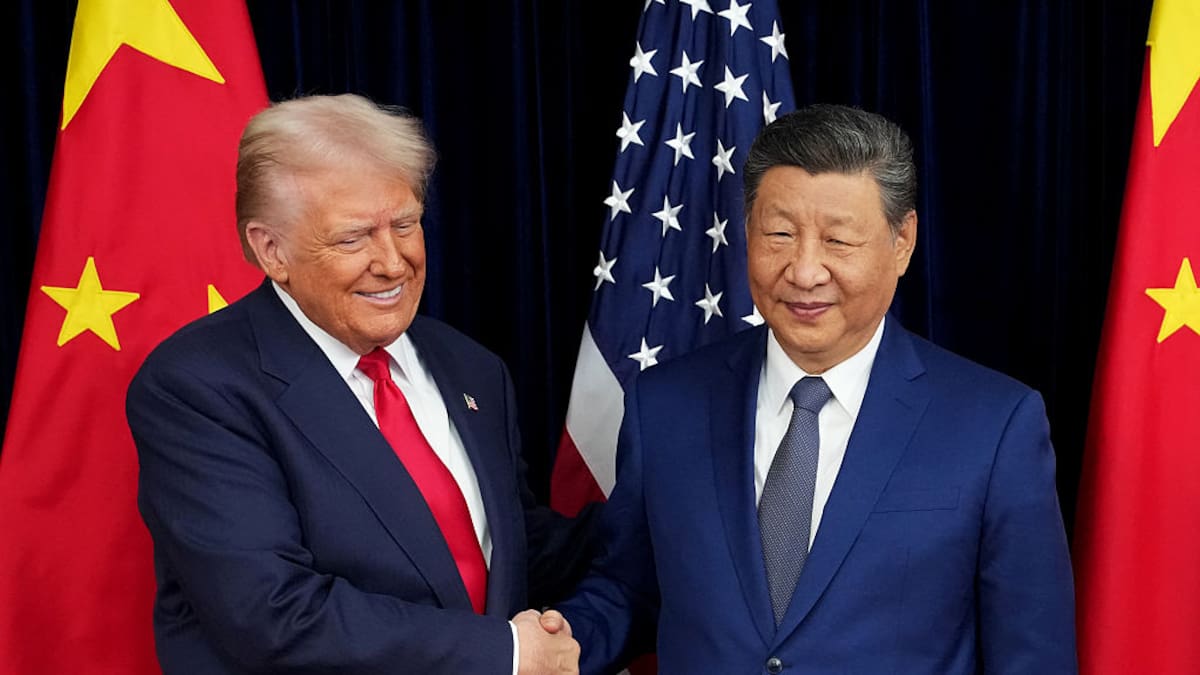
Trump, after referencing Russia’s invasion of Ukraine, said of Taiwan, “I don’t think it’ll happen”.
“I think we’ll be fine. I have a very good relationship with President Xi. He knows I don’t want that to happen,” he said.
But Trump also noted that the United States was “very, very far away” compared with China.
Congress backs Taiwan
The United States recognises only Beijing but under domestic law is required to provide weapons for the defence of Taiwan, a self-governing democracy that China considers its own.
Under the 1982 Six Assurances, a key foundation of US policy on Taiwan after the switch of recognition, the US said it would not “consult” Beijing about arms sales to the island.
Trump has long berated allies as not spending enough on their own defence. Days before his trip to China, Taiwan’s parliament Friday approved a US$25 billion ($42b) defence spending bill, although it fell short of the Government’s proposal.
Pointing to the vote, a group of US senators led by Jeanne Shaheen, the top Democrat on the Senate Foreign Relations Committee, said that Trump should immediately green-light a US$14 billion arms package to Taiwan.
“We urge you and your team to make clear that America’s support for Taiwan is inviolable,” wrote the senators, mostly Democrats but including two centrists from Trump’s Republican Party.
While discussing economic concerns, Trump should also state that “American support for Taiwan is not up for negotiation”, they wrote.
New sanctions over Iran
Trump delayed the trip once because of the war he launched with Israel against Iran, which is still rebuffing his appeals for an agreement.
China is the main international customer for Iran’s oil, which Trump has tried to stop all countries from buying through unilateral US sanctions.
Israeli Prime Minister Benjamin Netanyahu, in an interview Sunday with CBS News’ 60 Minutes, said he was unhappy that Beijing had shared missile technology with Iran.
Trump’s Treasury Department on Monday issued sanctions against 12 individuals and entities it said facilitated the sale and shipment of Iranian oil to China.
The sanctions came even as Treasury Secretary Scott Bessent prepared to set up Trump’s visit during talks with Chinese Vice Premier He Lifeng in Seoul on Wednesday.
Bessent and He have been the chief negotiators for the US and China on all trade and economic issues.
In Beijing on Monday, foreign ministry spokesman Guo Jiakun said top-level diplomacy was “irreplaceable” between the two countries.
“China is willing to work with the United States in the spirit of equality, respect and mutual benefit, to expand co-operation, manage differences and inject more stability and certainty into a volatile and intertwined world,” he told a briefing.
Asked about US pressure on Iran, Guo said only that China’s position on Iran was “consistent” and that Beijing would continue to play a “positive role” in promoting a ceasefire and peace talks.
Trump and Xi last met face-to-face in October on the sidelines of a regional summit in South Korea.
They agreed then to a one-year truce in a blistering trade war that increased tariffs on many goods by more than 100%.
– AFP