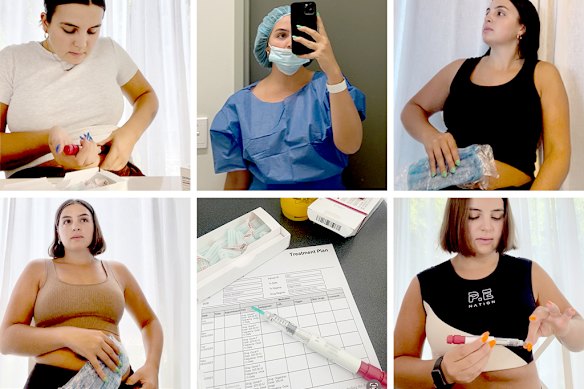
She could feel her future children slipping through her fingers. Her fertility specialist was saying she needed to do more. Bloated and financially, physically and emotionally spent, 25-year-old Mollie Bennett had nothing left to give.
For 12 months, Bennett had endured seemingly endless hormone injections, blood tests, internal ultrasounds, doctors’ appointments and surgeries.
“I want to be a mother more than anything,” says Bennett. “I’m not gonna roll the dice and risk it.”
It started with irregular menstrual periods. Then came the anti-Mullerian hormone (AMH) test result. An imperfect measure of fertility, Bennett’s was 10 times below the median for her age.
Further genetic testing revealed Bennett is also a Fragile X premutation carrier, significantly increasing her risk of primary ovarian insufficiency. Characterised by fertility issues and early menopause, it’s currently experienced by four per cent of women globally.
Advised her chance at parenthood was eroding, and with no long-term partner, Bennett began the process of medical egg freezing. After emptying her $50,000 housing deposit fund for five cycles, the now-28-year-old has 26 frozen eggs stored at a Melbourne clinic.
Egg freezing is the process of retrieving, freezing and storing eggs until a woman decides she wants to use them to have a child, donate or discard them.
The biggest determining factor in a woman’s fertility is the age of her eggs. In theory, it allows you to put a pause on your reproductive biological clock.
Originally developed in the 1980s to preserve the fertility of sick patients whose treatment compromised the quality and quantity of their eggs, egg freezing was transformed in 2012 when the fast-freezing technique of vitrification went mainstream in medicine.
“With vitrification, the chance of pregnancy with a frozen egg is probably roughly the same as with a fresh egg,” explains University of Melbourne faculty of medicine and health sciences Associate Professor Alex Polyakov, who is also medical director at Genea Melbourne.
Suddenly, egg freezing was no longer just an essential fertility lifeline for people like Bennett. Now, it could be a form of family planning for any woman who wanted to delay the decision to start a family (known as elective egg freezing).
The most recent data shows elective egg freezing more than doubled between 2020 and 2024 in Australia and New Zealand, with demand from under-35s increasing the most of all age cohorts.
It’s expensive, physically demanding and emotionally draining. Bennett felt she had no choice apart from medical egg freezing. But the rising number of women pursuing elective egg freezing do.
“It is promoted as insurance,” Polyakov says. “Doctors would say, ‘Freeze your eggs, and you’ll be fine’. But in actual fact, that’s not always the case.”
The big egg freezing boom
American politician and activist Alexandria Ocasio-Cortez, 36, became the global face of elective egg freezing earlier this month, making what she called a “political risk” to share her decision to freeze her eggs on social media – but she did so “to show more depictions of women having full lives in every context and every choice.”
Most women choose elective egg freezing simply because they’re unlucky in love, says Karin Hammarberg, adjunct senior research fellow of global and women’s health at Monash University.
“It’s mostly because they don’t have a partner, or they have a partner who’s not ready,” Hammarberg says, citing the work of Yale anthropologist Marcia Inhorn.
Inhorn calls it “the mating gap”: where “highly educated, heterosexual, professional women want the three P’s of partnership, pregnancy and parenthood, but are missing the three E’s of eligible, educated and equal male partners.”
“We have so much more choice than any women who’ve come before us, and that’s something that we should be grateful for,” says former Today presenter Brooke Boney. (Nine, the owner of this masthead, broadcasts Today.)
A breakup at 33 prompted Boney to undergo two egg freezing cycles in 2021, a process she found “wonderful”. Watching her belly swell as her ovarian follicles grew made Boney feel “so beautiful” and “so emotional”.
Now 39, Boney has completed her Master of Public Policy at Oxford University, and embarked on a PhD at the University of Sydney. While she hopes to be a mother with someone she loves, Boney is “not taking any steps to make that happen right now” – and she’s at peace with that.
The roughly $14,000 she paid to freeze her eggs, and the $60 monthly storage fee she’s happy to have paid in the five years since, is not an insurance policy for childlessness. It’s a safeguard against regret.
“It has given me a little bit more comfort in pursuing things for probably a bit longer than what I would have if I didn’t have any frozen,” says Boney. “That is the luxury it gives you.”
Beware Rumpelstiltskin
While Ocasio-Cortez speaks candidly about her bruising and bloating, the testimonies you’ll find among the 176,000-plus videos under #eggfreezing on Instagram and TikTok aren’t always so honest.
In a 2024 systematic review of influencer content about egg freezing, researchers found that the benefits of egg freezing were often emphasised over the downsides.
A mere 11 per cent addressed the financial costs – the average elective egg freezing cycle in Australia will set you back at least $7000 to $12,000 upfront. Many influencers who post glowingly receive discounted prices in return for their promotion.
Confusing things even further, fertility clinic websites aren’t always reliable either. A 2020 review declared more than half of Australian fertility clinic websites have “poor” quality information. The fragmented state-based regulation of the industry means misleading and deceptive marketing can go unchecked.
As it stands, all Australian IVF clinics are required to provide their data to the Australian and New Zealand Assisted Reproduction Database (ANZARD). However, in 2025, nearly one in 10 declined to have their success rates published on YourIVFSuccess, an independent, government-funded website designed to offer transparency in the space.
“Clinic advertising, corporate benefit schemes and social media particularly, frame it as this empowering choice for women to be proactive and responsible, but this marketing and advertising really gives a false impression of what’s possible with egg freezing,” says Dr Tessa Copp, a senior research fellow in the University of Sydney School of Public Health.
“It’s certainly not an insurance policy. There is no guarantee of a baby and, when you look at the data, most women do not have a baby from their frozen eggs.”
According to a new study – the most comprehensive look at elective egg freezing in Australia and New Zealand, currently under peer review – just under 400 babies have been born from approximately 30,300 elective egg freezing cycles since 2009.
The researchers found that among women with at least 10 years’ follow-up, as few as 27.9 per cent of women returned to use their frozen eggs, and only one-third of those achieved a live birth. The reasons why so few women return are largely unclear. The experts explain that many go on to conceive naturally, while other women never find a partner and don’t want to be a single parent.
“It is really sobering to look at what the actual return rates are and what happens to those who return,” says Hammarberg, a co-author on the study.
“That’s what I want people to have a really clear understanding of when they ponder a decision to freeze their eggs, because the numbers are not great.”

They also found that the younger a person is when they freeze their eggs, the less likely they are to return to them at all, often leaving unanswered questions on what to do with those unused eggs.
Dr Devora Lieberman, medical director of City Fertility NSW, says she spends more time talking young women out of elective egg freezing than actually carrying out the procedure.
“They’re too young, their reserve is too good. They can wait,” says Lieberman, who stresses that unless you have a medical reason, there’s little need to freeze your eggs before you’re 32, and doing so will not increase your odds.
Polyakov agrees: “Bottom line is whether you’re 28 or 32, the chance of pregnancy is the same.”
Meanwhile, the so-called “fertility cliff” of 35 is more like a steep downhill. Older women often have to go through more cycles to get a substantial number of eggs; even then, their frozen eggs will be less likely to survive thawing and fertilisation.
“Every six months makes a difference after the age of 35,” Polyakov says.
The ideal time to do elective egg freezing is between the ages of 32 and 35. Doctors and research agree that to give yourself the best chance of one live birth, you should freeze roughly 20 eggs. Still, there is no guarantee.
“Twenty eggs or three cycles, whichever comes first,” Lieberman advises. “Because if the 20th egg doesn’t get you a baby, it’s highly unlikely the 21st, the 25th, or the 50th would.”
Plus, she says, why would you sign up for unnecessary bills early? “If you’re 25, and you freeze eggs, you’re going to have 12 years of storage fees to pay.”
Freezing eggs and flashing dollar signs
Market research firm IBISWorld projects that the Australian fertility industry’s annual revenue will reach $1 billion in 2031, with analyst Aishni Singh identifying elective egg freezing as a “favourable” driver of future growth.
Based on the per-cycle pricing from 29 accredited clinics and the most recent ANZARD data, Dr Maryam Naghsh Nejad, senior research fellow at University of Technology Sydney’s Centre for Health Economics Research and Evaluation, estimates revenue from fertility preservation cycles (including egg and embryo freezing) was about $53 million in 2024. Of that, elective cycles contributed about $13 million to $26 million.
Storage, says Naghsh Nejad, adds a separate revenue stream of about $8.3 million annually, which compounds as frozen eggs add to the pool faster than women return to use them.
This is being seized upon by private equity firms, now with an outsized presence in the Australian fertility industry.
In 2025, the Victorian government conducted a review of the industry and found 80 per cent of the fertility clinics across the country are operated by four major corporate and for-profit providers: BGH Capital, Monash IVF, Genea and City Fertility.
It’s a development that threatens the future of accessibility, transparency and accountability, says Dr Sean Docking, a researcher in the commercial determinants of healthcare.
“It can sometimes distort the provision of high-quality and evidence-based care because now they have a fiduciary duty to their shareholders to grow the business and generate profit,” he explains, noting the problematic expansion of IVF add-ons as a revenue stream for fertility clinics (a recent review concluded there’s no evidence that these add-ons improve live birth outcomes).
“Egg freezing is a little bit different, highlighting this growth imperative and why we’re seeing such an uptick in its marketing: traditionally, fertility clinics serve people who are currently actively trying and struggling to conceive. Egg freezing changes that. Now any woman becomes a potential customer regardless of their fertility status, their age, or even whether they’re trying to conceive at that point.”
“On the whole, people don’t actually regret freezing their eggs even if they don’t use them.”
Associate Professor Michelle Peate, University of Melbourne
Julia Leigh, 56, believes private equity’s hold on the industry is “absurd”.
The Sydney-based author and filmmaker froze her eggs when she was 42. Of the five eggs mature enough to freeze, three survived the thaw. All had to be discarded due to abnormalities or failure to develop.
It was 2012, the year elective egg freezing lost its experimental label. At the time, Leigh says many of her questions about success rates were answered with: “It’s hard to say.”
Thanks to since-developed independent tools such as the YourEggFreeze Estimator, we can calculate that today, even with 14 years of medical advancements, Leigh would have had a 9 per cent chance of a live birth.
But that reality is not broadcast by similar-aged celebrities who tag their fertility specialists and clinics in pre-retrieval selfies shared on social media, with and without relevant advertising disclaimers. To Leigh, that’s like thanking Rumpelstiltskin.

No regrets
Despite these concerns, research has found that among women who freeze their eggs, regret was not a commonly expressed emotion, says Associate Professor Michelle Peate, program lead of psychosocial health and wellbeing research at the University of Melbourne.
“On the whole, people don’t actually regret freezing their eggs even if they don’t use them,” Peate explains, citing a US study that found in cases where there was regret, it was linked to not being given enough information at the start.
Research shows 78 per cent of women considering elective egg freezing experience high uncertainty. To address the lack of comprehensive, independent, and evidence-based information about egg freezing, Dr Sherine Sandhu developed a decision aid for those considering the procedure.
“Women want and need better information and support when deciding,” says Sandhu, a research fellow in obstetrics, gynaecology and newborn health at the University of Melbourne.
The tool provides detailed information alongside practical exercises to help women weigh the pros and cons, allowing them to make an informed choice that aligns with their personal circumstances.
“There isn’t a right or wrong choice as long as it’s informed,” Sandhu says. They hope to release the aid next month.
Though Mollie Bennett got $15,000 of her $50,000 back through the Medicare rebate, the costs persist four years on – and it’s not just her $550 annual storage fees.
Now living on the Gold Coast, every person Bennett dates “needs to be on board” with conceiving their children in Melbourne through IVF, which, she says, is expensive and “not for everyone”.
Nevertheless, she doesn’t regret freezing her eggs. In fact, Bennett was advised that half her frozen eggs would likely be nonviable due to her Fragile X premutation carrier status, so she “probably should” do more cycles.
But does Bennett recommend it for social reasons?
“I wouldn’t have spent my whole savings on it and put my body through it… if I didn’t really, really medically need to,” says Bennett.
“But everyone’s different.”
Medical information in this article is general in nature and is not intended to influence readers’ health decisions or actions. Readers should always seek their own professional advice that considers their personal circumstances before making any medical decisions or undergoing any treatments.
Start the day with a summary of the day’s most important and interesting stories, analysis and insights. Sign up for our Morning Edition newsletter.