

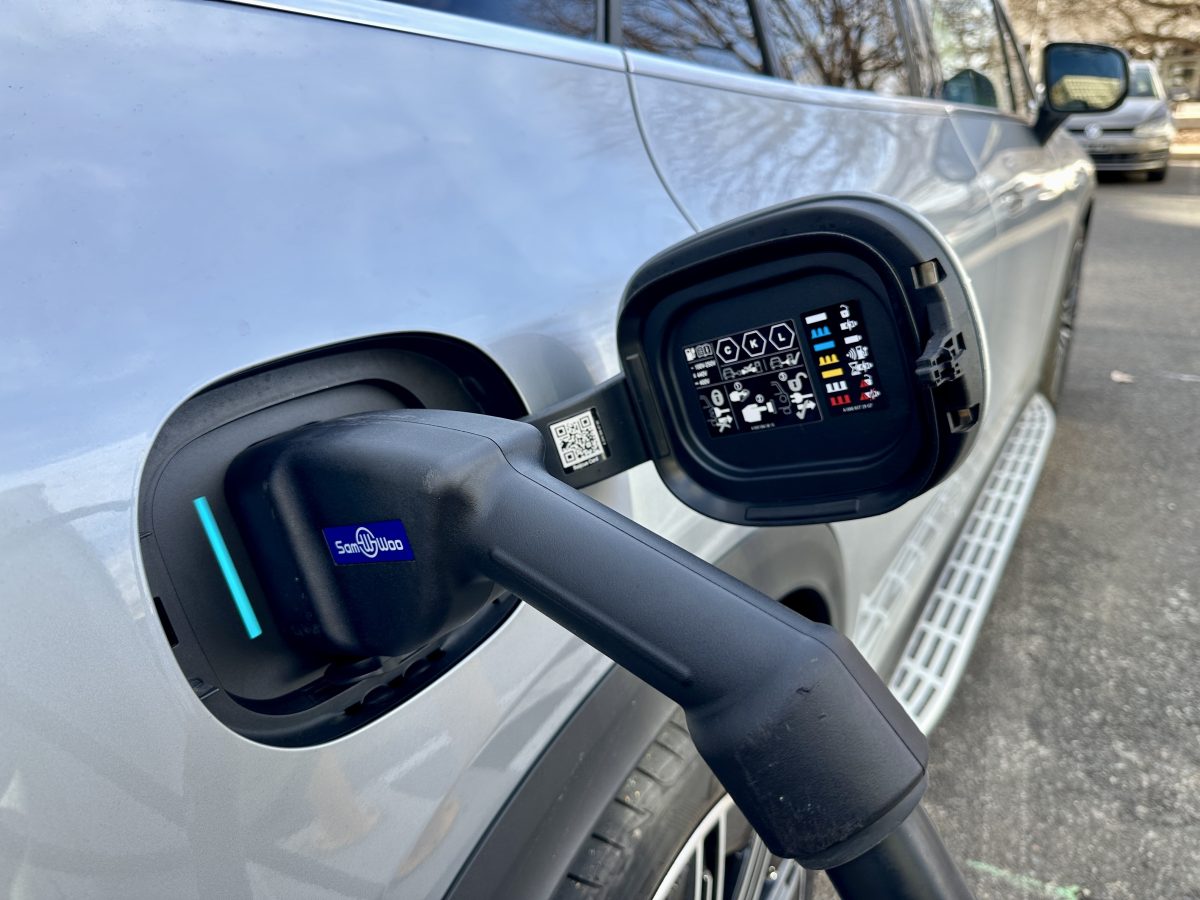
Who should pay for the charge and the charger isn’t an easy question. Photo: James Coleman.
A resident in a Canberra apartment complex had been plugging their electric vehicle into a common-area outlet, effectively sharing the electricity bill with everyone in the building.
Other residents noticed. Complaints followed, and eventually the body corporate pulled the plug.
But that solved only one problem and created a much bigger question: as more Canberrans buy electric vehicles, who should pay to make apartment buildings ready to charge them?
The issue recently sparked a lively discussion in a Canberra community group after a resident said their owners corporation was now considering installing a proper communal EV charger.
The resident stressed they were hardly anti-EV – they hoped to own one themselves one day – but questioned why people without electric cars should contribute towards infrastructure predominantly used by those who had them.
“If the EV owner wants the convenience, the installation and associated costs should be covered by the owner,” the resident argued, also questioning whether scarce visitor parking should be given over to charging bays.
Canberrans, it turns out, have plenty of opinions on the matter.
Some community members firmly backed a user-pays approach. One said owners in their complex could install chargers in their allocated parking spaces at their own expense. Another argued it was unfair to expect the body corporate to pay for installation and maintenance.
Others saw a communal charger more like a gym or another shared facility – something not everybody uses, but which can add value to the building.
And several Canberra complexes appear to have already found a middle ground: share the cost of getting the infrastructure in place, but make EV drivers pay for the electricity they use.
One resident said their building had operated that way successfully for three years. Another said chargers had been installed in common-area bays with individual users paying for their power.
At another complex, technology has even taken care of the potentially awkward question of whose turn it is. Residents book a charging bay through an app and pay individually.
“This system works very well,” the resident said.
So, if Canberra apartment dwellers are already trying everything from private chargers to communal bays, which model is winning?
There isn’t one.
Alex Boundy, general manager – facilities at Civium, said the answer often depended on the building and how many residents actually owned EVs.
Some owners corporations fund common infrastructure. Elsewhere, individual owners pay to install chargers in their own allocated spaces. A third option splits the bill: the owners corporation pays for the electrical “backbone”, while residents pay for the equipment needed to connect their own parking spaces.
Mr Boundy said when an individual owner funded a charger, it was installed in their allocated parking space.
For buildings where interest was starting to grow, he said the sensible first step was to work out what was technically possible, take the options to owners and gauge demand before spending money.
And the communal charger may not necessarily be the future many imagine.
Mr Boundy said shared chargers were becoming less common as EV owners increasingly used slower “trickle top-up charging” at their own parking spaces rather than relying on a small number of common chargers.
What is becoming more common is the conversation itself.
“The demand is linked to EV ownership uptake which is on the up, partnered with more Canberrans living in apartments than previously,” Mr Boundy said.
“It certainly is par for the course now with regard to talking vehicle charging within apartment buildings.”
Is it as simple as finding a spare outlet? Hardly. While that initial shared-socket approach offered an easy fix, building power is not a free-for-all resource.
An ACT Government spokesperson said those power points are managed by the owners corporation under the Unit Titles (Management) Act, and corporations can introduce rules governing their use.
That doesn’t necessarily mean an existing outlet is off limits forever. Devices are available that can measure how much electricity a resident uses and ensure they pay their share – potentially removing one of the biggest causes of neighbourly irritation.
Installing a dedicated charger requires another step.
Whether it is going into an owner’s parking space or onto common property, the installation must be approved by the owners corporation through a special resolution. The government says that permission cannot be unreasonably withheld.
If the charger is connected to the building’s common electricity meter, there should also be a mechanism for the EV owner to repay the corporation for the electricity they consume.
The bigger challenge is avoiding a situation in which every new EV owner arrives with a different proposal, leaving the building with a patchwork of chargers and electrical connections.
The ACT Government is instead encouraging apartment buildings to think ahead and become “EV ready”. In simple terms, that means installing the shared electrical backbone needed to reach every apartment’s parking space. Residents can then add and pay for their own charger when they eventually buy an EV.
For new Canberra apartments, some of that future planning is already built in. Since September 2024, new multi-unit developments have been required to provide EV-ready infrastructure to every residential unit’s car space.
Older buildings face the harder task of retrofitting infrastructure that was never designed to accommodate dozens of cars plugging in overnight.
“Owners corporations can seek free building-specific advice through the ACT Government’s Sustainable Apartments Program, while interest-free loans for EV-ready infrastructure have also been announced and are due to launch,” the spokesperson added.
Which brings the debate neatly back to where it began: one car, one communal power point and a few neighbours wondering why they were helping pay the bill.
The extension cord may have been unplugged, but the question it sparked isn’t going away.
As more Canberrans switch to EVs – and more call apartments home – body corporates will increasingly have to decide whether charging infrastructure is a private convenience or simply the next thing a modern apartment building needs to be ready for.


