

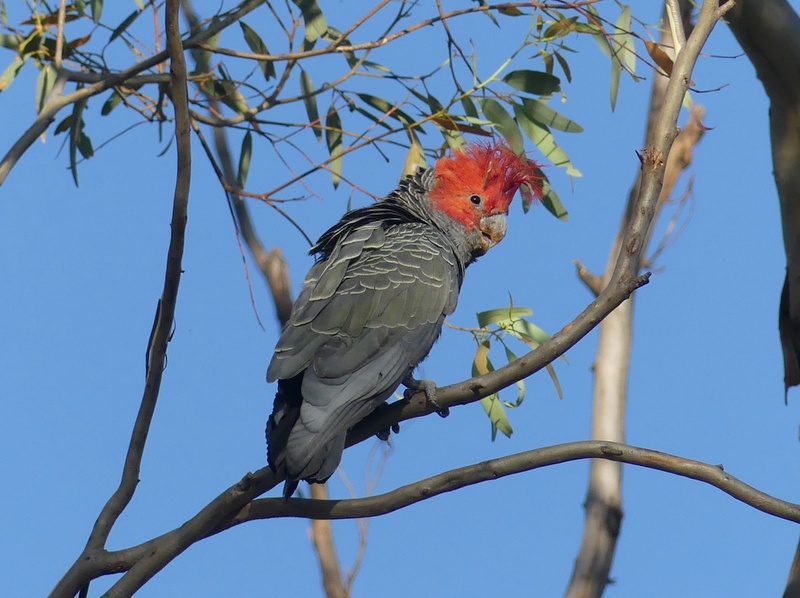
A Canberra-based ecologist is sounding the alarm over his belief that a plan to save the Gang-gang Cockatoo needs to go further. Photo: Ian Fraser.
The government says it has a plan to bring the endangered gang-gang cockatoo back from the brink, but a former ACT Government ecologist says that without accounting for climate change, the plan is a “dagger through the heart of the gang-gang”.
The Draft National Recovery Plan for the Gang-Gang Cockatoo aims to ensure the gang-gang’s population is genetically diverse by 2050 and that they’ll be making homes in stable, well-connected habitat.
It also wants to make sure that, in 2050, their population hasn’t dropped below their 2027 level.
The report notes that the bird’s population has declined by an estimated 69 per cent over the past 20 years, and that was before the 2019/20 Black Summer bushfires destroyed key habitat.
Dr Michael Mulvaney is a Canberra-based ecologist who co-founded NatureMapr and has spent years studying the bird.
He gave the government’s proposal a mixed grade, describing it as being “typical” of government.
“[Minister for the Environment Murray Watt is] basically putting the dagger through the heart of the gang-gang, and wants us to smile about it. Well, no, minister, we’re pretty upset with you.”
Dr Mulvaney told Region that the report needed to place greater emphasis on climate change as a threat.
“It just beggars belief that the [Environment] minister is asking for an action plan to recover the gang-gang, when he is contributing to the chief threat by continuing to approve the expansion of mega coal and gas mines,” he said.
The report notes that for bird species such as the gang-gang cockatoo, changes in the frequency and intensity of fire can reduce the availability of key foraging resources and hollow-bearing trees, which are essential for nesting.
It also notes that “die-offs” in another bird species have been recorded after heatwaves, while changed rainfall patterns could result in myrtle rust on their food or a loss of vegetation in drought.
“We’ve only got 25 years if we don’t turn things around … Its habitat is mainly woodland and sclerophyll forest, and that is just going to burn so frequently that it’s going to become unrecognisable,” he said.
“Hot weather and fire have already taken a big toll on the gang-gang.”
The government’s report ranks habitat fragmentation, accidents involving power lines, bushfires and disease (such as bird flu and Psittacine Beak and Feather Disease) as among the biggest risks facing the gang-gang.
Dr Mulvaney said that protecting the bird’s population within the bush capital is key.
He estimated that 150 gang-gangs live within the ACT.
“Canberra does appear to be the gang-gang capital of the world,” he said.
“We seem to have the highest density and certainly the most number of known nests. We could be rightly proud of the gang-gang as our bird.”
According to the report, the bush capital sees relatively high levels of breeding activity compared with other areas.
“Urban Canberra supports the largest known number of breeding pairs of the species, with multiple active nesting pairs confirmed annually in nature reserves and street trees,” it states.
“This may in part reflect the greatest survey and monitoring effort in the Canberra region. There are consistently high reporting rates of the species year-round in urban Canberra and the monitored population is considered stable.”
You can find the Draft National Recovery Plan for the Gang-Gang Cockatoo online. Consultation closes on 7 October.


