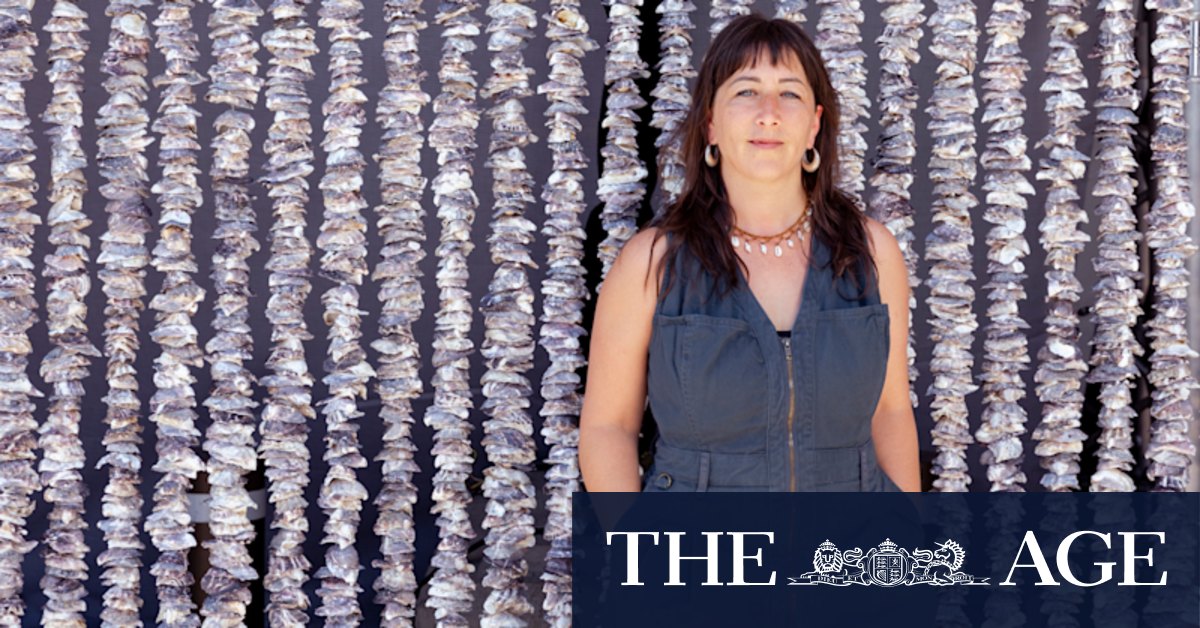
Quandamooka artist Megan Cope turns an oyster shell in her hand to catch the light.
“So gorgeous,” she says. “Some of them turn purple when they’re wet. Some are creamy, some are pale white. And, look, this native one, these tiny little lines, they’re teeth.
Artist Megan Cope with part of her monumental installation.Credit: Dominic Lorrimer
Cope, an artist from Moreton Bay/North Stradbroke Island in southeast Queensland, known for her site-specific installations, has just finished installing Whispers, a major new public artwork for the Sydney Opera House, commissioned as part of its 50th anniversary.
Using more than 85,000 oyster shells, or kinyingarra in Jandai language, the work explores climate change and the fragility of the ecosystem, while honouring the pre-settlement history of the site called Tubowgule by Gadigal people.
Tubowgule, a resource-rich area and a historic place of ceremony, gathering and celebration, featured middens, mounds of shells and bones discarded by Aboriginal people. After colonisation, the middens were crushed to create lime to make stone and brick buildings.
Cope says Whispers, which features three installations on and around the exterior of the Opera House, combines two histories.

More than 85,000 shells went into the installation.Credit: Daniel Boud
“It’s a sculpture that’s an architectural intervention at the site,” she says. “With the part near the steps it will appear that the stairs are resting on that midden and the mound comes up through the top. It’s a cultural foundation.”
The installation comes from more than six months of work. The shells, sourced from restaurants, pubs, the fish market and shell waste from oyster farms affected by floods and toxic run-off from agriculture, have been individually cleaned by volunteers and project staff using a cement mixer, toothbrushes, and buckets of soapy water.