“Fiji is the Jerusalem of the Pacific – it’s been blessed because of its strategic political and financial location in the region,” said Aholotu Palu, chief executive officer of the Pacific Catastrophe Risk Insurance Company (PCRIC).
“Fiji has been recognised by the whole world as a hub for the whole region. Economically, financially…and that is why I’m happy with the Deputy Prime Minister Biman Prasad for his thinking to unite the region in terms of regional solidarity, unity and cooperation”.
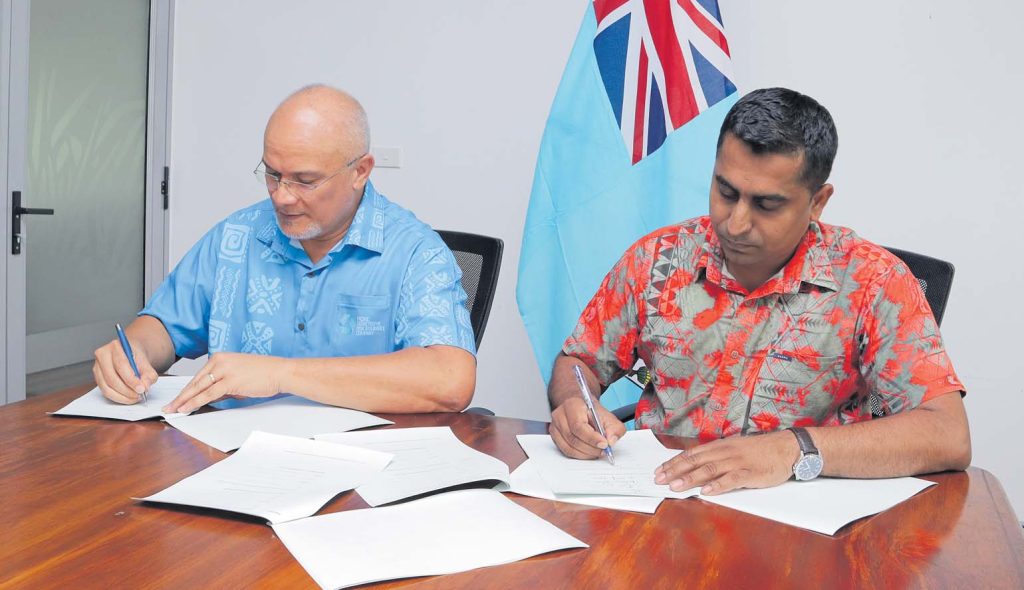
In what has been seen as a major win for the Pacific region, Fiji officially committed to PCRIC’s parametric insurance offer last October.
This, according to Mr Palu, has set in motion much needed interest from donors in terms of subsidising premiums as well as other Pacific countries who PICRIC hopes would join the scheme.
“When Fiji comes on and does something in the region, it creates some sort of political attention from big countries. The whole world cares about what Fiji does because it’s huge and it has its own economic empowerment. So the whole Pacific thanks Fiji because of its standing,” Mr Palu said.
New interest
“Niue has just signed a policy. We now have five policy holders – Cook Islands, Samoa, Tonga, Fiji and Niue. We’re finalising a few things with Papua New Guinea.
“The donors are all of a sudden emailing me for a meeting, they are interested but they said they were waiting to see if Fiji comes on. They said if Fiji comes in, we’ll support you.”
Fiji’s participation is crucial to PCRIC’s efforts to get reinsurance, a costly exercise that would need donor assistance.
“Fiji can easily magnetise other Pacific countries. But even if they’re not coming, if the donors are going to create more collaborations with us, more resources, we can then go out to the countries and say, we’ll give you any percentage of premium, let’s join so that when disaster strikes, we’ll be able to give you a payout.”
“We wanted to leverage on Fiji’s political situation and political power and convening power of Fiji, to bring in the attention of the Pacific,” Mr Palu said.
“Because we have the resources but we don’t have the political capital. The political capital depends on the political commitment of the minister of the day. If the new minister changes (the commitment to buy) he or she can change it. And this is why we go around and talk to the donors. Germany gave us nine million euros ($F21.9 million) to subsidise all the premium of the Pacific. And the current conversation with the donors now is to see if they can provide a long-term premium subsidy, by long term, we’re looking at 10 to 20 years.”
This year, PCRIC will be working on a product that would be applicable to the Northern Pacific.
“What is applicable for them is drought. So we are going to roll out a drought product, so we’ll be going to Marshall Islands, Kiribati, FSM to roll out these products for them,” Mr Palu said.
Fiji’s policies
Fiji signed on to two covers – one for a Category 5 cyclone and the other for rainfall.
“If the triggers are activated, Fiji will receive close to $US10m within 10 days,” said Mr Palu.
“The premium is $1.5m a year for a potential payout if a CAT 5 cyclone hits Fiji. If it does, then definitely Fiji will receive close to $US10m ($F22.29m). Fiji is not paying $1.5m absolute amount, no.
“We (PCRIC) are subsidising it. We’re paying half a million.
“But the money that Fiji pays is going to a company that Fiji owns anyway (PCRIC).
“Whenever you become a member of the council, you own it.
“And at the same time, you’re a policy holder.
“We’re only deducting $1.5 million. The rest of the policy and the payout, we’re sending it to the reinsurance market.
“So even if Fiji is projected to receive close to $US10m ($F22.29m), we only pay Fiji $1.5 million.
“The other $9m is coming from the international market. It’s more cheaper for the countries to pool with us and take the risk to the international market then to do it directly. It’s very expensive. If you go directly to the market, it’s going to kill you.
“When we pool the risks of the countries in the Pacific, you’re creating some sort of economies of scale. Then you will be able to penetrate the insurance market and you can lower the price of the insurance.”
An insurance provider for governments, PCRIC traces its origin to an initial request to the World Bank by finance ministers in 2007 for an initiative to help them mitigate the costs of natural disaster.
Based in the Cook Islands, the company was finally established in 2016 and is owned by Pacific island nations through the Pacific Catastrophe Risk Insurance Foundation (PCRIF).