
Opinion
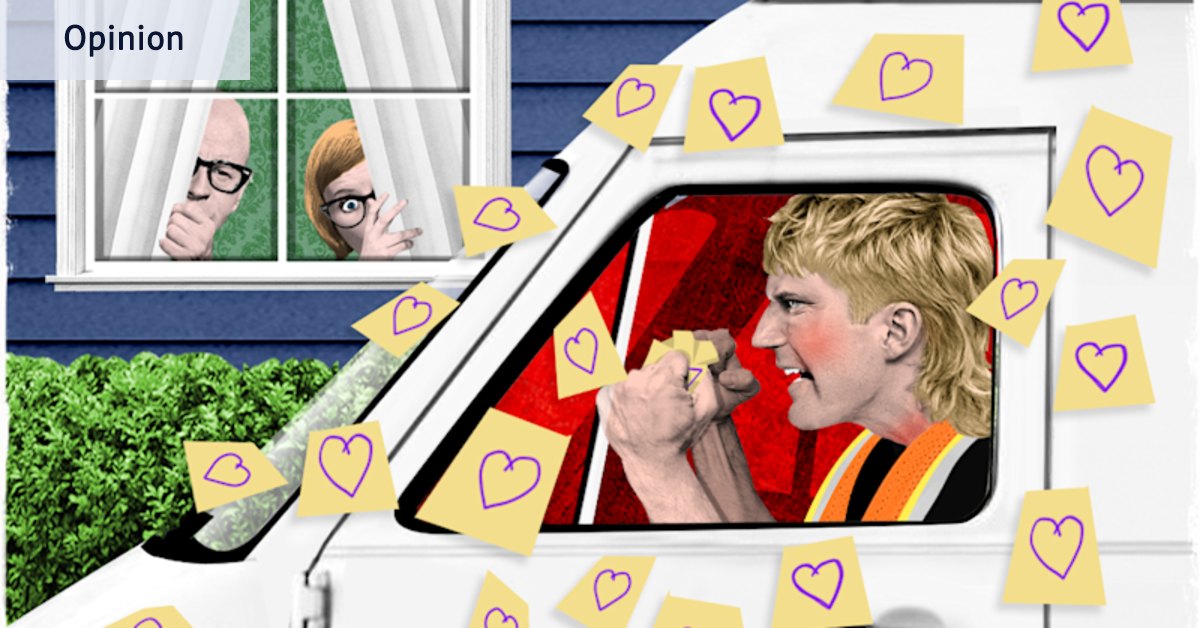
“Hello! Just a friendly request. Your van is parked across two spaces and it’s hard to find parking in this street. Would you mind moving it a little forwards or backwards? Thank you! Have a nice day!”
The handwritten note was under the windscreen wiper of a white van. I said, “There’s a person after my own heart.” Readers will know my opinion of dickhead parking, and here was a fellow sufferer.
“A woman after your own heart,” my beloved observed. The shape of the handwriting, in purple texta, with balloony curves and a smiley face at the end to indicate that it really was a friendly request, indicated, she thought, a female hand.
I didn’t think much of this until a day later, when the note had been replaced under the windscreen wiper by another. “You make me sick. What you need is a GOOD F—. The world doesn’t revolve around people like you. If you want to say it to my face, come over.” Below this, the van driver left his address. His vehicle remained parked across the two spaces.
Antisocial hostility in the language of sexualised violence: my beloved wanted me to report it to the police. Hanging from the van’s rear vision mirror was a surf wax tag (“Sex wax”) and on the dashboard and front seat were piles of clothes. Work equipment was on the roof racks. Here we are in 2026, with male violence against women, random or targeted, finally reaching a threshold where the authority of the state must finally give force to protection, and a low-stakes neighbourhood interaction had escalated in a blink.
This was earlier in the year, when the champions of all the big men on campus were globally rampant. The strongmen were dropping their bombs from stealth aircraft and firing their missiles from expendable drones. The backlash against “woke” smelt like testosterone in the morning. Voters were flooding to machismo, even in Australia where the machismo was embodied in a red-haired woman.
As he’d given his address, I was tempted to pay old mate a visit. My beloved warned me against it. I just wanted to see what was his go. My curiosity was part stickybeak, part anthropological – what did such a person look like, how did they speak? – and part precautionary, if he posed a danger to society. When I realised that his home had a direct sight line to ours, I dropped that plan. We are conditioned for fear. In cop dramas, white vans are what the bad guys drive.
The world went on. The strongmen spent their brute force and got on the wrong side of their transactions. The domestic abusers kept killing their female partners. A sovereign citizen killed police. A man allegedly crushed Helen Haines with his vehicle. Bad guys’ momentum couldn’t suddenly be turned around by awareness campaigns and tweaks to bail laws.
Then, last week, another white van was dickhead-parked across the same two spaces. Our purple-penned note writer was undeterred. “Hello!” she wrote, with the same polite message, the same sign-off of “Have a nice day!” and the same smiley face. This second white van was also full of male detritus.
A couple of days later, the handwritten note had been replaced under the windscreen wiper by another. “I’m so sorry. My sister has taken the keys away, but she’ll be back on the weekend. I’ll move the van then. Sorry!!!” By the weekend, this white van had moved.
The two white van drivers were on my mind when the US midterm elections rolled in a couple of days later. The threats, the verbal and physical abuse, the intimidation have their day and leave damage that can never be undone. The spread of violent speech and actual crime, supercharged by artificial intelligence tools, pour over us in a torrent. When the Van Driver Number Ones are winning, it seems like they can never be stopped, and they want us to feel that theirs is the natural way of things. But this week, in godforsaken America of all places, the weight of money, the threats of authoritarian crackdowns and cry-baby complaints that the results were rigged turned out to be mirages. American people power spoke against them. Democracy itself acted in self-defence. The system, for all its imperfections, worked on such a scale that even the losers accepted it.
The system in our street showed its resilience too, sort of, as far as common decency and respect for unseen strangers is a system. First, the woman note-leaver held her ground. Van Driver Number One’s threat of sexualised violence did not stop her. Maybe it made her more determined. Second, Van Driver Number One was only one person, maybe battling his own demons, maybe just a weak prick. But he wasn’t allowed to set the tone of the neighbourhood. Van Driver Number Two responded in a way that gave you hope that the social tissue will hold.
All of these communications were anonymous. Social media has turned anonymity into a weapon of choice for the weak and the bad actors. Cowardly abusers and mechanised bots merge into a single upswell of the nameless. But anonymity is not only digital and not only a disguise for the gutless. The exchange of notes on my street was all anonymous, all analogue, and the only person who identified himself was the big man who wrote down his address as a challenge. Anonymity can just be a prudent precaution, a de-escalation. Anonymity let Van Driver Number Two respond without prejudice. Anonymity itself isn’t the problem. Dickhead behaviour is.
Things like this restore hope. Of course there is hope in humans. As the English writer Caitlin Moran says in her book What About Men?, expansionary, humane, modern expressions of masculinity, shucking off old straitjackets, need only to embed themselves in the mainstream in the way that new expressions of non-male identity have done. Van Driver Number One doesn’t have to define all van drivers. I saw his van this week. It found a space only because someone else had parked considerately. When someone else puts the community first, Van Driver Number One benefits. I somehow doubt he’d have learnt that lesson, but he might have.
There are plenty of models of Van Driver Number Two in the big public. In the small public – in a neighbourhood – you can just communicate with others in a civil manner. It won’t kill you. Sometimes you lose the argument and lose an election. It won’t make you less of a man to move your van. We have bigger battles ahead. In the coming struggle for our planet and our survival as democratic societies, it’s not a bad thing to remember, once in a while, that most of us humans will be on the same side.
Malcolm Knox is a journalist, an author and a columnist for The Sydney Morning Herald.
Get a weekly wrap of views that will challenge, champion and inform your own. Sign up for our Opinion newsletter.
 Malcolm Knox is a journalist, author and columnist for The Sydney Morning Herald.