

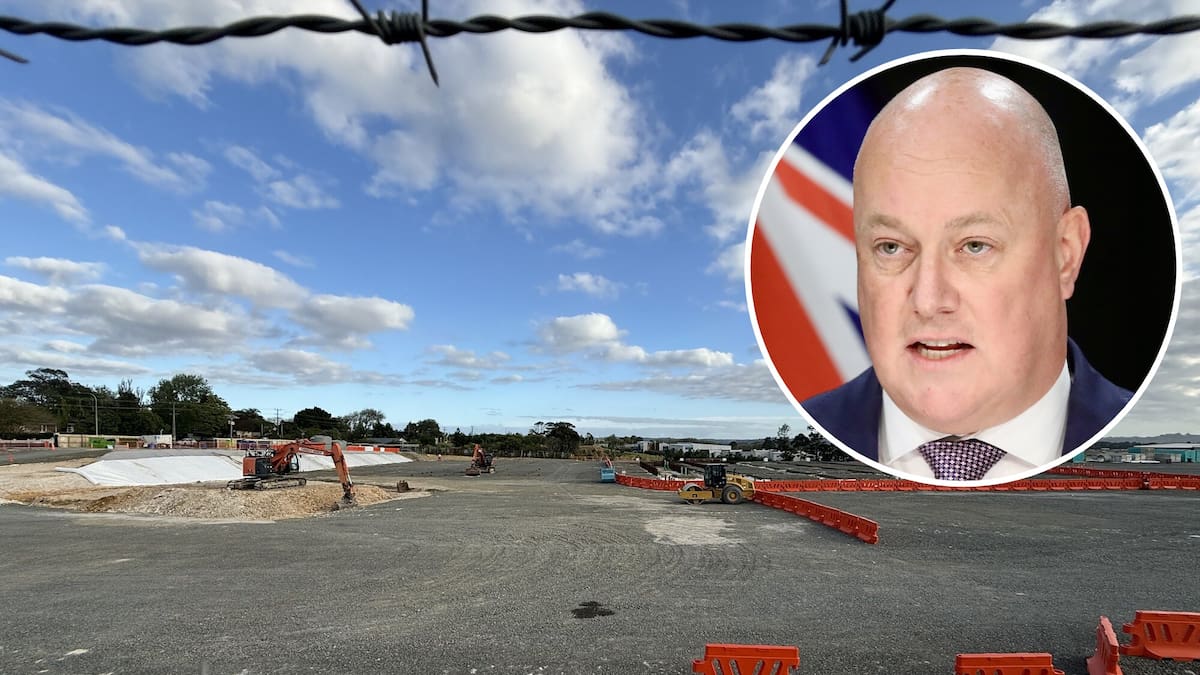
The Datagrid “AI factory” planned for Southland – first announced in 2020 and put at $5.1b in promotional material, still needs Transpower consent, funding, and a cable partner (after Chorus pulled out, citing a lack of anchor customers). As of this week, national grid operator Transpower remains in an “investigation phase”.
Spark’s huge “surf park” data centre – first announced in 2023 and consented the following year, remains on the drawing board.
The telco said it needed to raise more than $1b for data centre expansion. It secured the bulk of it by selling 75% of its data centre business to Australian firm Private Equity Partners, with a company called TenPeaks (25% owned by Spark, 75% by PEP) formed as a result of the deal.
This week, TenPeaks chief executive Michael Stribling (until recently, general manager of Spark’s data centre unit), told Tech Insider: “We are continuing to invest to progress design and prepare for construction, and for the provision of power to the site. I can’t yet confirm a date for commencing construction.”
And now there’s an update on a fourth mammoth project that’s MIA: Microsoft’s hyperscale data centre in Whenuapai.
Microsoft’s first data centre: built
In 2020, following meetings and correspondence with then Prime Minister Jacinda Ardern – who was also the first to announce the news, calling it a vote of confidence in NZ’s economy – Microsoft gained Overseas Investment Office approval to buy 4ha hectares of land at 7 Kanano Rd in Westgate, northwest Auckland.
(The application was made by “Microsoft 6399″, a vehicle, owned by a Microsoft subsidiary in low-tax Ireland, created for the firm’s data NZ centre business.)
The tech giant duly built a huge data centre at Westgate, which opened in December 2024, with the Microsoft 6399 accounts for that year detailing a $1b project.
Microsoft’s second data centre: Never built, consent lost
In February 2023, Microsoft gained Overseas Investment Office approval to buy a 6.5ha, undeveloped property at 151 Brigham Creek Rd, a site close to the air base at Whenuapai with a rateable value (by a 2024 Auckland Council valuation) of $15m.
(The location was initially kept secret by the OIO but revealed in later assessment documentation, as well as public property records. Microsoft has never confirmed the location – or the Westgate location – citing a global policy. The company declined to comment on the Whenuapai site this week.)
The OIO decision on 151 Brigham Creek Rd said, “The land is currently a vacant site, ready for development. The Applicant intends to construct a data centre on the land.
“The investment will benefit New Zealand by introducing significant capital into New Zealand (including approximately $180 million of initial capital investment into this site), and by creating 50 new fulltime equivalent (FTE) jobs once the data centre on this site is operational plus 300 temporary FTE jobs during construction of the data centre on this site.”
Some $180m was the required “initial” minimum spend. Full construction and “IT computing fit-out, equipment and installation” costs were redacted.
Use it or lose it …
The OIO gave Microsoft four “special condition” deadlines for the Whenuapai data centre.
- “You must lodge and obtain all necessary approvals, permits or consents required to construct the data centre: July 30, [year redacted].”
- “You must commence construction of the data centre: January 31, [year redacted].”
- “You must introduce at least $180m in capital expenditure to construct the data centre: June 30 [year redacted].”
- “You must complete the construction of the data centre and begin operating the data centre: June 30, [year redacted].”
If Microsoft failed to meet any of the special condition deadlines, the OIO could require it to dispose of the land.
… and they lost it
But in the event, Microsoft fell at the first hurdle on a standard condition: it failed to buy the property within a required time.
The OIO won’t disclose the deadline, only that it has now passed.
The timeframe for the applicant to acquire the land has now passed and if they have not acquired the land they can no longer rely on the consent to do so.
“The timeframe for the Applicant [Microsoft] to acquire the land has now passed and if they have not acquired the land they can no longer rely on the consent to do so,” an OIO spokesman told Tech Insider earlier this week.
The property remains with the vendor, Neil Construction, which now plans a light-industrial park for the site.
Will Amazon lose its Westgate land?
Amazon gained Overseas Investment Office permission to buy three properties at Westgate at 73, 75 and 77 Fred Taylor Dr, which together formed the 4ha site on which it began earthworks for its first hyperscale data centre in New Zealand.
The site, roughly the size of four rugby fields, sits just over the road from the data centre that Microsoft did build at Westgate, and another constructed by DCI (and an independent data centre player owned by Canada’s Brookfield). A Costco and Mitre 10 sit nearby in the retail-heavy development.
Only one section of the Amazon site – 77 Fred Taylor Dr, a 2018sq m property (73 Fred Taylor Dr is 26,411sq m, 75 is 13,345sq m) is subject to a use-it-or-lose it requirement, an OIO spokesman said.
The deadline has not been disclosed.
Amazon gained OIO permission to buy 77 Fred Taylor Dr, for $5.5m, in December 2024 and the deal was closed in January 2025 – just weeks before the tech giant walked away from the site.
“The land is required to be used for stormwater drainage infrastructure. If the Applicant does not do so, Linz may require them to dispose of the land if they are not taking steps to dispose of it themselves,” the OIO spokesman said. (The OIO falls under Land Information NZ.)
Amazon originally planned to open its data centre at the end of 2024, only for initial earthworks to stall over a drainage issue. In June 2025, after Amazon had abandoned the build, the Auckland Council told the Herald that the drainage issue had been resolved. There were no regulatory hold-ups.

Why did Microsoft have a blanket use-or-lose-it requirement for its Whenuapai site, while it applies to only a corner of Amazon’s Westgate property?
The OIO spokesman said it was because Microsoft applied for OIO consent to buy 151 Brigham Creek Rd under the “benefit to New Zealand” test, a pathway that allowed for use-it-or-lose-it provisions.
The respective properties that Microsoft and Amazon bought at Westgate were approved applications under the “significant business assets pathway”, which has no such forced disposal provision, bar 77 Fred Taylor Dr, which Amazon applied to acquire under the OIO’s “residential land development” pathway, which does allow for the regulator to apply a use-it-or-lose-it provision.
If you’re vexed about inconsistencies between the three OIO pathways, hold your letters.
The Overseas Investment (National Interest Test and Other Matters) Amendment Act 2025, which came into force on March 6 this year, obliterated them in favour of a whole new, streamlined regime.
Co-Lo a-go-go
How could Amazon and Microsoft launch their “zone” and “region”, respectively despite only building one between them?
Neither will comment on the record, but the presumption – confirmed by industry insiders – is that they “co-locate” or lease space and move in their own gear with third-party data centre operators, easily the largest of which are CDC (which has hyperscale facilities at Hobsonville) and DCI (Westgate and Albany).
The northwest is favoured by all contenders because of its proximity to the landing points for international fibre cables and a peering exchange, which joins all the dots for international connectivity. The physically closer you are to this infrastructure, the better.

Ardern – and, years later, current Prime Minister Christopher Luxon – have been starry-eyed at the prospect of multinationals investing billions in building their own data centres here.
But the co-location model they’ve largely followed instead has been proved a multibillion-dollar boon for CDC, which is half-owned by New Zealand’s Infratil. The national interest test has been passed, if not in a way some of our politicians can get their heads around.
Chris Keall is an Auckland-based member of the Herald’s business team. He joined the Herald in 2018 and is the technology editor and a senior business writer.


