
You have reached your maximum number of saved items.
Remove items from your saved list to add more.
No gift articles left
You’ve used all of your gift articles. 3 more will become available on the 1st of every month.
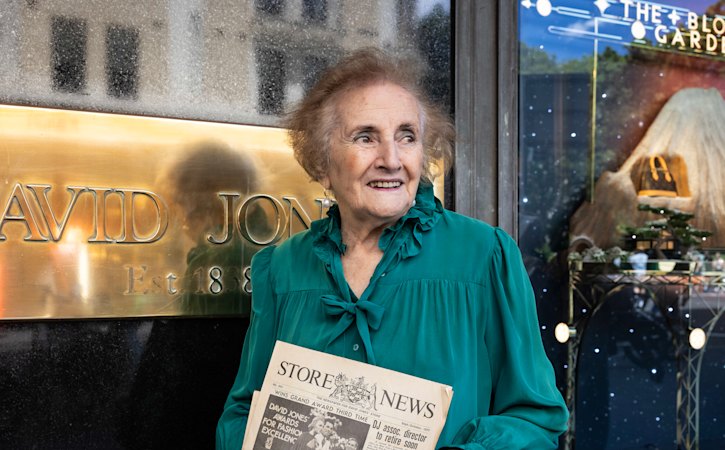
Working as a graduate pharmacist at David Jones’ Sydney CBD Elizabeth Street store in the 1960s, Laudie Sneddon sometimes felt she was at the epicentre of Australian high society.
“Anybody who was anybody shopped at David Jones. It was the place to see and be seen,” she says.
Gough Whitlam and Sonia McMahon, wife of former prime minister William McMahon, were regulars at the dispensary. Hannah Lloyd Jones, the third wife of long-serving David Jones chairman Charles Lloyd Jones, would regularly bring Sneddon fresh flowers from her garden.
Visiting David Jones on Thursday, as the historic retailer faces collapse, the 90-year-old is emotional and points out the prime corner spot where she once spent countless hours helping customers, now home to a Louis Vuitton store.
Sneddon began working at David Jones in 1962 (when the lifts were operated by people, the food hall was bustling and a trip to DJs was still an occasion to dress up for), starting as an assistant pharmacist and climbing the ranks to chemist in charge. Throughout her time, she says dispensary staff were fairly evenly split between men and women.
With a keen eye for famous faces, the young pharmacist kept an autograph book close at hand.
“Whenever there was a big shot on the counter, I’d get it out,” she says.
Over the years, she collected the signatures of politicians, socialities, film and television stars and athletes – including those of Whitlam, alpinist Edmund Hillary and Zara Bate, the wife of Harold Holt.
On one occasion, word got around that Barry Humphries was trying on wigs nearby. Naturally, Sneddon wandered over to look.
“He pulled a funny face at me,” she says, contorting her face to mimic the one Humphries made all those years ago.
Working at David Jones, Sneddon also bore witness to a changing Australia. In 1970, for instance, she watched as thousands of Vietnam War protesters marched past the store’s brass doors.
Sneddon spent 15 years working for the retailer, hanging up her smart white laboratory coat uniform at eight months pregnant with her first child (she would have liked to have returned to work, but says it was difficult finding someone to mind the children).
“I was given a good send-off when I left. Various department heads came to the dispensary. Charles Benyon Lloyd Jones [the last member of the family to preside over David Jones] invited me to his office, but I could not stop crying, so I rang him up and said, ‘sorry, I can’t make it’. He was very nice and sent down a written reference,” she recalls.
Sneddon says she was shocked to hear the news about her former employer, but acknowledges times have changed.
“They were customer orientated, not like they are now. People who went in were regulars – they’d get a chair to sit on, they knew the staff…. It’s sad it’s going, it’s an institution.”
Matthew Bailey, a retail historian at Macquarie University, says David Jones employed thousands of women like Sneddon.
Department stores recognised, in the 1950s and ’60s, that women did most of the household shopping – an extension of their domestic duties.
Having predominantly female staff, then, was a natural choice, says Bailey, though pointing out there was a distinct division of labour in stores. Female employees were overwhelmingly assigned to sections associated with the home and children, for example.
Despite forming the backbone of department stores, women were paid 54 per cent of the award rate compared to their male counterparts, and support such as maternity leave was non-existent. Marrying or having children essentially meant leaving the workforce altogether, says Bailey.
“What this means, which is not widely recognised, is that that customer service model the department stores were famous for was actually built on very cheap, highly skilled female labor. And in the 1970s, when equal pay is introduced and there’s wage inflation generally, this creates a significant cost pressure on department stores.”
But what stands out about department stores in the 20th century, says Bailey, was the social world they fostered – even if employees weren’t always happy or paid well.
“There were sporting clubs, choirs, theatre groups, charitable organisations, company newsletters. There was care shown for employees in ways that we don’t really see now,” he says.
For 50-year-old Carly Smith, the iconic department store is part of her family history.
“My dad and grandfather were retailers and my cousin and great uncle worked at David Jones. It was just the natural progression that I followed,” she says.
At 17, fresh out of school, Smith started as a sales assistant at their East Garden branch in Sydney (which closed in 2007 and became a Myer), working on the chocolate counter.
“I remember being absolutely petrified on my first day. The person who was training me basically had to push me towards the customer,” she says.
But nerves quickly gave way to joy as Smith discovered she had a knack – and affinity – for customer service.
“I thought I was going in to operate a cash register, but it’s so much more than that. It’s making someone’s day. It’s finding something that someone needs and having a nice conversation and orchestrating a nice experience,” she says.
Smith then moved to the music bar, where she witnessed the transition from vinyl and cassettes to CDs.
“I tell my friends, ‘back in the day, I was spinning records at David Jones’,” she laughs.
Smith would spend 31 years at the company, working her way up through the ranks, culminating in a senior position in training before she left last year.
But more than a career, David Jones gave her a family: Smith met her now-husband after being set up by co-workers.
Reflecting on what the store has meant to her, Smith is teary.
“It was there for the people – I met my best friend and husband there. I had a good time, and I reflect on it dearly.”
Make the most of your health, relationships, fitness and nutrition with our Live Well newsletter. Get it in your inbox every Monday.
You have reached your maximum number of saved items.
Remove items from your saved list to add more.
No gift articles left
You’ve used all of your gift articles. 3 more will become available on the 1st of every month.