

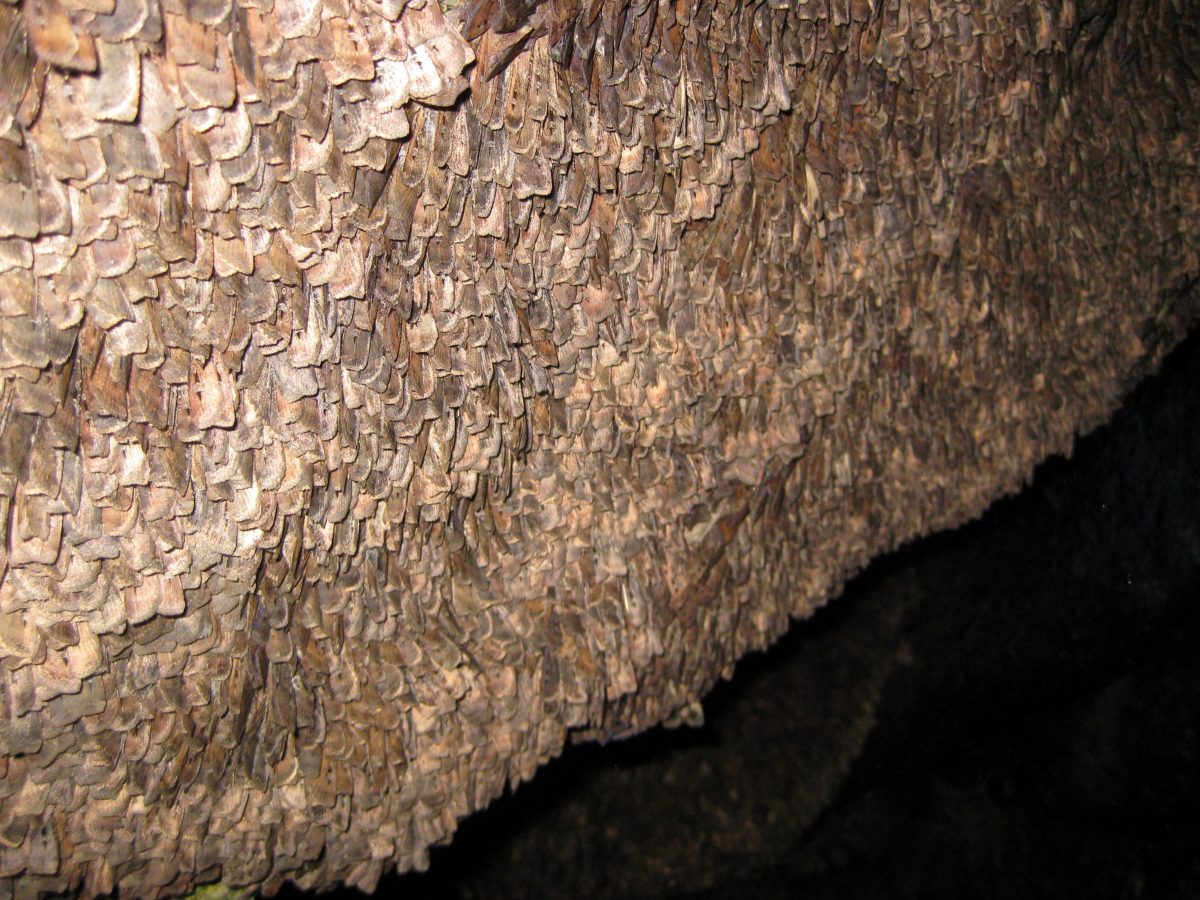
A wall of Bogong moths, aestivating in a cave in the Australian Alps. Photo: Professor Eric Warrant.
I think anyone in Canberra with an interest in the natural world is well aware that something seemingly miraculous is happening all around us right now.
Vast numbers of the lovely grey-patterned Bogong Moths have returned on their annual trip south, as they had for millennia until just a few years ago when the apparently infinite stream of them suddenly dried up.
This began in 2017 at the start of the savage drought that lasted until about 2020. There was serious concern for their future, but now, after a few wet years, they have bounced back.
Bogongs are a direct link to a colder Australia, which began to warm again with the end of the last glaciation period, some 10,000 years ago. For a long time before that, most of eastern Australia was similar to the highlands of the southern mountains today – cold, windy and mostly treeless – and that suited the Bogongs well.
Today the Bogongs breed on the black soil plains of northern NSW and southern Queensland. The caterpillars – known to unappreciative farmers as ‘cut worms’ – shelter underground by day and emerge at night to feed on pasture plants, substitutes for the native herbage they used to rely on.
In spring, as temperatures rise, they pupate, emerge as moths and fly south, travelling by night and feeding on eucalypt nectar. They navigate by the stars, using a map hard-wired into their minute brains.
Unlike migratory birds, they can’t follow older, experienced individuals, as no Bogong ever makes the trip twice.
When they get to the mountains, they head to the same rock shelters in Namadgi, Kosciuszko and the Victorian Alps that thousands of generations of their foremoths have used before them. The first arrivals get the deepest, coolest crevices, and later arrivals tuck their heads under the wings of the moths already there, a tiled wall of moths at a density of over 15,000 per square metre.
In the mountains, they don’t feed, but every night clouds of them emerge like smoke from the rocks and return by dawn. We might think it’s to escape the Mountain Pygmy Possums and other small native mammals that snack at night on their rich, fatty bodies, but it’s really a no-win for them, as in the air they’re hunted by Boobook Owls, bats and Owlet-nightjars. So why do they do it? Only the moths know, and they’re not telling.

Little Ravens in the cloud on Mount Kosciuszko, searching the crevices for accessible Bogongs. Photo: Ian Fraser.
Another, equally dangerous and far more insidious predator of the moths exists. Two species of tiny parasitic mermithid roundworms have adapted entirely to the Bogong migration. They overwinter as eggs on the cave floor and in spring they swim up the walls in melting snow water and infect the arriving moths as they drink the water. In January they leave the dying hosts and return to the floor, rich in moth bodies and debris, to mature, mate and leave eggs to await next year’s moths.
In late summer the Bogongs fly north again, lay eggs and then they all die, leaving the next generation in the black soil to carry on.
The numbers are phenomenal. It is reported that a Sydney church service was interrupted in 1865 while the congregation was counting 80,000 moths on the windows. I’m not sure how that lack of concentration was the moths’ fault, though!
Their preferred route is usually the more direct inland one, but they are at the mercy of the winds too and often turn up at the coast, as they are this year.
At times, clouds of moths have even been blown across the Tasman and arrived in New Zealand.

Bogong Moth tastefully settled on a doormat. Photo: Ian Fraser.
The great and sadly late CSIRO moth expert Ted Edwards once described our Parliament House as the world’s biggest moth trap, and so it proved when vast numbers of moths were distracted by the overnight lights and then took refuge in the house when daylight came. This was not at all where they wanted to be, but certain under-informed members then insulted them by accusing them of being a threat to the great house tapestries! These moths eat only nectar. It was sort of funny at the time, but probably not so much for the moths.
I, for one, am in dire need of some good news stories these days, and the return of the Bogongs has given me great cheer.
Ian Fraser is a Canberra naturalist, conservationist and author. He has written on all aspects of natural history, advised the ACT Government on biodiversity and published multiple guides to the region’s flora and fauna.


