
You have reached your maximum number of saved items.
Remove items from your saved list to add more.
Save this article for later
Add articles to your saved list and come back to them anytime.
It’s a balmy Thursday night, and as I cross the road towards the Potts Point bar, I’m already regretting my leather jacket.
Things get worse when I step inside, and it’s obvious the air-conditioning doesn’t work. Nonetheless, I remain optimistic as I wait in line. “Is this your first time?” the host asks as he puts my wristband on. It is, I tell him.
After 10 years of situationships and an on-and-off affair with dating apps, I’d finally found myself at a singles event. Specifically, the “Top 3 AI Matchmaking Night” run by a company called Thursday, which teams up with local venues to host IRL singles events at various cities around the world. I was there mostly out of curiosity.
Inside, I look at the drinks menu, where my options include a $23 “sneaky link cosmo” and $25 “XO espresso”. I opt for a $14 vodka soda hoping I might avoid extortion.
The energy of the crowd is tentative. We’re told to fill in a quiz that AI technology will use to deliver us three matches over the course of the night.
Prompts include how creative we consider ourselves, and how important independence is to us in a relationship. At three moments in the evening, we will be notified of our match and have roughly 20 minutes with them before the next. The host informs us that we’re “in luck” – there are more women than men.
My first match was Jerry (name changed for privacy reasons). He’s in a blazer and striped shirt, which was unbuttoned deep enough that he could hang his glasses on the opening.
“Can I ask,” he probed tentatively, “Is your heritage actually Swedish?” (I have blonde hair and blue eyes, and he apparently has no imagination.) I probably shouldn’t have been surprised when he bid me farewell by way of unprovoked sexual innuendo.
My second match was better. Louis was a comfortable conversationalist, which makes sense because this wasn’t his first singles event. Fifteen minutes into our discussion, we realised we were both journalists, and another five minutes later, he paused ominously. “Wait,” he said, “you’re not writing about this are you?” (Sorry, Louis.)
My third and final match arrived not long after. George “might help you feel more fulfilled in your day-to-day life”, the app told me. (Is it little wonder our expectations are so high?) I sent him a text asking if he was still around. “Yup,” he replied with no elaboration.
It was all the encouragement I needed to call it a night.
The state of online dating is dire, if not entirely dead, resulting in a new surge in singles events.
Overseas, there are events for every niche: from the Silicon Valley tech founders, to the Brooklyn-based wrestling fanatics and London foodies. There are events where you can go and “pitch” your friends with a PowerPoint presentation, and companies selling Victorian-era “acquaintance cards” to make it easier to approach people in public.
Even the dating apps started pivoting to incorporate the shift. Bumble has “Bumble IRL” and Feeld hosts “socials” (though neither currently have recent events listed for Australia). At their inaugural product keynote in March, Tinder announced a number of new updates including the introduction of an “events tab”, which will allow users to scout local IRL opportunities to meet fellow singles out in the wild.
According to the Match Group-owned company, the move was informed by research that found Gen Z (56 per cent) and Millennials (53 per cent) are more likely to describe themselves as “better in person”, and offline singles are two to four times more likely to engage in low-pressure IRL experiences compared to one-on-one dating.
“It’s about creating spaces where people can meet more organically,” a Tinder spokesperson said. “We want to make dating feel more human, social and fun, and help users rediscover the excitement of meeting someone new.”
From an evolutionary perspective, this was inevitable, says Dr Adam Bode, an interdisciplinary love researcher. “We didn’t evolve to scan through thousands of people over the phone and make a decision within the first second of seeing their profile picture whether we want to spend some time with them,” he says. “Traditionally, you’d get into someone, and then you’d ask them for a date.
“But dating apps actually reverse that process in that you try to get a date to determine if you’re into them or not. It’s just not normal.”
Among singles, there’s a tension that defines our current moment: people really want to get off the apps, but feel handcuffed to them because of the lack of viable alternatives. People got so desperate they turned to clubs to try to find a partner. They’re too nervous to approach someone at the pub for fear of rejection or the chance it’ll become a viral TikTok story, and many people have never considered a singles event, because the uncertainty about what really goes on, and the kind of people who go, puts them off.
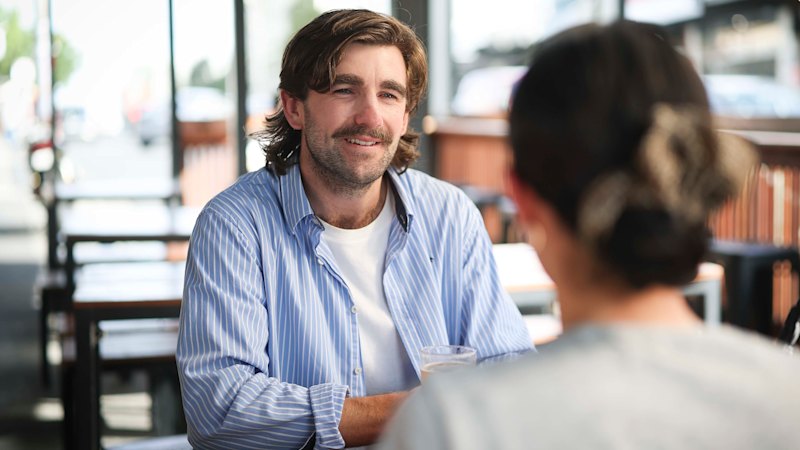
Hugh Tyson, 31, is someone you might find at a singles event. After his last long-term relationship ended in 2022, the teacher from Northcote has been navigating the Melbourne dating scene with what he describes as “an open heart” and “deep curiosity”.
He first heard of Melbourne’s IRL dating event series, Crush Club, through a friend. “I thought he was about to tell me a state secret,” Tyson tells me.
He’s since been to two events and thoroughly enjoyed them. “I loved it because it just makes you present with other people immediately,” says Tyson, who believes there’s been a “disappearance of the approach game”, referencing the ability to talk to a stranger in public.
“The fear of rejection can really cripple your confidence,” he says, “and you can just psyche yourself out with thoughts like, oh, what if they’ve got a partner? You’re gonna look like an absolute twat.”
The way Tyson sees it, there are three types of people you’ll encounter at an IRL singles event: those with genuine intention to meet a romantic partner, those who are curious and there for a good time, and the people who’ve rocked up with friends. The latter group tends to be a bit reserved, while the former are more engaged.
Crush Club founder Izzy Burns, 27, has multiple event formats – speed dating, dinners and mixers – to cater for the different preferences. “The thing with the speed-dating events is there are people who really like them and enjoy that kind of structure and the match cards and being told, OK, you’re gonna sit here, and then you’re gonna move over here, and everything’s very planned out,” she says.
“And then there’s also people who prefer a more relaxed setting where they can just go up and chat to people as they like. If they get on with someone, they’ll just kind of share their details as they go.”
There have been a handful of couples to meet through Crush Club since it began in 2024, and the series has grown to the point where their biggest event – two speed-dating sessions at the Victorian State Library for 200 people – have waiting lists.
Tyson believes the curation of the event – they’re usually held at trendy wine bars or restaurants – sets it apart from the kind of generic “throw them in a room and hope for the best” approach of other companies running events for singles. It also requires an open mind.
“It is what you make of it, if you go in thinking, ‘oh, I’m going to have a horrible time, it’s going to be awkward’, it probably will feel a little bit clunky,” Tyson says. “But I think as soon as you embrace that clunkiness, that’s where the fun is.”
They are, however, still an imperfect way of meeting potential mates, says Bode. “You are still expected to make a decision about whether you’re into someone or not in the first meeting,” he explains. “As a result, people are always talking about that ‘spark’ that they get, which does happen occasionally, but not that often.”
That, and there’s the risk that you’ll end up stuck talking to a person like Jerry.
For Burns, safety is prioritised by ensuring plenty of roving hosts and encouraging group tickets, where women can invite (and vouch for) male friends.
Bode believes the ideal way to meet someone hasn’t really changed in decades: a house party. He explains that you’re inherently brought together by mutual friends, making it more likely you’ll have common interests, the environment relaxed and there’s an in-built element of vetting.
“It not only gives you access to people that you’re more likely to want to form romantic relationships with, but also a higher-calibre person than you would normally meet on an app.”
With that, I’m off to find a house party.
Make the most of your health, relationships, fitness and nutrition with our Live Well newsletter. Get it in your inbox every Monday.
You have reached your maximum number of saved items.
Remove items from your saved list to add more.