

Time:2 hours +Makes:1 cake
Fruit cakes carry with them a certain ceremony – the long list of ingredients, the slow baking, the promise of weeks of keeping. In truth, they’re not difficult to make, though a few careful touches can make all the difference.
This tradition of making the cake well ahead is why many families still observe “stir-up Sunday” – the last Sunday before Advent – as the day to gather and mix their Christmas pudding or cake for optimal flavour development.
Lining the tin with two layers of baking paper insulates the cake from the heat of the baking tin, so the sides don’t cook too quickly. Choosing the best-quality dried fruit ensures a moist, flavourful crumb, and brushing the cake with a little more alcohol seals in freshness and sets the cake up for slow maturing. The cake can be eaten two weeks after baking, and keeps for up to six months, but is optimal at four to six weeks.
Baking the cake in a 23cm square tin makes it easy to divide into four smaller cakes for gifting but it can also be made in a 23cm deep round tin.
Decorating the cake
When the cake has matured, you can decorate it for the table, choosing a decoration method to suit your style. Whichever method you choose – a creative arrangement of dried fruit and nuts, or marzipan, fondant and icing – start by applying a thin layer of warmed apricot jam to the surface, which acts as a glue.
For a jewel-like finish decorate the top a few days before Christmas with lightly toasted whole pecans or almonds, and whole dried fruit such as apricots, prunes and figs.
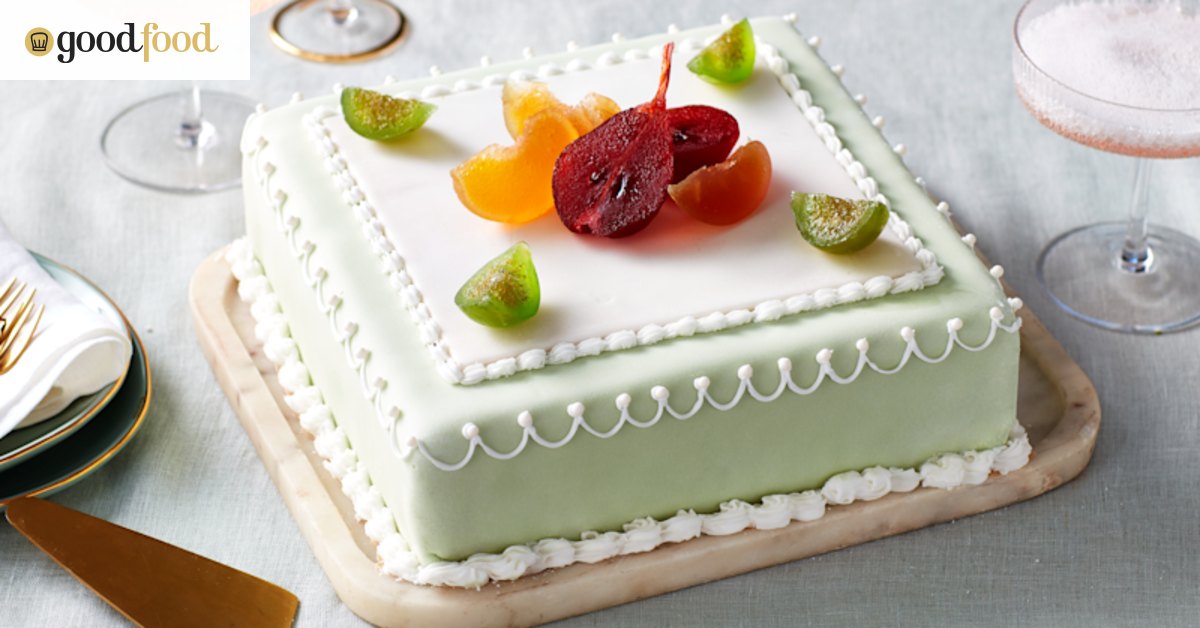
For a classic, polished finish you’ll want to apply a layer of marzipan first, followed by fondant. This method is best done a week before serving to allow the marzipan to set without drying out too much.
Lightly dust the kitchen bench with icing sugar (not flour). Take a 500g block of shop-bought marzipan. Knead it briefly to make it pliable, then roll it out to a thickness of 2-3mm. Roll it into a shape slightly larger than the cake’s top and sides combined.
Loosely roll the marzipan over your rolling pin. Carefully unroll and drape it over the cake, starting from the centre. Gently smooth the top first, then work your way down the sides, pushing out any trapped air bubbles. Trim the excess marzipan neatly at the base using a sharp knife.
Lightly brush the entire marzipan surface with cooled, boiled water. This provides a slightly sticky surface for the fondant and helps it adhere.
Take about 750g of shop-bought fondant (sugar paste). You can knead in a few drops of food colouring if desired for a custom colour. Roll it out to a uniform thickness of 3-4mm. Drape the fondant layer over the marzipan, using the same rolling pin method as before.
Work quickly to smooth the top and sides, eliminating all air pockets and wrinkles. Trim the edges neatly at the base.
Once the icing is complete, you can add your final festive touches:
- Piping: Pipe a decorative border (like a shell or rope pattern) around the top and/or bottom edges of the cake using royal icing.
- Ribbon: For a simpler look, tie a festive, food-safe ribbon securely around the base.
- Toppings: Add decorative elements such as sprigs of synthetic holly, candied orange slices, or clusters of whole glace fruits (cherries, pineapple, etc).