

Seven platypuses were rescued from Tidbinbilla during a severe drought. Photos: Taronga Conservation Society Australia.
When several platypuses took a holiday at Taronga Zoo in Sydney, it was just the start of a journey that has shed light on conservation work for their species as a whole.
Seven platypuses (two males and five females) were rescued from the drought-stricken Tidbinbilla Nature Reserve in December 2019.
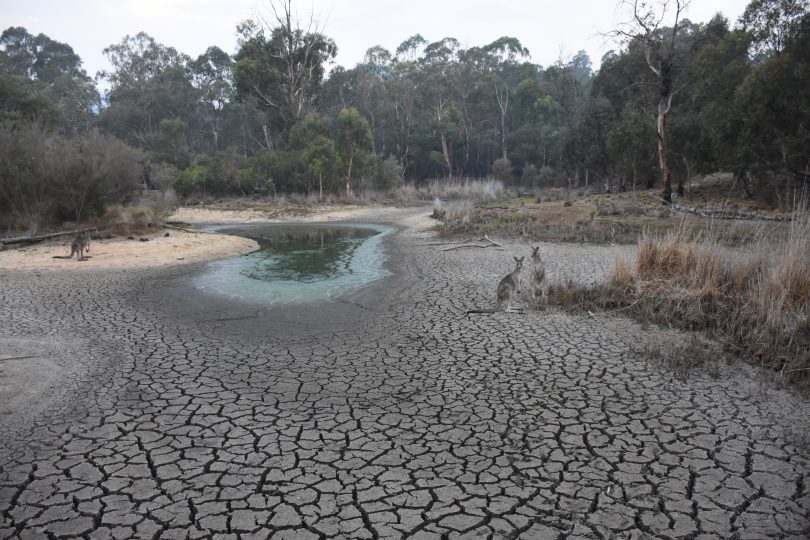
The interconnected pond system within the reserve dropped to critically low levels during the 2017-19 drought, likely resulting in the deaths of multiple platypuses by mid-2019.
Researchers from Taronga Conservation Society Australia and UNSW Sydney’s Centre for Ecosystem Science teamed up with officers from ACT Parks and Conservation for the evacuation.
Ultimately, five platypuses were returned to Tidbinbilla after a five-month stay at Taronga Zoo (one male escaped after arrival, while another died after becoming trapped in part of its enclosure).
They had been surgically fitted with acoustic transmitters, which the researchers used to track their movements for 18 months.
Their findings were published this month.
“Tidbinbilla, in a sense, is an interesting case – it’s where the reserve itself offers really good habitat when conditions are favourable,” lead author and University of NSW Associate Professor Gilad Bino says.
“But as waterways dry up there … [the platypuses are], in a sense, stranded there.”
Associate Professor Bino says the tracking devices meant they could keep a close eye on the mammals when the five survivors were returned to Tidbinbilla in May 2020.
“[Those transmitters] really gave us the ability to track these platypuses over really extensive periods of time, and conclude that they were establishing well and returned to kind of their normal habits, settling into kind of their areas.”
One of the repatriated platypuses wasn’t detected after 39 days, though their fate remains unknown as no body was recovered.
According to their study, it’s believed to be the first to quantify the post-release movements of returned platypuses after a drought-driven evacuation.
The four female platypuses exhibited consistent site preferences, whereas the male visited more sites throughout the area covered by the transmitters.
But all went to their capture locations and showed typical foraging behaviour within days of being released back into Tidbinbilla.
He says continued monitoring has revealed there are currently about 20 platypuses in the reserve.

One of the rescued platypuses receiving a check-up upon arrival at Taronga Zoo. Photos: Taronga Conservation Society Australia.
But Associate Professor Bino warns that more animals could face similar problems as their habitats are continually fragmented and affected by climate change.
He says that these platypuses settled back into life at Tidbinbilla quickly, raising hopes others could be evacuated if their habitat hits a crisis point.
“The next drought will hit us, without a doubt, at some point. Really, habitat restoration is the best strategy, the most cost-effective strategy … and restoration can only happen with communities.
“It’s not enough for us to rely on protected areas to safeguard platypuses.”
He says their results shine a light on the undeniable impact humans are having on the environment.
“We have to remember that we’re in this space now of undertaking intensive conservation actions because of the impact that we’ve had on our environment in terms of destroying habitat, fragmenting populations,” he says.
“We have to, in a sense, jump into this natural process and assume this role of facilitating connectivity, of movement of individuals to safe havens or to temporary facilities.
“Ideally, we wouldn’t have to be here if we would take care of our environment.”


