Opinion
This is a story about changing yourself. George Bernard Shaw said, “Those who cannot change their minds cannot change anything.” We live in a time, seemingly, of deepening entrenchment. If Shaw was right, this rigidity is not strength but powerlessness.
I never liked small dogs. Growing up, we had medium-sized dogs, proper dogs. We had one seriously big dog: my brother, a vet who should have known his stuff, brought home a beagle pup that didn’t stop growing until he’d become a giant fox hound, who looked like Snoopy but was bigger than his kennel.
Years later, my family adopted Bruce, a rescue blue heeler-kelpie cross, another proper dog with a beautiful loyal intelligence, a classic best mate. Since 2021 when he died, I was mourning Bruce. His collar still hung from the car’s rear vision mirror. Our children moved out. My beloved kept telling me I needed a dog, but I couldn’t replace Bruce (or, for that matter, the children).
I didn’t replace him. Instead, I changed.
Plenty of people dislike small dogs, and I was one of them. As for very small dogs, which even the pet industry classifies as toys rather than actual dogs? Bulgy-eyed, yappy, precious little tyrants who travel in handbags: you might as well get a ferret. I didn’t want another dog anyway.
Sometimes change comes because something deep inside you says if you don’t do it, you are giving up on more than you know. The dog change was like that. We dogsat a friend’s chihuahua, and he was unexpectedly loveable. My wife began haunting chihuahua rescue sites. A certain momentum built. Of course, it wasn’t really about a dog; it was about whether one of us had become stuck.
Danger Mouse, as he was known, was having trouble getting adopted. Two years old, black with tan markings, he had behavioural problems after being raised in a family with 11 children. Yes, such families still exist, and this tiny dog had grown up with wave after wave of two-legged monsters in his face. He’d developed severe anxieties. Great.
When you procrastinate for long enough, it can be best to let the universe have its way. Every good story starts with “yes”. So here I was, giving up and changing before I could get in my own way and unchange.
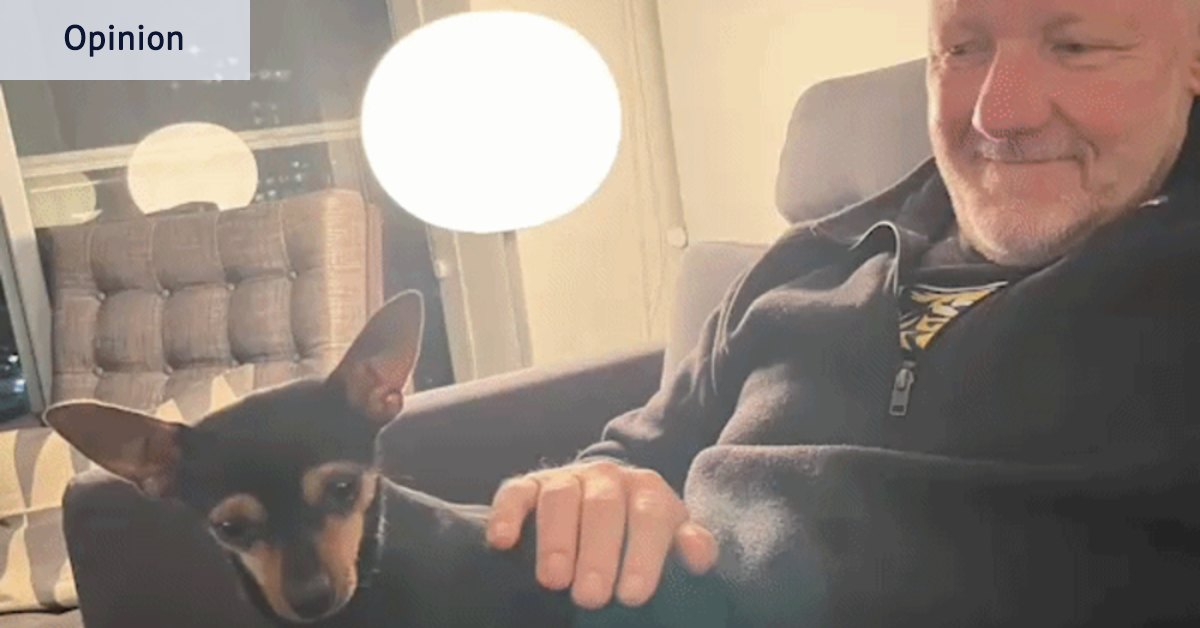
Because we thought he was a chihuahua, we gave him a Spanish name. Ferdie didn’t act like a chihuahua though: no barking, no aggro towards other dogs, a lusty appetite and a rather more handsome longer snout and smaller eyes offset by a weirdly big set of ears. He was also, if possible, smaller than a chihuahua. Some kind of miniature pinscher?
Then during a morning walk, this random woman said, “Is that a Prague ratter?” Excuse me, we don’t think so. Did she just call our dog a rat?
On a city walk, a young drinker in a pub yelled out, “Oi, how’s ya Prague ratter!”
What the actual? An imposter chihuahua? We looked up Prague ratters and they looked like Ferdie. The behavioural tics – the non-barking, the ease around other dogs, the food obsession, the devotion to curling up in your lap – were pure Prague ratter. There aren’t many in Australia and only Ferdie knows how he got here, but he’s telling no tales. Conveniently, Ferdinand can also be a Central European name.
The best thing about toy dogs, what I never realised because I never liked them, is how much pleasure they give strangers. Honestly, it’s like walking around with Timothée Chalamet on a leash. The guy’s a superstar. Kids, adults, old folk, it doesn’t matter: Ferdie puts smiles on faces. You can’t go one block without being stopped by people who want to pat him, talk to him, ask you about him. Passers-by say, “Look, he’s so cute!” and they’re not talking about me. As charismatic as Bruce was, he was a D-list celebrity compared with this bloke. It’s nice to make people happy without doing anything to earn it.
He’s become the most photographed member of the family. Beyond cuteness, why does a dog complete the picture? In a new book about dogs in art, The Dog’s Gaze, historian Thomas Laqueur details how the first family member Odysseus meets, returning to Ithaca in Homer’s Odyssey, is his dog Argos: “Look! – he wagged his tail and both his ears went flat.” Centuries later, the photographer Richard Avedon said his parents always borrowed a dog for family portraits. “They bring their world into ours, which is perhaps how they make us feel less lonely as a species,” Laqueur writes. “They humanise humans.”
Ferdie is gracious about his work to humanise humans. Like a Sam Neill of dogs, he takes it in his stride and is happy to have made others happy. You wouldn’t call him gregarious, and he’s actually hoping they have food for him, but he has none of that small-dog Napoleon syndrome. He gets on with fellow dogs except the odd greyhound who eyes him off like he’s an hors d’oeuvre. Out in the world, he’s a lover, not a fighter.
Different story at home, where he seems to think that I need a bodyguard. In a recent American YouGov survey, 95 per cent of dog owners said their pet gave them unconditional love. Ferdie thinks I’m pretty awesome, like my kids did when they were about nine, but he also thinks I need close protection. He thinks any visitor has come to hurt or steal me. He has bitten my brother, my son, my daughter, my friends, my mother-in-law, the neighbours and the oven man. Visitors/intruders/hostile alien life-forms need to pass this trial before he settles down. Prague ratters don’t take well to types of discipline that work for other dogs: we tried using a water spray to correct his behaviour and he nearly took our arm off. As a last resort, there are muzzles small enough to fit over one of your fingers.
Nobody’s perfect. He hates being left alone but at least he doesn’t take it out on the furniture. He’s more or less house-trained but isn’t above the occasional excitement wee or poo; he just prefers to do his ablutions out on the Walk of Fame.
In that same YouGov survey, 66 per cent of owners thought their dogs’ intelligence was above-average and 27 per cent average, leaving just 7 per cent who thought their dogs were below average. Everyone scores an A. I’ll admit Ferdie is probably among the 7 per cent. What is dog intelligence worth anyway, when you put so many smiles on faces?
Having changed, there was one other change to cope with. Chihuahuas’ life expectancy can be 20-plus years, whereas Prague ratters only live to 12 or so. So we probably won’t have him as long as expected. More reason to make the most of things while they last. By that time, I’ll have become that most risible of human beings, the “toy-dog person”. I might have reckoned with other new realities. If you can change not only your views but your affinities, not only your likes but your loves, not only your preferences but your weaknesses, then you can still change the world beyond your door.
Malcolm Knox is a journalist, author and columnist.
The Opinion newsletter is a weekly wrap of views that will challenge, champion and inform your own. Sign up here
 Malcolm Knox is a journalist, author and columnist for The Sydney Morning Herald.