

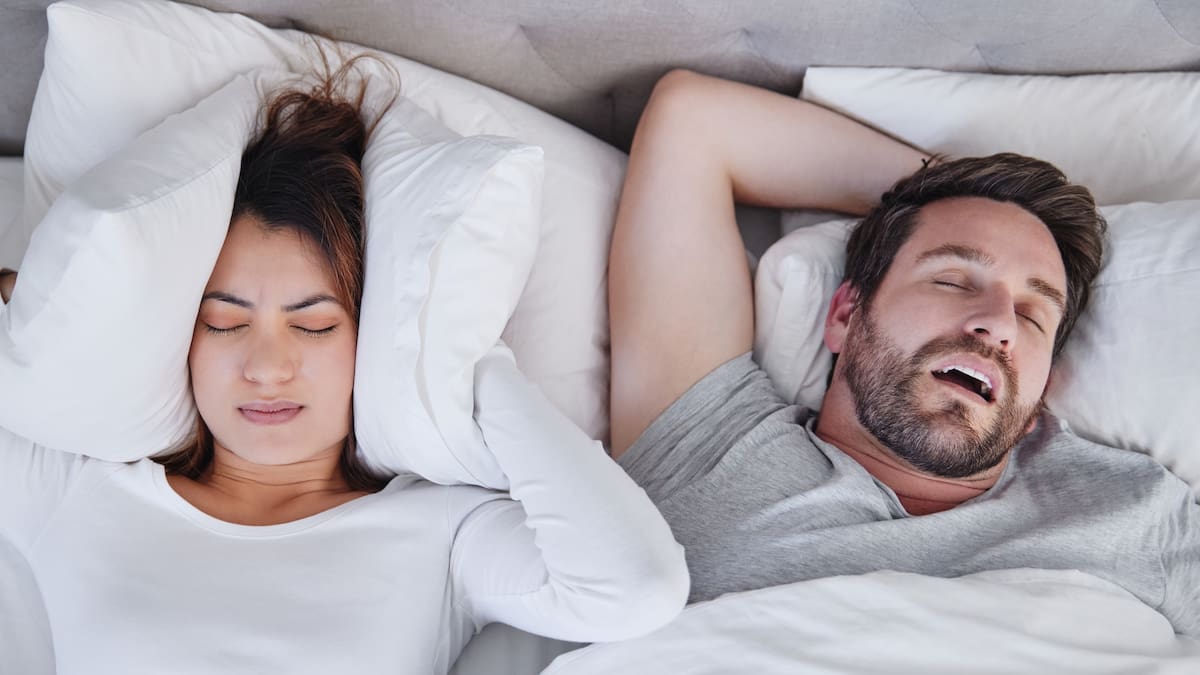
This is especially worrying, because as reported in a 2014 study from the journal Thorax, 80% of sleep apnoea cases go undiagnosed and untreated.
So should you get your snoring checked out? Here’s what you need to know.
What is sleep apnoea?
Put simply, sleep apnoea is a disorder that occurs when your breathing stops and starts while you’re asleep.
There are two types of the condition: obstructive sleep apnoea (OSA) and central sleep apnoea (CSA). “The central type is far rarer, is related to signals from the central nervous system, and is linked to heart failure and brain abnormalities,” says Leschziner. “Most people will suffer from the obstructive type.
“OSA causes partial or complete closure of the airway while you sleep,” he says. “The muscles that support your airway lose their tone and go floppy, and your tongue drops back. This causes changes in your body including a drop in oxygen and an increase in your heart and blood pressure.”
What are the symptoms of sleep apnoea?
Obstructive sleep apnoea sufferers might:
- Have a gasping or choking sensation when they snort themselves awake
- Often start the day with a headache, dry mouth or sore throat
- “They might also have facial and jaw pain,” says Desai.
“Each time the airway is obstructed, we partially wake up, until our breathing returns to normal,” says Leschziner. “We may not always be aware of this. People with sleep apnoea might wake up several times a night, but in the most extreme cases it can happen more than a hundred times an hour. People often need to pass urine in the night as well, and have heart palpitations.”
The biggest risk of all is daytime tiredness, and falling asleep in dangerous situations, says Leschziner. “Sleep apnoea has been blamed for numerous road traffic accidents, including the Selby rail crash.”
Sleep apnoea can also lead to weight gain, though obesity is a main cause of OSA. “It’s a bit of a vicious circle,” says Leschziner.
What raises your risk of developing OSA?
- Being overweight or obese is a well-documented risk factor
- Being male
- Being older
- Having trouble breathing through your nose
- Possessing an unusually small jaw or large tonsils
- Smoking
Smokers are three times as likely to have OSA than those who have never smoked. You’re also more at risk if you take sedatives or tranquillisers, which relax the muscles in your throat, and worsen obstructive sleep apnoea.
“But anyone can get OSA – even slim women, even children,” says Leschziner.
How do doctors diagnose sleep apnoea?
“One of the big problems is recognising that you have OSA in the first place,” says Leschziner. “Symptoms often creep up on people, and so often go unnoticed for many years.”
Patients tend to seek medical advice after repeatedly disrupted nights – or the repeated nagging of their partner. However, in a few cases, sleep apnoea doesn’t have any symptoms, says Leschziner.
“In some cases, we refer people to a sleep clinic, but there’s also the option of a home respiratory study,” says Leschziner. In a nocturnal polysomnography test, the patient is hooked up to equipment that monitors their heart, lung and brain activity, breathing patterns, arm and leg movements, and blood oxygen levels, leading to a diagnosis.
Can sleep apnoea be cured?
Sleep apnoea can be treated in the following ways:
- Avoiding sleeping on your back
- An APAP or CPAP machine
- A mandibular advancement device
- Surgery
Some people find that shifting their sleep position from lying on their back to lying on their side is enough. There are belts and pillows available to buy online which help avoid sleeping on your back.
Others – especially those with a more serious condition – may require more specialist intervention. “The gold standard is a machine called an APAP, a mask which covers the patient’s nose and mouth, attached to a machine, which adds positive pressure to keep the airway open,” says Leschziner. This is a more modern, targeted device than the better-known CPAP machine.
The problem with APAPs and CPAPs is that they are cumbersome and noisy for both the sufferer and their long-suffering bed partner. “Using an APAP feels like breathing into a strong wind. It’s true that some people don’t get on with it, and adherence can be low,” says Leschziner.
For less serious cases of sleep apnoea – or if you are unable to tolerate an APAP or CPAP machine – a mandibular advancement device (or MAD) can be used instead. This is similar to an Invisalign brace or gum-shield, but on the upper and lower teeth.
“A MAD pulls the jaw forward and moves the tongue, opening the airways,” says Desai. “It’s certainly ‘sexier’ than a CPAP, but isn’t suitable for everyone: for example, if you don’t have enough teeth to hold the device in place.”
Surgery is also an option for a few patients. Removing the tonsils and adenoids can help in some cases. There’s also a cutting-edge treatment called hypoglossal nerve stimulation, which involves having a device implanted under the skin in your chest. The device sends electrical impulses to a nerve under your tongue to make your tongue contract and stop it falling backwards. “But this is a very expensive option, and not available in routine practice,” says Leschziner.
Can over-the-counter treatments help?
Nasal strips and decongestants might help reduce snoring. “However, OSA involves the back of the throat as well as the nose, so these are unlikely to help that much,” says Leschziner.
You can also buy mouth guards online, which might help temporarily, says Desai. “However, these are genuinely suboptimal as they haven’t been fitted in a way that is bespoke for you,” she says.
What if my sleep apnoea remains untreated?
An August 2023 study published in JAMA, a peer-reviewed medical journal, suggested that the lower blood oxygen levels caused by disruptions in nocturnal breathing had a significant adverse effect on cardiovascular health.
This adds to a body of existing research linking sleep apnoea with metabolic syndrome, a cluster of heart disease risk factors that include high blood pressure, high LDL (“bad”) cholesterol levels, high blood sugar levels, and a larger-than-normal waist circumference.
“Scientists still need more evidence as to whether there are strong associations between OSA and these conditions, or whether the link is causal,” says Leschziner. “But there is a pretty good certainty that one causes the other.”
Is there anything I can do myself to lower my risk of sleep apnoea?
“Avoid alcohol and nicotine, which can irritate the airways,” says Leschziner. “Losing weight is particularly key.”
People who accumulate fat in the neck, tongue and upper belly are especially vulnerable to getting sleep apnoea. This weight reduces the diameter of the throat and pushes against the lungs, contributing to airway collapse during sleep. Men are particularly prone to this weight distribution, but women “catch up” after menopause.
I think I might have sleep apnoea – what should I do?
Traditionally, the first port of call has been your GP, who can refer you to a sleep clinic as necessary. However, many sleep clinics have long waiting lists. Dental surgeons are now increasingly dealing with sleep apnoea. For a list of an appropriate dentist near you, visit the British Society of Dental Sleep Medicine.
FAQs
Is sleep apnoea considered a disability?
No, sleep apnoea is not considered a disability, but severe cases can cause severe secondary symptoms such as heart disease or depression.
Can you die from sleep apnoea?
Long-term, severe sleep apnoea can cause heart problems such as a heart attack or stroke.
Is sleep apnoea hereditary?
Yes, you can inherit sleep apnoea.


