My son has begun listing the things he will miss. Turning on the lights in the loungeroom, he says, “I’ll miss turning on the lights.” Out the back, kicking a ball, he suddenly notices moss between the tiles. “I’ll miss the moss.”
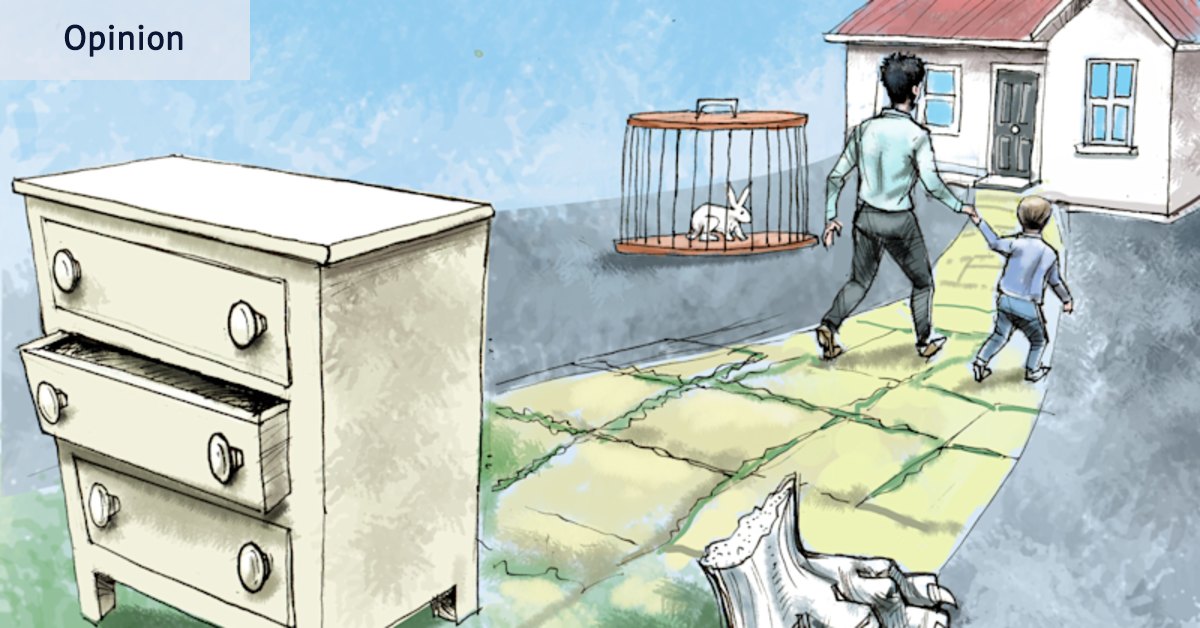
Sometimes this pre-emptive nostalgia gives way to distress and rage. Having mixed up the time at which someone would be arriving to pick up a set of drawers – his set of drawers – I had to inform him, while riding home, of the situation. At home, while he sobbed, I tried to console him with the fact there would be new drawers, better drawers, in our new home. “But these drawers push in! The new ones will only – sob – pull out!”
It is not the first time he has moved – but last time he was just one. Now he is five. To prepare, we watched an episode of Topsy and Tim about moving house. He seemed cheered, reassured. At the end, a grandfatherly old man rushes up to Topsy and Tim – he could not possibly let them leave without a present. He hands them a rabbit. A few days later, I asked my son what he was most looking forward to about moving. “Getting a pet rabbit!”
In her entire childhood, my partner never moved – her parents live in that house still. Not me: I moved 11 times (and many more since then). I wonder sometimes if this is why I have such difficulty recalling episodes from my childhood: that there is no obvious geography in which to locate them.
She has moved since, though always they have been big moves: to another state, another country. That has meant putting most things into storage while keeping with you only what is strictly necessary. This time we are moving only a suburb or two, and while this should be simpler, it feels more complicated. There is no grace period in which to forget how well a thing matched its space – a space to which it had been assigned by time and use. So much potential for things to feel off-kilter.
And yet there is also a type of magic to this, one easy to overlook: your entire life translated to another place! I loved this as a child. Much of it was the opening of boxes, the rediscovery of possessions you’d forgotten or got into the habit of ignoring.
But it was more, too. Then, a new house was not merely a new set of walls and ceilings. Spaces, to a child, are always on the cusp of being magical: there is the sense they contain dimensions just out of sight. Coincidentally, perhaps, I just started re-reading The Enchanted Wood to my son. When I was his age, there was nothing more magical than the magic Faraway Tree. I had forgotten that the book starts with a move: town kids moving to the country. In a few sentences, the move is done: a van comes and for a week the family cleans, gardens, unpacks. I saw, for the first time, the lives of those adults that week, the labour of sorting and scrubbing and making things good. For them, those sentences lasted many days. For the children, perhaps they really did last only a few sentences. And after that: the enchanted wood! A strange place that whispered to them, hiding any number of lands and adventures. Which, if we stay here for a while, may turn out to be true of this house.
The things to which my son attaches his sadness are endearing, but his sadness is real – as is his attachment to them. Moss between tiles holds more meaning for him – more dimensions – than it does for me. Turning on the lights – something he couldn’t do, was not tall enough to do, until recently – means more, as does the idea of his very own drawers. We bought them for him from someone whose father had made them for their first child – and the people who bought them from us were just weeks away from having a baby. The man I carried them down the stairs with looked nervous, excited, determined.
I will miss our neighbourhood, but for my son, I know, if he remembers them later, these streets will have the yellow shine of childhood. And for me, they will always have the shine of his childhood. There is the street where we followed – from one end to the other! – a line of ants. There is the corner where we once – just once – saw a cat. There is the spot where we found a single foot from a lion statue, which we decided was a fossilised dinosaur foot. There is the milk bar where we have bought an uncountable number of lollipops.
To attach my sadness to moving house is a little artificial. The truth is that with children, you are always saying goodbye. I am acutely aware – in part because Instagram influencers make it impossible to forget – that each age I see only once. I will never again meet the baby that my son was, nor the three-year-old. Leaving this house feels, to me, as though I am leaving those ages behind, but the truth is they are already gone.
For my son, too, these streets hold memories – but mostly they are a form of present knowledge. The world is very large, but these few streets are his, contained and controllable in a way few things, as a child, really are. He knows where the driveways are and which houses have dogs.
But I am really writing of myself. The world is still large to me and these are streets I know – in a time of life I know. Right now, I know what it is like to have a child who still notices moss. A child who is proud when he gets taller – and who wants a pet more than anything else he can imagine. A child who still believes that one day, on this street, he found a real-life dinosaur fossil.
I am not yet ready to leave all this behind. And then I realise: in the new house, the light switches are higher. My son can’t reach them yet.
Sean Kelly is an author and a regular columnist. He’s a former adviser to Julia Gillard and Kevin Rudd.
Get a weekly wrap of views that will challenge, champion and inform your own. Sign up for our Opinion newsletter.
 Sean Kelly is author of The Game: A Portrait of Scott Morrison, a regular columnist and a former adviser to Julia Gillard and Kevin Rudd.Connect via X.