“The most important outcome is that there were no safety issues,” Malpas says.
“The primary outcome was that there were no adverse effects.
“After the first human trial, you usually have to go back and redesign large elements.”
At least two rounds of human trials are necessary for US Food and Drug Administration (FDA) approval, which Malpas sees opening the door for approval in multiple other markets, including the UK, Singapore, Australia and NZ.
He’s confident regulatory sign-off will be given around March for a 150-patient trial from around July.
A partner is already lined up with the Texas Children’s Hospital, part of the Texas Medical Centre in Houston – a 5.5sq km campus that bills itself as the world’s largest medical facility.
It employs more than 100,000 people and hosts more than 10 million patients per year.

Two years ago, Kitea appointed Texas Children’s Hospital paediatric neurosurgeon Dr David Bauer to its clinical advisory team.
Malpas says the American has been instrumental in designing the pending US trial.
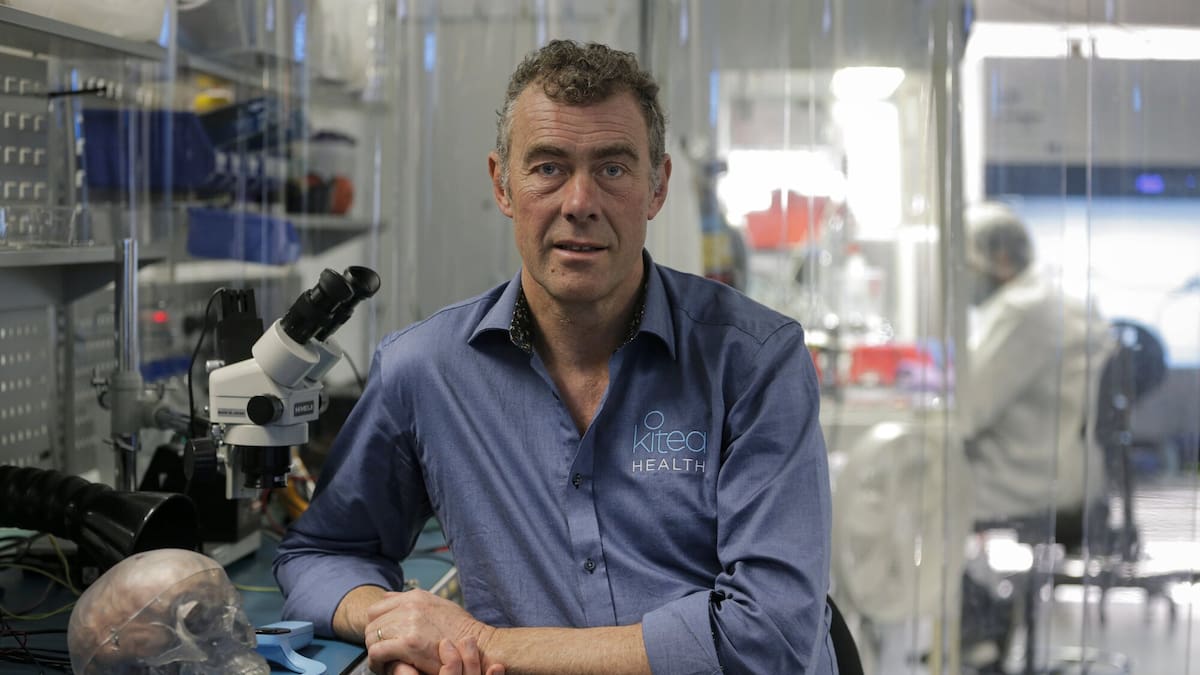
Kitea – one of a string of med-tech startups spun out of Auckland University’s Bioengineering Institute – now has 24 staff (23 in Auckland plus one in the US, working on regulatory affairs).
“That’s a lot of mouths to feed,” jokes Malpas.
Still, he says the $13m round just closed should see Kitea through to the end of the 19-month US trials – or late 2027, all going to plan.
“We started the round over a year ago and encountered some head winds,” Malpas says.
In crowdfunded equity documents posted mid-year, Kitea said it was aiming for a $10m “pre-Series A” raise at a pre-money valuation of $35m.
The ultimately over-subscribed $13m round was led by Auckland’s Icehouse Ventures and pushed to its final close by two Sydney-based venture capital funds, both of which specialise in health tech: Biosure and Karst Peak Rx (aka KP Rx).
Malpas says such specialist funds are one of the missing pieces of the puzzle on the local VC scene.
Earlier backers Cure Kids Ventures and Uniservices (Auckland University’s commercialisation arm) also continued to back Kitea, Malpas says.
The firm has also received $14m in research grants, and staged a $6m seed raise in 2023.
Malpas says the next major capital raise will likely not take place until after the outcome of the US human trials is clear. He sees it involving US VCs who specialise in medtech.
A trade sale is another possibility once approvals are won, he says.
He’s done it before. Malpas founded two spin-outs from Auckland University research: Telemetry Research – also based around wireless implants – sold to US medtech Millar in 2012 after reaching $3m in revenue; and Kaha Sciences, a maker of wireless health sensors for animals bought by the multinational AD Instruments in 2020. Both deals were on undisclosed terms.

Kitea’s world-first chip implant measures fluid pressure on the heart or brain, which could be the result of a genetic condition, heart failure, or trauma such as a car crash or stroke.
Participants in its first human trials suffer a condition called hydrocephalus, which causes a build-up of fluid in ventricles deep within the human brain.
Treatment involves placement of a tube, known as a shunt, into the ventricle of the brain to drain the excess fluid. Kitea’s sensor works with a wireless “wand” to collect data.
Malpas says one of the key benefits is to reduce “false positives” – or false alarms over what can feel to a patient like excess pressure – overwhelming stressed health systems.
There are an estimated one million people living with hydrocephalus in the US, Kitea says. In the UK, one in every 750 children has some form of this brain condition and it is the most common reason for children to have a brain operation.
Chris Keall is an Auckland-based member of the Herald’s business team. He joined the Herald in 2018 and is the technology editor and a senior business writer.