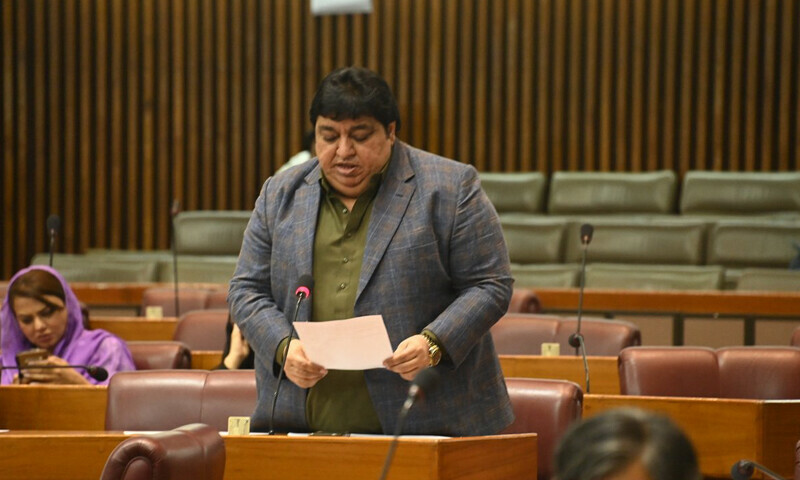
The National Assembly on Friday passed a resolution calling for the reallocation of Mohmand and Diamer-Bhasha dam fund towards helping people affected by last year’s floods.
A fund for the construction of the two dams was launched by former chief justice of Pakistan (CJP) Saqib Nisar in July 2018, and the initiative was later joined by then-prime minister Imran Khan.
The resolution moved today by PML-N MNA Kesoo Mal Kheeal Das Kohistani said Nisar had begun “collecting funds for the development of dams and water reservoirs in violation of the law and going beyond judicial traditions”.
As a result, the “Supreme Court of Pakistan – Diamer Bhasha and Mohmand Dams – Fund” was set up on 10 July 2018, the resolution said, adding that according to a news report, a five member bench of the Supreme Court — headed by CJP Umar Ata Bandial — was informed in January that the fund’s value stood at Rs16.53bn and was expected to rise to Rs16.98bn by the next next quarter of this year.
“This House demands that this amount collected in the dam fund is deposited in the national treasury and these resources be utilised for the relief and rehabilitation of the victims of the catastrophic floods of 2022,” the resolution read.
Pakistan’s disastrous floods of 2022 were the tenth most expensive climate disaster to have buffeted a nation over the last decade, according to risk modelling firm RMS. The floods inflicted an estimated loss of $3bn on the country, caused over 1,700 deaths and displaced eight million people.
During the January hearing cited in MNA Kohistani’s resolution, CJP Bandial had asked Auditor General of Pakistan Muhammad Ajmal Gondal to audit the fund and observed that the funds would not be used for repairing the flood damage but only for the purchase of machinery necessary for dams.
Supreme Court (Review of Judgements and Orders) Bill, 2023
On Monday, the NA also passed the Supreme Court (Review of Judgements and Orders) Bill, 2023, which was moved by PML-N MNA Shaza Fatima Khawaja.
The statement for the objects and reasons of the bill its purpose was to enlarge the top court’s jurisdiction of reviewing its judgements and orders and “strengthen the exercise of this power by the Supreme Court”.
It added that it was necessary to ensure the fundamental right to justice by providing for a “meaningful review” of the apex court’s judgements and orders in exercise of the SC’s original jurisdiction as described in Article 184 of the Constitution.
The bill, a copy of which is available with Dawn.com, said that the scope of review on facts and law in case of apex court judgements and orders while exercising jurisdiction under Article 184, would be the same as an appeal under Article 185.
Furthermore, the bill said a review petition was to be heard by a larger bench than the bench that passed the original order or judgement.
It added that a review petitioner shall have the right to appoint any advocate of the Supreme Court of their choice for the review petition.
The bill also said that the right to file a review petition would be extended to any aggrieved party against whom an order under Article 184(3) was given prior to its commencement, provided that the review plea was filed within 60 days of the bill’s passing.
The bill also set the limitation of filing a review petition within 60 days of the original order’s passing.
Lastly, it said, “The provisions of this Act shall have effect notwithstanding anything contained in any other law, rules or regulations for the time being in force or judgement of any court including the Supreme Court and a high court.”