You have reached your maximum number of saved items.
Remove items from your saved list to add more.
Lately I’ve been seeing hotter, more successful versions of myself everywhere.
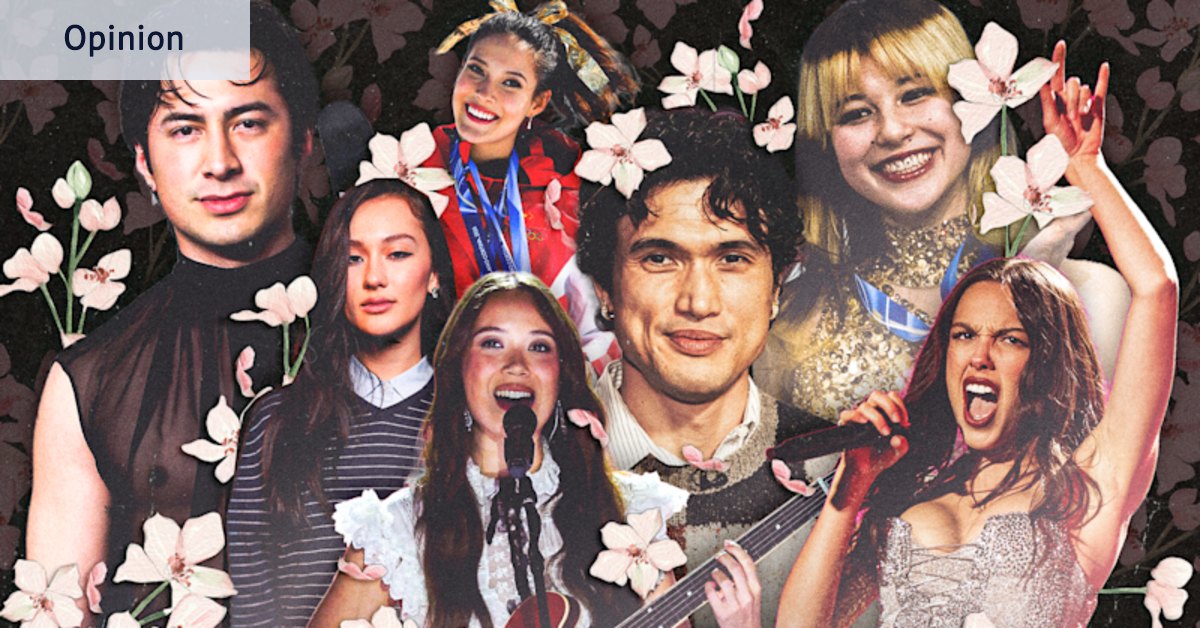
There was Hudson Williams, star of HBO’s queer hockey series Heated Rivalry, and Lola Tung, lead of teen romance The Summer I Turned Pretty. Then there’s Charles Melton in season two of Netflix’s Beef, pop star Olivia Rodrigo and indie darling Mitski. During the Milan Winter Olympics, free skier Eileen Gu and figure skater Alysa Liu dominated my social media feeds.
Yes, “Wasians” (portmanteau slang describing people who are half white, half Asian) are everywhere.
I’ve watched on with joy and fascination as this tide of Wasian pride has crested over popular culture. As a Wasian myself (although back in my day we called ourselves Eurasian, halfies or mixed), I’m genuinely happy to see people like myself celebrated.
But I’m also troubled by the narrative I see unfolding, one that only includes a certain type of biracial person – emphasis on the “W” in Wasian.
This narrative – a celebration of Wasian representation as a boon for diversity – evades the point: whiteness is what makes us more palatable; a Goldilocks-esque vision of not too Asian, not too white, but just right.
My mum, a Vietnamese refugee, met my dad, who has German and British ancestry, in Melbourne. They moved to Sydney shortly before I was born and raised me in a predominantly white inner-city suburb – a conscious decision towards “assimilation”, my mum recently told me.
Whiteness is what makes us more palatable; a Goldilocks-esque vision of not too Asian, not too white, but just right.
It’s common for mixed race people to discuss feeling like we’re caught between two worlds. I’ve certainly felt this – the pang of longing when listening to family members talk in a language I only have a passing familiarity with, and, conversely, of being seen as “other” by white friends.
I attended a weekend Vietnamese school in Marrickville for a time, but remember little besides a few nursery rhymes, the horror of my stern teacher’s detachable bun and being teased by my classmates for not looking like them (my own version of the famous Mean Girls line, “If you’re from Africa, why are you white?” ).
Fellow Wasians, seeing themselves on the big and small screen, have flocked around this shared phenotype and experience of “betweenness” like moths to a flame. In April, Icelandic-Chinese singer Laufey assembled a squad of high-profile Wasians, comprised of Williams, Liu, Tung and Katseye singer Megan Skiendiel, for her Madwoman music video.
“Welcome to the ‘The Republic of Wasia’,” declared NPR last month. Countless think pieces ensued. In the United States over the past few weeks, thousands of Wasians have gathered in major cities like New York and San Francisco.
But I think we’re missing something when conversations about mixed race identity start and end with this idea of exclusion, as I’ve seen some people frame it.
Conversations about diversity tend to point to Wasian actors – from Keanu Reeves to Olivia Munn and beyond – as instances of representation.
According to a Hollywood diversity report from UCLA, 22 per cent of leads in streaming films in 2025 were multiracial, the second-largest share after white actors. Non-mixed Asian leads comprised just 2 per cent.
For most of my life, I’ve been able to move deftly between these two identities, playing up my whiteness or Vietnameseness as the situation requires. My racial ambiguity allows me to access spaces my Asian peers cannot.
Being Wasian is a chameleonic identity that meant in kindergarten I was on the delivering, not receiving, end of schoolyard taunts directed at Asian friends. The next week I’d show up to school in an ao dai, or traditional Vietnamese dress, emblazoned with an Australian flag (sorry Dai Le, I did it first), flaunting my mixed heritage.
Olympic freestyle skier Eileen Gu pulled this off on a much larger scale when she switched from team USA to China, going from immigrant success story and poster child for the American dream, to a symbol of a more globalised, cosmopolitan China.
My legal name, which bears no trace of my Asian heritage (I do have a Vietnamese middle name), also affords me certain privileges. My mixed race friends, who carry the first and last names of their Vietnamese families, have described to me the racism they’ve experienced – whether it’s on a resume or coffee cup.
Yes, I’ve been confused for Asian colleagues, fetishised by men on dating apps for looking “exotic” and been typecast by white peers (shout out to my well-meaning old housemate who loved giving me paintings of pandas and The Beatles standing in rice paddies wearing conical hats).
And sure, these microagressions grate.
But have I experienced the systemic racism my Asian friends have? Was I subject to the wave of xenophobic hate that swept the world during the pandemic? No.
Race, after all, is constructed, and the treatment of biracial people in history is complex.
Australian journalist Jane Hutcheon explored this in a stage show about her mother Beatrice’s experiences growing up mixed race in 1920s Shanghai.
“‘Hybrid’ children weren’t exactly viewed as an exotic blend of east and west. They were, as author Vicky Lee described them, a kind of ‘unwanted by-product of a colonial encounter’,” she wrote in a piece for this masthead.
And I’m only really talking about mixed-race Asian people here. The reality for Indigenous people, and the painful history of the Stolen Generation, shapes their experience of racism in very different ways.
Conversations around mixed race people still, by and large, centre whiteness. The very terms “Wasian” or “Eurasian”, and the mass gatherings they have inspired, ignore people who might be “Blasian” (Black and Asian), or in Australia, Aboriginal-Chinese.
Asian, too, tends to be code for east Asian, not South Asian, while popular culture representations of interracial couples – like Netflix’s To All the Boys I’ve Loved Before – tend to privilege those with one white partner.
It seems to me that Wasians, in 2026, have become a new model minority, or post-racial ideal.
In an essay on Substack, Patrick Kho writes that “Wasians are the new face of eugenics”, arguing figures like Eileen Gu and Alyssa Liu have been “co-opted by an extremist mixed-race eugenics movement”, pointing to conspiracy theories the athletes were designer babies.
Like many Wasians living in the west today, I’m a product of imperialism: my mother escaped Vietnam after the war (the “US” or “Vietnam” war, depending on who you ask); my father’s ancestors were early European settlers. You could argue the platforming of mixed race Asians in 2026 is a continuation of this thread; the gaze of empire turned brightly upon the children it helped create.
It’s not my intention to tear down people like myself. I just hope this cultural moment, rather than turning the Wasian community in on itself, huddled around this buzzword that’s so limited in whom in includes, is not where the conversation stops.
Make the most of your health, relationships, fitness and nutrition with our Live Well newsletter. Get it in your inbox every Monday.
You have reached your maximum number of saved items.
Remove items from your saved list to add more.