
You have reached your maximum number of saved items.
Remove items from your saved list to add more.
Save this article for later
Add articles to your saved list and come back to them anytime.
Carolyn Polley-Peters was 14 years old, sitting an exam in her high school classroom in Mackay, North Queensland, when the thought first occurred to her.
“I was looking out the window and I watched the girls playing basketball, and in my head I said, ‘Gosh, girls are just so much more beautiful than men or boys’,” recalls Polley-Peters, who is now 59 and living in Sydney’s inner west.
“I went, oh, that’s a bit of a strange thought. And then I shelved it.”
After leaving school at 16, Polley-Peters moved from Queensland to Sydney, joined a band, married a man she loved and had a child at 24. “That’s your trajectory as a woman,” she says. “You fall in love, you get pregnant, you have a child and everything else kind of just falls into place, but that didn’t happen for me. There was something very wrong, but I couldn’t figure out what it was.”
It would be another 17 years before Polley-Peters would come out as a lesbian, aged 41.
Women who come out later in life, sometimes referred to as “late in life lesbians” (and accompanying acronym LILLE) have had increasing visibility over the past 20 years.
Today, there are plenty of celebrities who have come out in midlife, including Natalie Bassingthwaite, Cynthia Nixon, Rebel Wilson and Niecy Nash-Betts.
There’s also an entire genre of memoirs dedicated to women who had a “delayed” coming out, including 2025 bestseller All the Way to the River, in which Elizabeth Gilbert recounts her falling in love with her best friend. Glennon Doyle’s 2020 memoir Untamed, in which she writes about leaving her husband for professional soccer player Abby Wambach, also became a rallying cry for women who felt unsatisfied and constrained by their lives.
But these women aren’t a trend. Together, their stories weave a tale about what happens when you finally give yourself permission to be precisely who you were all along.
The fluidity of sexuality
According to the Australian Bureau of Statistics, which released its first published estimates of LGBTI+ populations in 2024, 4.5 per cent of all Australians 16 years and older are LGBTI+.
Studies have shown that women in particular are more likely to change how they identify as they age, and that for women more than men, sexuality is fluid.
Dr Lisa Diamond has been researching women’s sexuality for more than two decades and in 2008, published a study where she followed a group of 79 women for 10 years to track changes in their sexuality. She found that as women age, they have more opportunities to become expansive in their thinking and exploration of sexuality.
“We live in a society in which heteronormative ideas about relationships dominate,” explains Dr Priscilla Dunk-West, a sociologist from Victoria University. “Women who might be in their 40s or 50s or 60s today may have been raised at a time when LGBTQ+ marriage equality didn’t exist and/or homosexuality was deemed illegal. Although it can be tempting to think that much has changed in our society, we still have strong social norms about gender and sexuality, including what we expect from relationships.”
For many women who come out later, it was an absence of queer examples to look to that left them assuming they were straight. Chelsea Heath, 32, grew up in the only biracial family in her small rural town in Victoria.
“It was a bit of a lonely experience,” says Heath, a comedian living in Brunswick who married a man when she was 25.
“In my teen years, I was really heavily involved in the church and I have no doubt that really repressed my sexuality. Being black, being the eldest child in my family, all these factors definitely contributed. I just didn’t have the opportunity to actually sit there and think about my sexuality.”
The complexities of coming out in midlife
Part of the intrigue that surrounds this particular group is the fact that many of them had happy marriages, and by the time they came out, their children (if they had them) were grown. This can create unique complexities for women navigating the transition.
Artist and mental health worker Claerwen Leahy from Brunswick met her husband young when she was 23. “He was very handsome and very charismatic, and I really fell in love with him,” the 54-year-old says. “We had a really great relationship, we’re a very good team, and we had three beautiful kids together.”
They were married for 22 years when Leahy realised the intense female friendships she kept were more than just platonic. “I was not very tuned into my own body. I grew up in a house where sex was sort of, not something that we talked about, it was seen as shameful,” she explains, saying that she and her husband initially decided to open their marriage before she realised she was a lesbian.
Leahy says the experience of coming out and separating from her husband was isolating. After 27 years of supporting her husband and children she felt she was starting over, and telling her ageing parents was challenging.
“It’s a pretty unique experience coming out to your dad who’s in his 90s,” she says.
“I was told that I was selfish that my duty was to my husband and my children. And look, this is someone who’s in shock, and from a very different generation. But they still haven’t really accepted it.”
Her experience led Leahy to start a support group for fellow late in life lesbians. “I just wanted to start what I would have liked to have had when I came out.”
Things went a little differently for Rose O’Brien, who came out when she was 42, after sharing 27 years and three children with her ex-husband. The 60-year-old disability worker stayed living with her family for two-and-a-half years after the relationship ended, and has maintained a close relationship with her ex, even after meeting her wife, Di.
Today, O’Brien still considers her ex-husband “her absolute rock” and says he now shares small traditions and inside jokes with Di.
Second life sex lives
Beyond the logistical hurdles one might encounter coming out in midlife, many women agree that their sex lives were transformed. “I called it doing my bachelors of lesbianism,” says Polley-Peters, who met her now-wife LJ four years after coming out.
“When I fell into a romantic thing with a woman for the first time, it’s like all of those feelings that I hadn’t had for such a long time just flourished. I’d said I felt like I was empty. Well, now I was full.
“I was like a teenager in a 40-year-old woman’s body.”
Leahy describes it as similar to “a dimmer switch that was turning up over my life”. For Heath, she was Dorothy in Oz. “When I was in the hetero world, everything was grey, I felt nothing,” she says. “And since I had my true awakening of realising I was a lesbian, I’ve slowly crawled my way back to where the colour is. And the colours are where the dykes are.”
The importance of visibility
On Saturday, February 28, one of the 170 floats that will proceed down Oxford Street for Sydney Mardi Gras will be led by 57-year-old psychologist Jane O’Keeffe, founder of The Itty Bitty Titty Committee. The group is aimed at increasing lesbian visibility, serving as role models for lesbians who are not yet out, newly out, or who are less confident in their sexuality.
“I just love that we have a mix of women who are varying degrees of feeling out,” she says. “I was speaking to one woman, and she’s got a male partner and child. She’s been in the float for three years now and over the years she’s said, ‘Oh, I think I’m a lesbian’, but she’s just not going to come out at the moment.”
For these women, O’Keeffe says, there’s a sense of validation in being seen by community, even if they don’t feel safe coming out.
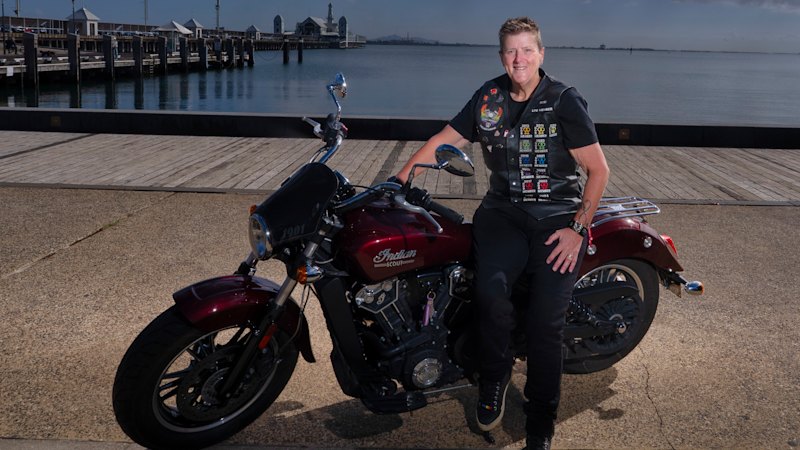
O’Brien has adopted a similarly protective role, becoming an integral member of Dykes on Bikes in Victoria. “We’re known to be the guardians or the protectors of community, and I take that extremely seriously. I love being out there,” she says.
For all these women, coming out was, in a way, a tuning in to their true selves. “I feel so comfortable in the queer community and I finally felt like I was able to be understood by other people and express myself in a way that I’ve never been able to before,” Leahy says.
Heath agrees. “Being a lesbian is the best gift,” she says. “My queerness is my freedom.”
Make the most of your health, relationships, fitness and nutrition with our Live Well newsletter. Get it in your inbox every Monday.
You have reached your maximum number of saved items.
Remove items from your saved list to add more.