- 2025: $285.3m
- 2024: $149.5m
- 2023: $373.7m
- 2022: $499.5m
- 2021: $230.7m
- 2020: $66.1m
For 2025, Tesla NZ’s revenue from automotive sales rose to $135.7m, from $107m in 2024.
Motor Industry Association’s new vehicle registration figures for 2025 had sales of the mainstay Tesla Model Y at 6878, up from 2024’s 6360. Sales of the cheaper Model 3 were 320 from the prior year’s 461.
Revenue from “regulatory credits” increased to $16.5m from the previous year’s $10.1m, while services revenue was near-flat at $13.8m.
But it looked like solar was the star, with “energy generation and storage” revenue surging from $19.2m in 2024 to $119.2m.
Squeaked into the black
The local operation achieved another break-even result (a $284,000 profit from 2024’s $457,000) as a majority of revenue went to related party purchases from various offshore Tesla units, the largest of which were with Tesla Australia ($9.2m) and Tesla’s operation in the low-tax Netherlands ($198.5m).
Tesla New Zealand is a 100%-owned subsidiary of Tesla Netherlands and ultimately owned by Tesla Inc in the United States.
Income tax expense was $385,000, down from $457,000 in 2024.
Contrasting forces
Last year was one of contrasting forces for Tesla.
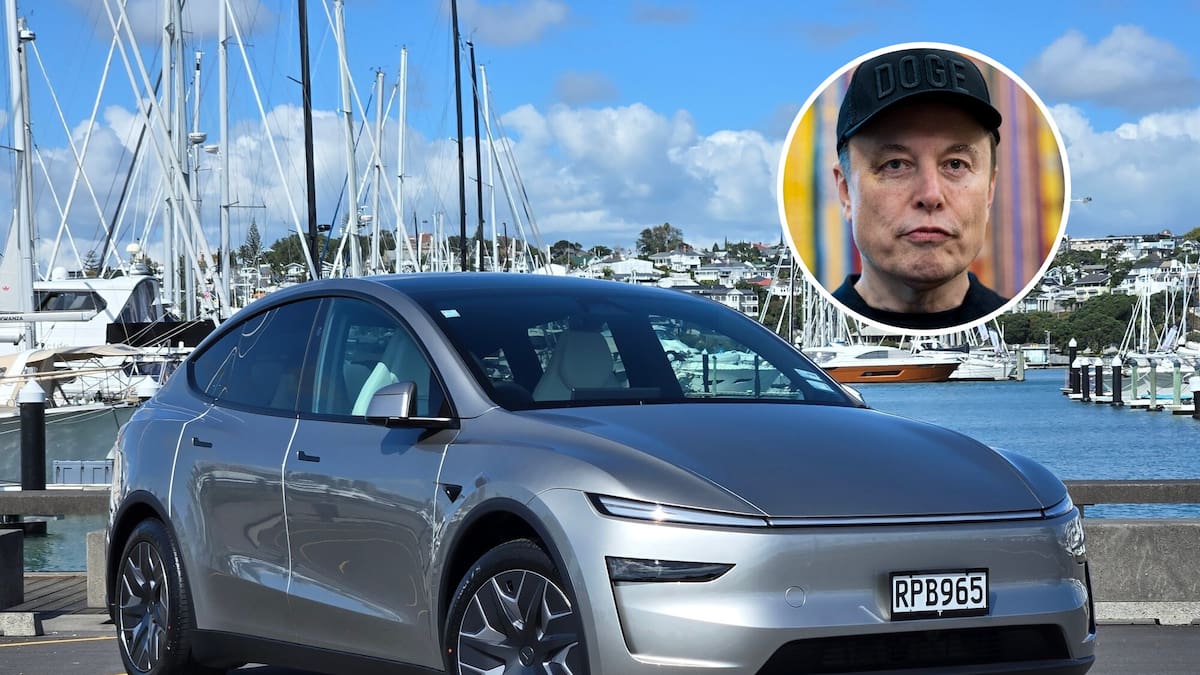
There were challenging political optics as chief executive Elon Musk first headed the Trump administration’s “DOGE” cutback effort, alienating many of Tesla’s traditional liberal/green buyers, then later fell out with the US President, antagonising some of the “MAGA” base.
But there was also pent-up demand for a long-awaited upgrade of Tesla’s best-selling vehicle, the Model Y, which received generally strong reviews (as did this year’s update).
Locally, Tesla got a boost in the second half as its $159 per month Full Self-Drive feature became available in New Zealand for the first time (with a few hairy moments for early adopters as its AI grappled with roundabouts but then received generally rave reviews as it settled in).
Musk’s firm also developed its new 18,000sq m “Tesla North” showroom and service centre at Westgate in Auckland’s northwest, which opened earlier this year.
Singapore, Netherlands focus
After reviewing Tesla’s latest local accounts, tax reform advocate Nick Miller said, “It looks as if some of the cost of the purchases reported by Tesla New Zealand, although initially paid to Tesla Motors Netherlands BV, must find its way to another Netherlands company, TM International BV, a holding company which appears to hold the rights to much of Tesla’s intellectual property.”
Tax Justice Aotearoa member Miller is a former EY senior manager in Britain and senior investigator with Inland Revenue NZ.
“If Tesla NZ is using the Tesla brand to market the vehicles, it’s likely that part of the purchase price of the vehicles [from Tesla Motors Netherlands] contains an ‘embedded royalty’.
“If such a royalty was paid separately, the company would probably have to pay non-resident withholding tax of at least 5%.”
Tesla did not immediately respond to a request for comment.
Miller highlighted a Reuters report earlier this month that said Tesla had paid federal tax for only one of the past 20 years while reporting US$18 billion in profits in Singapore and the Netherlands.
Reuters said its investigation found no indication that Tesla broke any tax laws and that “Tesla would hardly be the first company to shift profits overseas”.
Regularity credits had also played a role in reducing Tesla’s tax exposure in the US.
‘Astonishingly low’ margin
Tesla NZ’s overall operating margin for 2025 was 1.7%, Miller said, “which is tiny – well below most other motor vehicle distributors in NZ, with the exception of Ford, and well below the 3% which Inland Revenue indicates in its International Compliance Focus would be likely to trigger a review for a distributor”. (Tesla NZ is not a distributor.)
“Tesla sells directly to customers, not through dealers, so you would expect a retail margin on top,” Miller said.
“For example, Toyota NZ uses this direct sales model and has an operating margin of 6-7%.
“Tesla’s return is also astonishingly low for a company with exclusive rights to import and sell a premium product.”
The global picture
Tesla reported better-than-expected total revenue of US$22.4b for the first quarter of 2026 as the Iran conflict boosted demand for EVs.
But sales were still below the fourth quarter (US$24.9b) and third quarter (US$25.2b) of 2025.
Beyond the roller coaster of Musk’s political fortunes, the firm has faced challenges from the rise of China’s BYD and Geely (now the world’s No 1 and No 2 EV sellers by some measures), the economic slowdown and tariffs, among other factors.
Shares closed today at US$398.73, below Tesla’s peak 2021 value of US$407.36.
Tesla recently announced plans to discontinue its cheapest vehicle, the Model 3, and its high-end, gull-wing Model X. The move would free up factories for Tesla’s push into robo-taxis and humanoid robots, Musk said.
Chris Keall is an Auckland-based member of the Herald’s business team. He joined the Herald in 2018 and is the technology editor and a senior business writer.