

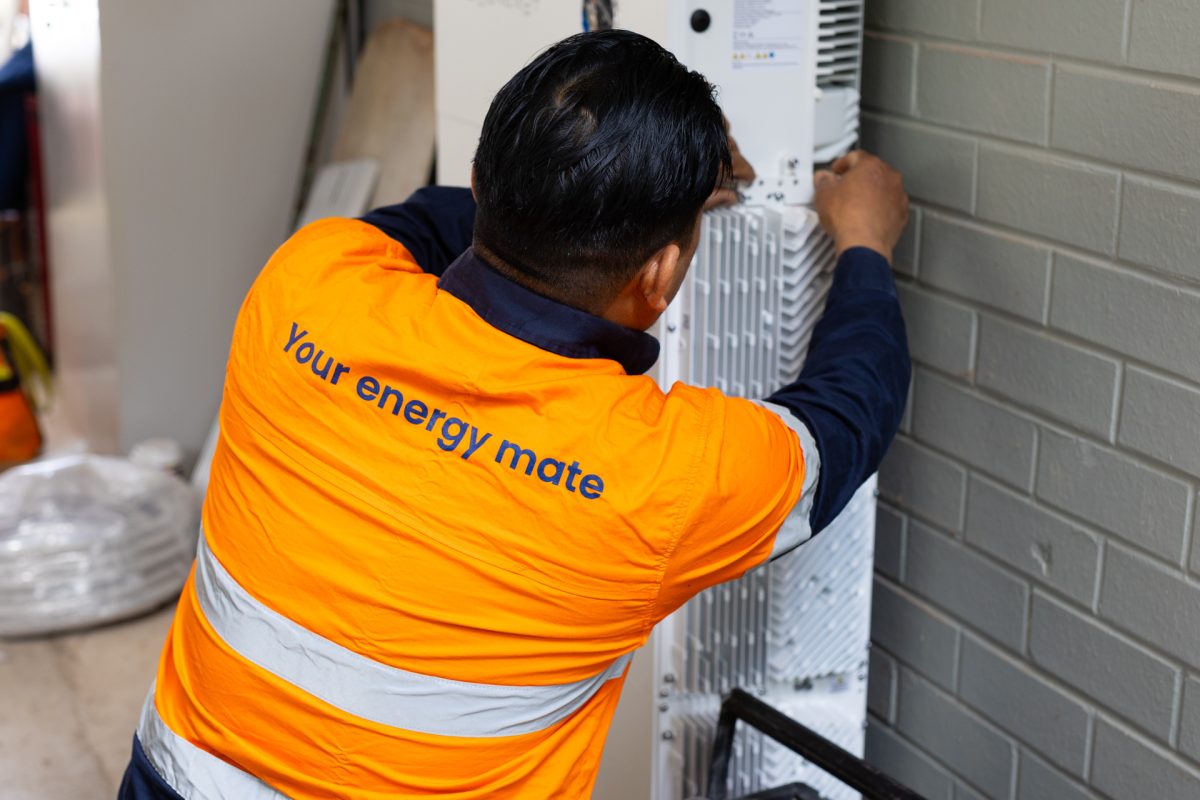
Are you paying a penalty for going green? Photo: Thomas Lucraft.
Generating your own power used to be a clear win-win for Canberra households: slash your bills while helping power Australia’s green transition. Today, that clean energy dream is caught in a tug-of-war.
As rooftop solar and battery storage eat into traditional power demand, experts say energy retailers are shifting their profit strategy to protect their bottom line — and leaving self-sufficient homeowners with serious bill shock.
“Retailers and homeowners are increasingly at opposite ends of a gridlock,” Huglo Solar co-director Lee Hindley says.
“While homeowners install their own power supplies to help the planet and reduce their bills, retailers do everything they can to keep their business profitable.”
Retailers generate revenue from two main services — variable usage fees and fixed daily supply charges. Lee says one common mode for energy providers to make up lost revenue from usage fees is to jack up fixed daily supply charges.
“If a homeowner has paid a baseline supply fee for a decade, seeing it spike just because they reduced their grid consumption feels like a punishment for doing the right thing,” he says.
He points to a recent customer whose peak and shoulder rates were quietly dropped by a few cents per kilowatt-hour — a move that looked like a discount on paper.
“At the same time, the retailer nearly doubled its daily supply charge from $1.50 to $2.90,” he says. “Over a 90-day billing cycle, that single tweak tacked an extra $126 onto his fixed costs. For a home relying minimally on the grid, lower consumption rates provided zero relief, leaving them paying significantly more overall.”
Unless a household exports massive volumes of energy, higher fixed daily fees cannot be easily offset by solar feed-in tariffs. This “damned if you solar, damned if you don’t” dynamic has left many questioning whether renewables are still worth the outlay.
Experts stress that self-generation remains the single best defence against skyrocketing power bills.
“Even as retailers shift their fee structures, driving down your usage remains the primary way to protect your wallet,” Lee says. “If a typical household is paying $150 a quarter in daily supply fees and $500 for actual energy usage, solar and battery systems directly target that massive $500 chunk. Shaving off the vast majority of your power consumption is still a huge financial win.”
However, as retailers quietly pivot toward guaranteed income through higher daily supply charges, choosing the wrong plan can quietly erode those hard-won savings.
Consumers can’t overhaul the broader grid structure, but they do retain one powerful tool in the power struggle: shopping their specific consumption profile.
“If you haven’t reviewed your plan in the last six months, there’s a good chance you’re overpaying,” Lee says. “Defaulting to the status quo carries a heavy penalty. Promotional discounts expire quickly, quietly dropping consumers back onto uncompetitive standard rates.”
Matching a plan to your specific setup can yield dramatic savings. For instance, EV owners without solar should look for specialised tariffs that offer free or ultra-cheap power during midday windows to soak up excess grid solar, provided the baseline daily supply charge remains low.
Conversely, households with solar and battery storage should prioritise plans with the lowest possible daily supply charge, even if the per-kWh consumption rate is slightly higher, since their grid reliance is minimal.
Decoding complex time-of-use structures — balancing peak, shoulder and off-peak rates against home generation — can feel like an administrative nightmare.
Independent comparison services such as Huglo’s free Compare Electricity Plans function allow homeowners to compare market options directly. But for those looking to avoid the life admin of a full provider migration, Lee says a simple phone call can spark immediate savings.
“Energy retailers are legally required to inform customers if a cheaper plan exists on their system,” he points out. “Calling your provider and asking point-blank, ‘What is the best rate available for my property?’ is the fastest way to squeeze out savings without switching.”
Re-evaluating your electricity plan every six to 12 months ensures your tariff structure keeps pace with your actual habits, potentially saving high-use households hundreds or even thousands of dollars a year.
For more information, visit Huglo Solar.


