One day, another old fellow was sitting on the bench out the front of the caravan park’s shop, gazing out to sea.
Loading
The following week, another of the park’s elderly residents was there, too.
Nods turned into pleasantries and the exchange of names and soon, my father took to sharing the bench. Without thinking about it, the old boys formed a morning chat group.
One of them, it turned out, had been born in Germany. Let’s call him Werner.
Werner was reserved to the point of commenting on not much more than the weather.
It took months before he began drip-feeding his life story. He had, my father learned, been a mere boy in Germany during World War II.
The other members of the chat group, understanding the gravity of this revelation, weren’t about to press him on details.
My father, born a year after World War I, had lived through World War II. He knew a bit about what war could do to a person.
Blokes around the district had come home not right in the body or the head, and it wasn’t from weakness.
To be a boy in Germany during that madness … well, if Werner didn’t want to talk about it, that had to be respected.
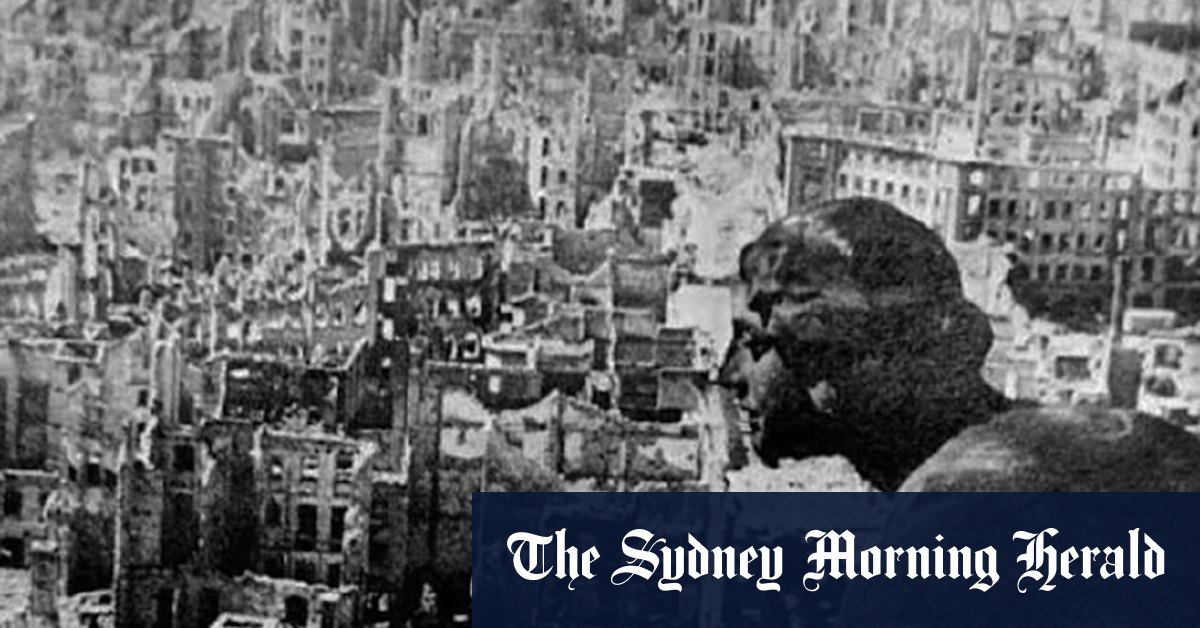
Dresden in ruins after the firebombing of February 1945.Credit: AP
Nevertheless, as the weeks went by and the old fellows took their ease on the bench each morning, Werner loosened up.
He’d spent his childhood in the city of Dresden, he divulged.
Anyone of my father’s generation knew what Dresden meant.
Over just three days in 1945, from February 13 to 15, 772 bombers of the British Royal Air Force and 527 of the United States Army Air Forces dropped thousands of tonnes of high explosives and 200,000 incendiary devices on the city.
The plan was for the bombs to destroy water mains and blow the roofs, windows and doors off buildings, exposing the interiors to create a fierce airflow to feed fires caused by the incendiaries.

Dresden in the aftermath of the Allies’ World War II bombing campaign.
The few survivors remembered forever the sight of men, women and children picked up bodily by tornado-force winds and sucked into the flames, there to be incinerated alive.
Thousands of residents sought sanctuary in cellars, only to be asphyxiated, their oxygen consumed by the conflagration.
And for what?
World War II was almost over in Europe. Germany, already in ruins, surrendered three months later, on May 8, 1945.
Only Dresden’s city centre, its population swollen by refugees, was bombed, rather than its industrial factories in the suburbs and outskirts. The bombing was designed to destroy morale.

The rubble of the Frauenkirche (Church of our Lady) in Dresden in 1967.Credit: AP
Historians still debate whether it was a war crime. There is no argument that it was an atrocity that killed at least 25,000 people, and some say more than 100,000, which would put it up there with Hiroshima.
Werner was orphaned.
He told the chat group he’d survived by scavenging for food and living like a small animal in a hole in the ruins.
He once explained what hunger and fear really was, and how when the Russians finally came, women who had survived the bombings were pack-raped.

Crowds gather to celebrate the dedication of Dresden’s rebuilt Frauenkirche in October 2005.Credit: AP
Years later, soon after the Berlin Wall came down, I visited Dresden. The ruins of the city’s cathedral still lay as rubble.
It has since been restored to its original magnificence thanks to donations from around the world, proving that rebirth requires assistance.
I went to Berlin, too, which had been left by the war a burnt-out shell and mountains of broken bricks and dust.
West Berlin was rebuilt with billions of dollars from the United States’ Marshall Plan, and once the wall came down in 1989, East Berlin was ready for a new life, too. The city is now one of the more compelling in the world.
Elsewhere, Hiroshima and Nagasaki, also rebuilt with US dollars, have grown into important industrial and cultural cities from the destruction left by atom bombs. London and Coventry, smashed in the Blitz, survived and now thrive.

People offer prayers at the Peace Memorial Park in Hiroshima.Credit: AP
The American author Kurt Vonnegut was a prisoner of war in Dresden during the bombing raids.
It took him another 24 years to bring himself to publish the novel called Slaughterhouse Five in which he assumed a droll, knowing voice to approach the hideous experience.
The novel closes with the war ended and the prisoners liberated.
“And somewhere in there it was springtime,” Vonnegut wrote, and in the last words of the book, a bird sings.
“Everything is supposed to be very quiet after a massacre, and it always is, except for the birds,” Vonnegut wrote.
There is nothing intelligent to say, he asserts – the bird’s chirp is as meaningless as anything else to be said after a massacre.
This week, around 80 years on from the Dresden atrocity, that still sounds about right.
Perhaps my dad and his seaside friend Werner, who both valued a chat and went on with life when there was nothing else for it, might have understood.