You have reached your maximum number of saved items.
Remove items from your saved list to add more.
Save this article for later
Add articles to your saved list and come back to them anytime.
There was once a time when the French pharmacy was an essential pitstop during a trip to Paris. Cult products like Nuxe’s Huile Prodigeuese and Bioderma’s micellar water, endlessly recommended by beauty editors, could only be purchased overseas.
But in the past few decades this has all changed, and last week, French skincare brand Vichy Laboratories joined the ranks of pharmacie brands available in Australia, with 41-year-old actor and model Jodi Gordon as ambassador.
Owned by beauty conglomerate L’Oréal, Vichy was founded in 1931, but it’s taken more than 90 years for the brand to reach our shores. With brands like La Roche-Posay (also owned by L’Oréal) Avène and Bioderma readily available, why wait this long?
Rachel McAdam, head of medical relations at L’Oréal Dermatological Beauty ANZ says while other brands on the market have focused on targeting skin concerns, like acne or rosacea, Vichy’s focus is on the exposome, a term given to the environmental exposures one encounters throughout life.
The focus of their collagen (a protein responsible for skin’s firmness and elasticity, which declines with age) range, being sold at Chemist Warehouse, is menopause.
The business of menopause
In 2026, menopause is big business. The industry, valued at US$17.66 billion in 2024, spans everything from vitamins to pyjamas, sex toys to underwear.
The beauty category is no exception, including celebrity-owned brands like Naomi Watts’ Stripes and Gwyneth Paltrow’s Goop.
The moment, then, seemed ripe to enter Australia.
“We know that these women are well-informed, they’re time poor, they are dealing with families and careers and then suddenly their skin is taking a hit. And their sense of self will change, and their self-confidence could be impacted,” says McAdam.
How menopause changes your skin
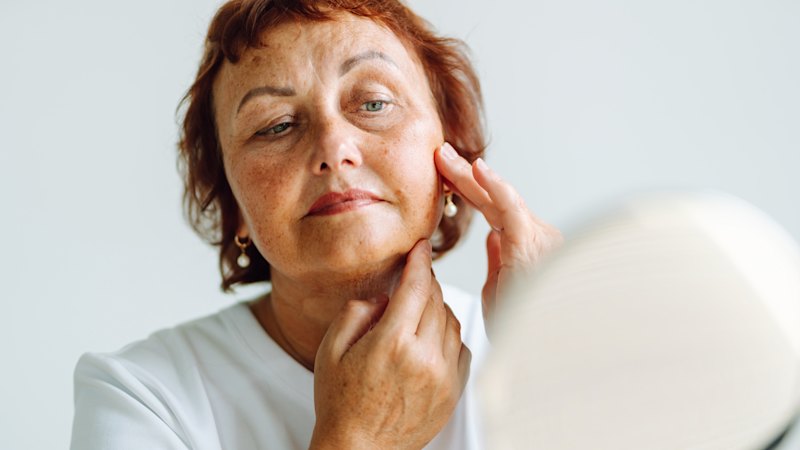
Perimenopause starts in the mid-40s but can start earlier, and menopause typically occurs between the ages of 45 and 55. Dr Ginni Mansberg, a GP and women’s health expert, says the decline in estrogen during this time affects the skin barrier, leads to a decline in collagen and can mean skin becomes more sensitive.
And according to Dr Leona Yip, a dermatologist affiliated with Vichy, biological ageing, as well as cumulative exposure to environmental factors like UV rays, pollution and cigarette smoke, can also mean skin appears duller and less firm. Changes to the skin barrier means conditions like rosacea and hormonal acne can worsen.
Given the age at which this transition occurs, the focus on the hormonal change also taps into a broader demographic.
Generation X (aged 45 to 60 today) – often dubbed the “forgotten generation” – have historically been a blind spot for brands, including in the beauty industry where “anti-ageing” products were marketed by smooth-skinned 20-somethings.
But despite representing a relatively small proportion of the population, their spending is set to skyrocket. A 2025 report from market research firm NielsenIQ estimated Generation X’s spending to surpass $US20 trillion (around $28 trillion) by 2033.
Dr Marian Makkar, an associate professor of marketing at the Royal Melbourne Institute of Technology, says brands are starting to pay attention.
“There is a growing demand for more visibility, dignity and authenticity. Ageing is OK.”
Makkar says the beauty industry previously used language like “fight wrinkles”, “reverse ageing” and “repair”, as if women were damaged goods.
Today, she says successful brands focus on “strength-based framing … because it [menopause] is not a condition, it’s a life stage,” and use diverse age representation in marketing.
McAdam agrees that “it’s not about not ageing. We embrace that, but it’s about having the best, healthiest skin you can have at every age”.
While Vichy’s marketing imagery may appear more youthful despite a focus on midlife, McAdam says the “brand is very conscious of representing women across different life stages”.
What to consider when buying skincare
Mansberg says women do not need to overhaul their skincare routines during this period with dedicated menopause products and encourages them to keep it simple.
Vichy’s collagen range includes peptides – one of the wellness industry’s favourite buzzwords – to stimulate collagen production.
But Mansberg says independent research on peptides’ impact on collagen production remains limited, as most studies have been commissioned by beauty companies.
Focusing on the basics, like wearing sunscreen and using evidence-backed ingredients that stimulate collagen production, like vitamin C and retinoids, can help.
Given increased skin sensitivity, Yip says some may need to eliminate or reduce retinoid use, and focus on gentler ingredients like hyaluronic acid and niacinamide. She adds that while using estrogen cream (a product intended to treat vaginal dryness) on the face is a trend right now, there’s not enough evidence to safely recommend it.
For women struggling with the transition, Mansberg encourages seeking the advice of a GP, dermatologist or healthcare professional, who may advise medication like hormone replacement therapy.
The writer travelled to Melbourne as a guest of L’Oréal
Make the most of your health, relationships, fitness and nutrition with our Live Well newsletter. Get it in your inbox every Monday.
You have reached your maximum number of saved items.
Remove items from your saved list to add more.