I don’t much like cats.
I have told myself this for more years than I’d care to count.
Always been happier around dogs. Dogs are loyal, full of character and, if trained properly, are particularly useful around sheep and cattle, if you happen to have a farm.
But cats. They’re loyal only as long as you keep feeding them, and they’re a menace to birds and small native creatures. They’re useful, I was long convinced, only if there’s a mouse problem.
But then came Sparkles, the homeless ragdoll.
She wandered our street with such haughty elegance, it was quite a while before we realised she was an actual street cat.
She was fond of sprawling on the bonnets of parked cars, choosing vehicles that had been driven recently. It meant the bonnet was nice and warm.
She’d close her eyes and give every impression of taking a lazy, contented snooze. From such a handy throne, she opened an eye as you walked past, apparently decided you were beneath her regal interest and resumed dozing.
She never came to the door yowling and begging to be fed.
Someone, we figured, must be feeding her, and therefore, she must have a home.
But then we discovered she crept under our house each night, and sought shelter there when it rained.
Inquiries around the neighbourhood revealed a complicated story of her owner moving overseas and a kind friend accepting responsibility for her.
Thus, she never went hungry. But the street she had long patrolled had become her chosen residence and the space beneath our house, close to the place she once called home, became her shelter.
My granddaughter, aged six, wasn’t having it.
“We’re adopting her,” she stated.
“We can’t have a cat,” I said. “We’ve already got a little dog. Besides, I’m allergic to cats.”
“No, we’re adopting her,” replied my daughter’s child.
“I am calling her Sparkles.”
If anyone has advice concerning what a grandfather should do in a case like this, they are too late.
Discussions took place with the cat’s guardian. He proved relieved.
My grandchild found Sparkles mid-snooze on a recently parked Range Rover (she has particular taste, this cat), and gathered her in her arms.
Sparkles is of the cat family known as ragdolls, and it became clear why the breed is lumbered with this less-than-regal title.
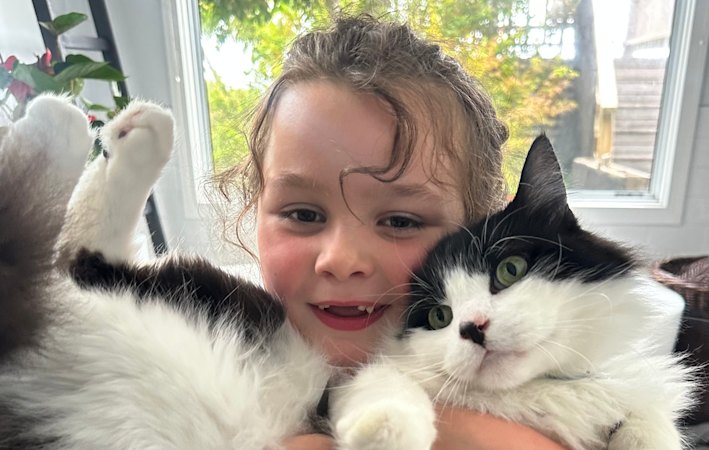
She flopped in Charlie’s arms, offering no complaint or resistance. She was too big for a little girl to properly cradle, and half her body spilled out of Charlie’s grasp, sprawling earthward as if there were no backbone to support her.
I was alarmed. Until I caught sight of the expression on Sparkles’ face.
It was bliss.
The ragdoll was being a ragdoll. Just as things should be, clearly.
A bowl of food was arranged. A folded blanket became a cat’s bed.
Cat and grandchild put their heads together and began communing at some pitch deeper than I could hope to grasp. It was as if Sparkles had always been part of the family.
Our little dog, Koko, took umbrage at the invasion of her territory. Sparkles, her bed having been moved to a tabletop, loftily ignored her. A truce of sorts ensued.
I drew a deep breath and reviewed my negative view of cats.
Sparkles made it easy. She sprang to the couch, slinked to my shoulder and peered closely. Her aquamarine gaze was as deep as the ocean.
Some nights later, she jumped on my bed and fell asleep.
The following morning, a grandchild took one look, demanded to know whether I had been sneezing, and ran through the house triumphantly hollering that her grandfather had been making things up. He wasn’t allergic to cats.
I was, in short, defeated. Not a leg left to stand on.
These days, Sparkles regularly travels with us far from the street she once stalked alone all the way to our house by the coast.
She is not allowed outside. Blue wrens hop around the garden and little marsupials rustle in the coastal scrub. I have no idea whether Sparkles the ragdoll would bother inflicting harm, but the fact remains: she is a cat.
She seems, anyway, placidly unconcerned at her confinement.
She sits by a window, watching the clouds and seagulls wheeling above the restless sea.
I spend no time wondering what goes through her head. I am not in favour of anthropomorphising one’s pets.
The idea of ascribing human feelings, thoughts and personalities to animals is absurd, whatever the age of TikTok and Instagram might pretend.
It is offensive to animals, for a start. Which among them would wish to bear the pain and disappointment that is the inevitable result of what humans hold out as their unique gift of free will?
Still, observing Sparkles can be instructive and soothing.
She is unmoved by the turbulence of the world beyond her window or by anything more disconcerting than if her food were to be served late.
She does not know or care of the world’s raging, lopsided wars.
She has no need to try to ignore the suffering of multitudes of the innocent.
She is unaware of a president of what was once known as the greatest nation on Earth upending the world’s order while ranting at increasing levels of madness.
The man could do with a dog or a cat, but no pet, it is reported, strides the halls of his gaudy White House, and perhaps it is for the best. Would even a blameless pet be safe at the world’s ground zero of unfocused fury?
Sparkles, the ragdoll rescued from the streets, has proved to be a worthy addition to our household beyond even her role as the love of my granddaughter’s life.
She is a calming eye within whatever storm comes by.
And she has forced me to know the futility of declaring I don’t much like cats, or anything, really, that I haven’t bothered first to try to understand, or to judge its worth.
In need of some good news? Sign up for our Greater Good newsletter for stories to brighten your outlook, delivered every Wednesday.
 Tony Wright is an associate editor and special writer for The Age and The Sydney Morning Herald.Connect via email.