

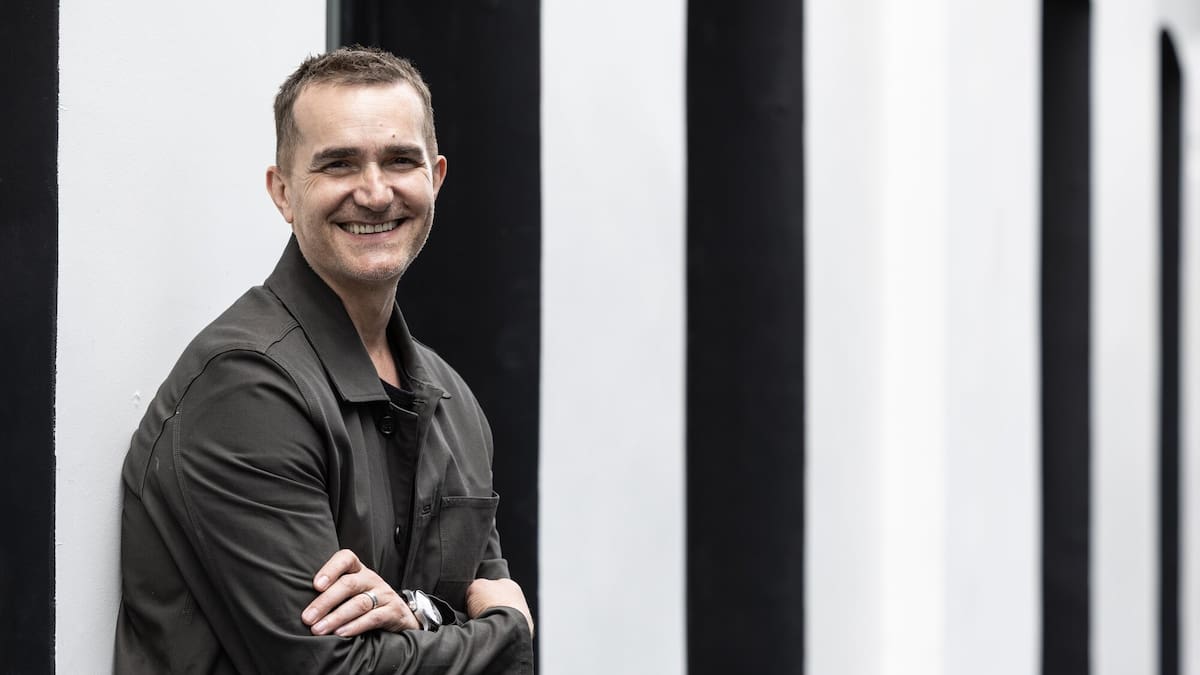
Remarkable is one word for MAFS’ impact. Others, like tacky, pathetic et al (feedback from Herald readers, by the way), are big flashing neon signs indicating just how polarising the relationship reality show everyone loves to hate (or hates to love) really is.
“What [those comments] say to me, is that we’re doing something right and that this show is extremely powerful. It is getting people talking about relationships and dating, which I love. And when that all stops, then you’ll probably see that the show will stop.”
You heard the man. Don’t like it? Don’t talk about it. Except, with New Zealanders watching almost 1.9 million hours of the show in its first three weeks of release this year, that would probably make us all very sad indeed.
Born in Sydney, and moving to New Zealand when he was 12, once upon a time, life looked very different for Aiken.
An opening batter for Auckland and Wellington cricket teams, he also played in the New Zealand Under-19s alongside Adam Parore and Chrisses Cairns and Harris. But while he was an athlete, he was also safeguarding, studying for a master’s degree in clinical and community psychology. Cricket didn’t last, but he has spent 30 years as a relationship counsellor.
Today, Aiken is MAFS Australia’s only original expert left on the couch, alongside Alessandra Rampolla and Mel Schilling. He was there in 2015, when four couples were matched, married and followed by cameras for six episodes before deciding if they would stay together. Last season – the show’s 12th – there were 13 couples and 40 episodes.
“I just sat back and hung on and watched what happened – and it just exploded.”
That explosion seems like old news. Can you remember a time we weren’t gossiping about it in work kitchens or group chats? And yet, Aiken’s one job for today, when he finishes his long black, is to hire an agent. Someone to help plan his life for him. Someone to help turn John Aiken into a business.
Eleven years after he grabbed hold for dear life and braced for impact. Twelve seasons of international infamy, headlines and fandom. It is season 13 that has forced his hand – he’s a bona fide TV star now.
“Well, you get to a point with the show where it becomes so big … You need people to manage things for you.”
When MAFS started, Aiken was “green” and the show was one-of-one, a lonely relationship reality TV series floating in a sea of singing, cooking and building competitions. Now, it’s leading an increasingly crowded pack. Aiken doesn’t watch many of the others. Formats like Love is Blind don’t interest him. And Love Island? At 55, he thinks he’s too old for that.
“I love relationships. I love the dynamics and intricacies of them. But when I try to watch, say, Love Island, I see abs and I see bikinis … and very little talking.”
On MAFS, there’s a lot of talking, quite a bit of shouting and maybe not so much listening. The talking part has been the biggest change to how Aiken does his job over the years.
Once he mediated, was reflective. Today, he’s “direct and hard-hitting”, economical with his words – like a dad who’s not angry, just disappointed you spent an entire dinner party bullying another woman about her bad shoes and hair extensions rather than sorting out the borderline toxic TV marriage you’ve signed up for. He suggests viewers love his approach.
“It’s like, ‘well, we need people to be held accountable here and you’re going to do that’. And so I think my role … has really been leaning into this no-nonsense, straight-shooting expert on the couch who’s going to deal with bad behaviour and call it out.”
So, each week the couples sit in front of him and if he spots something he doesn’t like, he pounces. The bride responsible for the shoe comments was told her behaviour was “ugly. It was mean.” When it connects, Aiken can see it in their face – shocked that no one’s ever spoken to them like that before.
“When it doesn’t land, and a lot of the time it doesn’t, they get defensive. They come back at me. They’re combative. They are blaming everyone. They avoid accountability. They may roll their eyes at me.”
Sounds fun. And for Aiken, it is. The brides and grooms are human Rubik’s cubes, problems to solve – or at least people to give the cheat codes to so they can try and sort themselves out.

The defensiveness is turning up more and more often though, and he can see more point-scoring between the experiment’s participants – and between them and the experts – than ever before.
Aiken thinks a lot about why this has changed. His unofficial diagnosis: an increasing lack of self-awareness, the way people are brought up, friendships and social media are making us all less empathetic and more self-centred. Just search TikTok for Main Character Energy if you need proof.
“It’s Planet Me: I’m right and everyone else is wrong … Often they’re surrounded by people that enable them. Just say yes. Put them on a pedestal,” Aiken says of the MAFS participants.
“You’re dealing with personality styles and patterns that are quite hard to shift. And not only are they hard to shift, but when you challenge them, they come at you hard.
“I’ve got to be on my toes every time I sit in front of a couple because they’re coming for the experts. [In other reality shows] they’re deferred to, you know? They are the experts. On our show, that’s not the case. [The cast] are like, ‘we are great at relationships. You’re doing this wrong, John’.”
Does he think people only come on the show for fame, like the critics suggest? Or is there at least a sliver of something more hopeful and heartfelt motivating them to lay it all out there for strangers at home to watch and judge?
“I assume everyone that I’m sitting in front of likes the spotlight and has thought about life after the show … you wouldn’t come on the show if you didn’t want some spotlight,” he says matter-of-factly.
“But what I’m also looking for, and needing [when we match them], is that they want to find love. That they are wanting to give themselves over to the experts in the process.”
Aiken knows people say the process is staged, scripted, heavily produced. He’s insistent though: the reason the show is called an experiment is because even the experts don’t know what’s going to happen.
“We do put [the couples] together, but then we sit back like everybody else and go, what are they going to be like?
“And that is the secret to the whole success, every year you’re tuning in and you go, who are these strangers and will they get the fairy tale?”
Watch: John Aitken on what it takes to make a relationship work
There’s another reason so many of us choose to plonk ourselves on our couches to watch/endure hours and hours of bad behaviour, too. Aiken thinks we want to learn.
“You do not set out with that in mind, ‘Let’s make an educational show about relationships’,” Aiken says. “But it’s certainly become a show where you learn what not to do.”
He’s not wrong. Whether it’s gaslighting, different communication styles, trad wives, men with “warrior mindsets” or, this season, something the experts have termed “boss babes” (women not putting up with anyone’s s***, for better or worse – usually worse in this case), if you’re dating and watching the show, you quickly realise the types of unwanted behaviour to avoid like a bout of gastro. And if you’re in a relationship, you’ll be renewing your vows, promising each other to never be like… that.
Aiken has been married to former journalist Kelly Swanson-Roe for nearly 19 years. For them, the relationship ground rules were laid out clearly and early.
“When we got married, she said, ‘I want a husband, not a therapist … don’t bring that psychobabble home with you’,” he says of his “very direct” Waikato-raised wife.
“So, I’m not some expert explaining to her what she needs to do better. We are in this together as equals. I make mistakes – and plenty of them – and I say sorry. And she does the same thing.”

It would be impossible for his career not to have an impact on his relationship, though Aiken says the shadow MAFS casts is less on him as an individual, and more on the way he and Kelly work as a team, and as parents to their kids, Aston and Piper.
There is almost nowhere Aiken can go where at least one person won’t recognise him. Restaurants, malls, airports, the gym, the beach, Australia, New Zealand, the UK, even the States all become a navigation of privacy and a realisation: “you are not anonymous anymore”.
“And so when you’re with your partner and kids, you have to be aware that people will stop you, people will want to talk and you’ve got to always be a role model in the public and try to be kind when someone’s really abusing you and giving you a serve, which they do.
“We’ve had to really adjust to that and be in each other’s corner.
“It’s brought us together, it’s made us stronger, but it is challenging at times because the noise is so great. And the noise doesn’t go away once it stops being on air in Australia.”
But Aiken helps people for a living, so it’s not surprising when he says he has a trick for when those comments get too loud.
He laughs. Sometimes, just to himself, sometimes he performs dramatic readings of particularly nasty social media messages at dinner parties with friends. It helps put it all into perspective.
“People either love it or they hate it, but they don’t sit in the middle … it can be brutal.
“I’m very passionate about the show, even after all these years. And it’s a real privilege to be on it … But if I didn’t enjoy it, I don’t think I could keep coming back because it’s too intense and there’s too much noise around it. It’s radioactive.”
And a trainwreck. Nonsense. Feral. Rotten … if you ask Herald readers, who are absolutely, definitely not watching every single episode.
Married At First Sight Australia screens Sunday – Wednesday on Three and ThreeNow.
Bridget Jones joined the New Zealand Herald in 2025. She has been a lifestyle and entertainment journalist and editor for more than 15 years.


