You have reached your maximum number of saved items.
Remove items from your saved list to add more.
Charlie Brookman’s first word wasn’t mum or dad. It was “fish”, the Kingsville resident says.
As a toddler, Brookman developed a fascination with marine biology, often captivated by fish tanks and obsessed with the underwater world. “I fell in ponds wherever we went, trying to look at the fish,” says the now 17-year-old.
Living around the corner from the local aquarium, he would visit fortnightly, probing staff for information about how they built and designed their tanks, which formed his introduction to the world of aquascaping.
“When I first levelled up to a big tank of my own, then I was non-stop watching videos learning about it and talking to people at the aquarium about it,” he says.
Today, Brookman works at the aquarium and has two fish tanks at home – one freshwater, one saltwater – of which he takes great care.
Sometimes called “underwater gardening”, aquascaping refers to the activity of artfully arranging plants, rocks, stones and driftwood in an aquarium or fish tank environment.
It started in the 1930s in the Netherlands with the increased availability of mass-produced freshwater fish-keeping materials. The Dutch style of aquascaping developed, emphasising various plants to create a flower garden and mostly omitting rocks and driftwood.
Today, aquascaping has blossomed into a globally recognised – albeit still fairly niche – hobby with multiple styles such as Iwagumi (prioritises stones as the main feature) and Diorama (inspired by a physical or fantasy landscape).
There are numerous online communities where thousands of hobbyists eagerly share their elaborate aquascapes, often dedicating entire rooms to them or turning garages into personal aquariums, as well as exchanging design and construction tips. The “Aquariums and Aquascapes Australia” Facebook group has more than 25,000 members.
The hobby attracts people for a number of reasons.
For Brookman, initially, it was the opportunity to blend his interest in marine biology with creative expression. “A big part of it is how nice it is to look at, and enjoying it as an actual art form,” he says. “But it’s definitely evolved into designing something that future organisms, plants or corals will interact with and imagining where they’re gonna go and how they’ll interact with it all.”
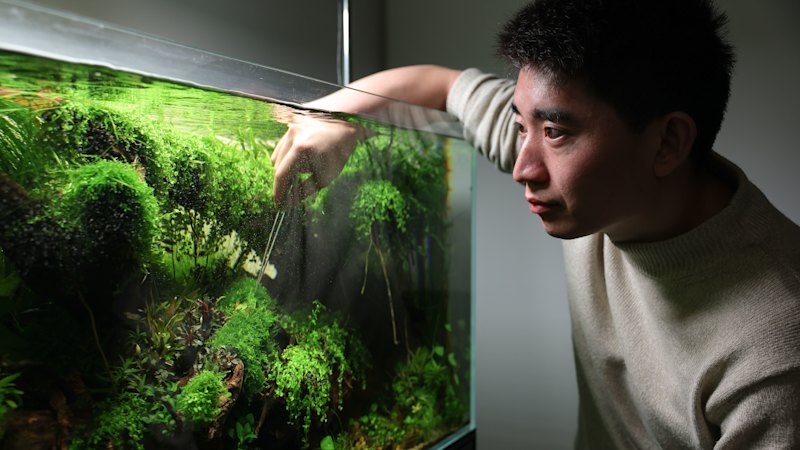
Aquascaping also provides a sense of calm. Architect Kevin Chuang, 29, first came across the hobby on YouTube while completing his master’s degree at university. “It just felt very calming and very natural,” he says. “In that moment, the stress of the master’s degree just faded, and it was very, very peaceful.”
The calming effect might also explain why Saturday Night Live boss Lorne Michaels famously keeps a 200-litre fish tank in his 30 Rock office, where he oversees one of the most high-pressure and stressful shows on television.
It featured in the documentary about his life, Lorne, and former SNL cast-member Bowen Yang spoke about its reputation in a recent video for The New Yorker.
“Kristen Wiig, her first meeting with Lorne Michaels, all she remembers from that meeting is, ‘Wow, that’s a huge fish tank’,” Yang said. “Lorne’s aquarium is quite special.”
Larry Liberstein designed and has been servicing that aquarium for over 40 years through his New York-based business, Aquarius Aquariums, which also looks after high-profile clients such as Robert De Niro.
“[Michaels’] staff feed the fish, and he just enjoys them,” Liberstein says. “He just sits back and watches them. The tank is actually just a few feet from his desk, so he has a perfect position for that.”
So influential is Michaels’ aquarium that Jimmy Fallon got one of his own for his Tonight Show office, also serviced by Liberstein. “Jimmy’s is actually very similar to Lorne’s in many ways. I can’t confirm this, but it may be intentional.”
While the research into the exact effects fish tanks have on our wellbeing is limited, the early literature points towards them reducing stress and anxiety, says Danielle Graber, clinical psychologist and director of 12 Points Psychology. It’s why you see them in offices of doctors, dentists or psychologists, including Graber’s practice where there are multiple tanks.
“There’s enough evidence to say that we do see an autonomic shift for most people when they’re exposed to fish tanks, and there are lots of different hypotheses as to why that might be. Most of them come back to the human-animal bond and the biophilia hypothesis, which is one of the big theories around animal-assisted therapy in general,” Graber says.
Animal-assisted therapy refers to an approach that incorporates animals into mental health treatment. Aquascaping isn’t technically categorised as animal-assisted therapy, but it would be considered an animal-assisted activity, which still has many parallels with the biophilia hypothesis. First proposed by American biologist E.O. Wilson, the biophilia hypothesis posits that being around animals, nature and natural environments helps calm our brain and nervous systems.
One 2016 study published in Environment and Behavior looked at the physical and mental effects of increasing the number of fish in aquariums on 116 randomly selected participants.
The researchers found that watching fish tanks, even while empty, helped people relax. As the tanks were filled with more fish, the mood of the participants improved along with their interest. Their heart rate and blood pressure, meanwhile, lowered.
Graber says that in her office, there was a noticeable shift in how clients responded to the tanks when staff started taking the aquascaping more seriously and introducing a more naturalistic approach to their design. “The fish tanks suddenly looked much more natural and people were drawn to them a lot more,” she explains, noting they grew so attached to the fish that when the clinic axotl died, many patients actually mourned.
The concept of the nature aquarium was made famous by designer, photographer and aquarist Takashi Amano in the 1990s. Amano drew on the Japanese aesthetic concept of “Wabi-Sabi” – which sees beauty in imperfection and impermanence – to create the nature style of aquascaping. It mimics natural landscapes rather than creating a colourful garden like the Dutch style.
It’s one of the designs favoured by Chuang, who also won the Australian Aquascaping Competition in 2023, came runner-up in 2024 and was ranked 187th in the 2024 world championships.
“The idea is that you are inspired by nature. You’re not copying it, you’re bringing ideas from nature into the aquarium,” explains Chuang, an Edmonson Park, Sydney, resident who keeps what he calls an “aquascaping gallery” in his home, which includes seven tanks of varying sizes and designs.
He estimates he spends about $2000 a month on maintaining his aquascapes, but stresses that cost shouldn’t prohibit people from getting into it.
“It all comes down to a person’s budget and what they want to get out of it,” he says.
“Some people like the really minimal style, so you only need three stones and one type of plant and that could look really amazing. Others might want a very intricate style which requires a lot of different materials, a lot of different plants. The beauty is that it’s for everybody.”
Brookman invests most of his earnings from his aquarium job back into his aquascapes. “As much as I try and convince my parents to give me money for it, it can be expensive,” he concedes.
It’s worth it, though, to be able to sit there, proud and engrossed in his own personal aquarium.
“You can just watch it non-stop,” says Brookman, who calls it “fish TV”.
“My favourite is watching the corals moving because … the saltwater replicates the flow of waves, and you can just sit there and stare at the corals flowing around.”
Chuang agrees. “It’s a place where I can ponder about ideas and create art. I see it as a collaboration with nature,” he says.
“There are unexpected things that happen in the process that are just as beautiful as the finished product.”
Make the most of your health, relationships, fitness and nutrition with our Live Well newsletter. Get it in your inbox every Monday.
You have reached your maximum number of saved items.
Remove items from your saved list to add more.