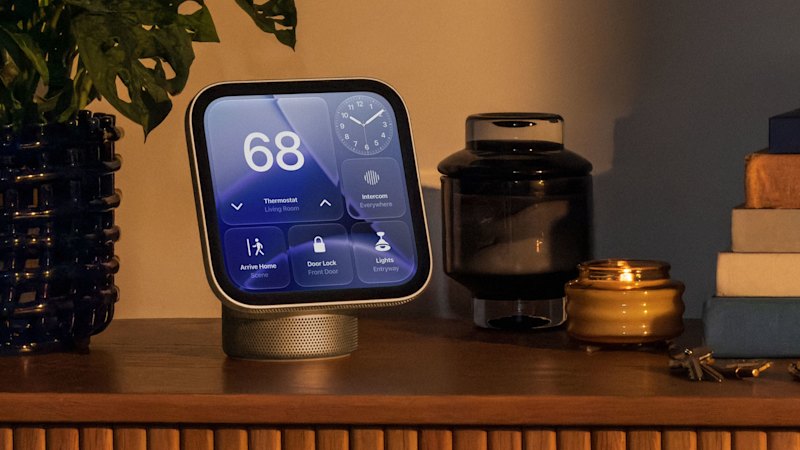


Facial recognition is used to load different apps for different members of a household.
Apple says personal content stays private from others, while shared photo albums and music can be easily enjoyed by everyone in a household.
It will also work with Apple Home Collection – a new line-up of smart home cameras, thermostats and a front door lock designed in collaboration with LG Electronics and Schneider Electric.
Devices created under the Home Collection collab will initially be available in the US, Canada and the UK but not here.

HomeView will also work with smart lights or other third-party smart home accessories that are certified to its HomeKit standard, or the multi-vendor Matter standard, which is supported by Apple, Google and Samsung, among others.
But there are several popular smart home gadgets, including Amazon’s Ring doorbell cams, Blink security cams, plus Eufy cams, that lack native support for many standards.
Apple’s new device will compete with smart screen/home hub devices already on the market like the Amazon Echo Show or Google Nest Hub.

The HomeView’s most immediately obvious point of difference is that each registered user needs their own iPhone or iPad running the latest version of Apple’s iOS.
That approach maximises privacy, security and user-friendliness, but also makes it challenging for a mixed Apple and Android household.
“I got to experience the HomeView up close in Apple’s lofty Tribeca showcase apartment, where one device sat on a marbled kitchen counter and another was mounted on the wall. It acted as a sort of CarPlay for the home, with an iPhone-like experience tailored to life inside and shared among multiple people,” the Wall Street Journal’s Nicole Nguyen wrote earlier today.

“After an Apple employee stepped in front of the screen’s camera to trigger facial recognition, a personalised array of apps and widgets appeared. Her pretend ‘roommate,’ another employee, did the same, and the display changed to a different set of apps in a custom green tint.”
HomeView is mostly controlled by Siri AI voice commands, but also lets you tap its screen to “hand” off content from your iPhone, such as a FaceTime call or recipe on your Safari browser.
You can ask HomeView to, say, “Play that song Eric texted me about”.

In another example, Siri AI handled a series of commands, Nguyen said: “What time did Andrew say he’s getting in from JFK?
“How long will it take him to get to my place if he takes the train?
“Let’s turn on the coffee maker 15 minutes before he’ll arrive.”
She said HomeView showed promise because unlike her Echo Show, it didn’t show ads or require a monthly subscription.

Apple also announced a new smart speaker, the HomePod mini 2 ($299) and the fourth-generation Apple TV 4K ($599), both boosted by the revamped Siri AI.
A HomePod mini 2 can be used by itself, or set up with a twin in a stereo pair. When paired with the new Apple TV 4K, HomePod mini 2 supports four-speaker surround sound.

Apple says the fourth-gen Apple TV 4K’s A19 processor makes it 50% faster than its predecessor.
“Ramageddon” means there’s been a similar northward tilt in pricing.
The new Apple TV features three far-field microphones, meaning you can give it Siri commands from across the room, hands-free (its predecessor required you to hit a Siri button on its remote).
Why do you need an Apple TV box, when your smart TV supports streaming apps and syncs photos and more from your phone?
Your smart TV could well have quite a gutless processor and minimal RAM. Apple TV is the equivalent of giving it a hardware upgrade. You’ll spend less time waiting for apps to load, and get Apple Arcade and other extras.
There’s support for Dolby Vision, HDR 10+ and Dolby Atmos.
And Apple TV also offers privacy guarantees in an age when many vendors are snooping on what you watch.
The minimalist remote – now much-imitated is also super sleek, if super-easy to lose.
Speaking of which, the upgraded remote also gets “Find My” support, a boon for anyone who regularly spends five minutes trying to locate which sofa cushion it’s slipped behind.
Chris Keall is an Auckland-based member of the Herald’s business team. He joined the Herald in 2018 and is the technology editor and a senior business writer.