You have reached your maximum number of saved items.
Remove items from your saved list to add more.
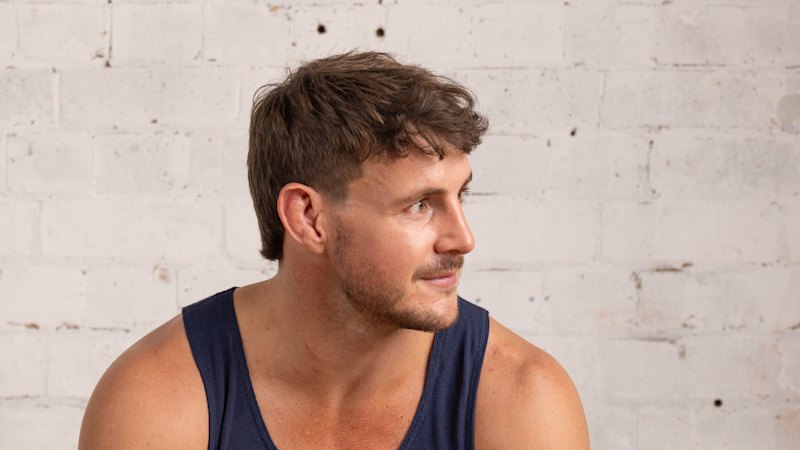
When Luke Bateman was at rock bottom, he was the picture of masculinity: a professional NRL player with a beautiful girlfriend. But Bateman was also battling a gambling addiction that left him in deep debt and self-hatred that saw him cheat on his partner.
Things got so bad he considered suicide.
Paul Harris
“I was in the most privileged position in society, living my dream, and I tried to take my own life,” Bateman says. “How does that happen?”
Six years later, having left the NRL, undertaken rehab and moved to a farm in remote Queensland, Bateman is starting to find the answers. Today, the 31-year-old is best known for his social media presence on #BookTok, where he enthusiastically shares his passion for reading and writing.
In a recent appearance on ABC’s Australian Story, Bateman spoke candidly about how detrimental understandings of masculinity fundamentally shaped his behaviour and relationships with women, seeing him cheat on every partner he had in his early 20s.
“A masculine identity is so fragile and requires you to repeatedly prove your masculinity to other men, and that was done through displays of aggression and how many women you could get,” Bateman says. “That was how you proved that you were manly to other men.”
The online response to Bateman’s honesty and willingness to take accountability for his previous actions was overwhelmingly positive, prompting an important conversation about how dangerous ideas of traditional gender roles continue to play out in modern relationships.
Women were especially grateful to hear Bateman’s words, with one of the top comments saying: “The self awareness and self growth is huge.”
“Nothing more courageous than telling uncomfortable truths,” reads another with over 3000 likes.
“As a mum of three boys – I appreciate these conversations so much,” wrote one user.
“Boys are told from a very young age that the worst thing you can be is a girl,” Bateman says. “To be emotional is to be feminine – I even thought reading was a feminine thing. That internalised itself where there were all of these parts of myself that I rejected and suppressed because they’re not rooted in dominance, power, aggression and control.
“When I entered into professional sport, it became a really concentrated version of that.”
Signed to the Canberra Raiders at age 12, Bateman made his NRL debut in 2015 when he was 20.
Instead of overt expressions of misogyny, Bateman believes harmful ideas about masculinity influenced how the young men around him acted and fed unconscious beliefs that women were inferior.
“This is not something where we were sitting around going, ‘Hey, we should reject women’, that’s not the case,” Bateman says.
“It’s subconscious conditioning that you’re not even aware of within patriarchy where you are constantly trying to prove to other men that you were the best, you were the most attractive, you had the most sexual prowess, you were the most powerful. And this is in every aspect of life.”
The idea that men perform masculinity for other men and bond through sexual conquests is echoed in the research of Michael Flood, a sociologist at the University of Queensland.
“These masculine norms around entitlement, treating women as objects and bonding over sexual status are pretty entrenched,” says Flood, who has been studying masculinity for over 20 years. “But they are shifting, too. I do think men in general are moving away from those traditional, sexist ways of seeing sex in relationships.”
For Bateman, cheating on his partner of three years was a turning point: “I felt so disgusted in myself and thought, ‘What would drive me to do something that makes me feel so incredibly disgusted in who I am?’.”
Bateman explains this behaviour served two functions: working as a manifestation of his internalised misogyny, and reinforcing his worst beliefs about himself.
“It’s so crazy to me that we continue with this corrosive way of conditioning boys into men,” he says. “It’s obviously harmful to women, but it also harms men so much. It strips them of their humanity and leads them to act in ways that will make them hate themselves.”
The sentiment is supported by Flood, who says that in attempting to live up to these narrow ideas of masculinity, men miss out on having “genuine, rich, trusting, mutually pleasurable relations with women”.
The will to change
For men seeking to challenge harmful attitudes, Flood recommends considering how they want to be known, and interrogating the friendships they keep: “Do you want a friendship where you’re always trying to prove yourselves to each other and competing to be seen as top dog? Or, do you actually want a mate who’s going to support you when times are tough, who’s gonna actually respect you, notice you as a person and give you a hand when you need it?”
It’s through recovery that Bateman started working to remedy his issues. He’s since spoken with and apologised to his previous partners, and started nurturing all the relationships in his life, platonic and romantic.
“I have seen how markedly my relationships with women have changed and improved,” says Bateman, who is currently single. “My friendships with both men and women have been so much richer, and they add so much to my life.”
He believes encouraging men to speak openly, honestly and vulnerably about their experiences is key to creating healthy relationships.
“Patriarchy masquerades as a castle, but it is really a prison that is dressed up to them as entitlement and power,” he says.
“Men are drowning in shame and vulnerability is the antidote. If we as men could only open up, be vulnerable, explore our own internal world, reflect upon the systems, the power structures and the peer expectations that have shaped us, and actually deconstruct them, it would heal the world.”
While it would be convenient for everyone to heed Bateman’s wise advice, sex and relationship therapist Tanya Koens says it can be easier said than done.
“A lot of it is really unconscious – what people are hoping for and what they’re expecting – and it can involve a lot of shame,” says Koens, who emphasises empathy is crucial for change.
Koens and Flood both say public figures like Bateman are important for modelling respectful relationships, while the author is adamant his life is all the better for his changed outlook.
“It’s so freeing to be able to show myself fully to a partner and not have to live up to a caricature of what a man should be,” Bateman says.
“The most wonderful thing is knowing I will meet any potential partner as an equal who isn’t with me because they need to be, but because they want to be.”
If you or anyone you know needs support, call Lifeline on 13 11 14, or Beyond Blue on 1300 22 4636.
Make the most of your health, relationships, fitness and nutrition with our Live Well newsletter. Get it in your inbox every Monday.
You have reached your maximum number of saved items.
Remove items from your saved list to add more.