


ACT City Minister Tara Cheyne, Ginninderra ACT Labor MLA Yvette Berry, Federal Transport Minister Catherine King and Fenner MP Andrew Leigh turning the sod on William Hovell Drive. Photo: ACT Government.
A generation of Canberrans has nearly finished school in the time it’s taken to get construction under way on the duplication of William Hovell Drive.
Ten years after ACT Labor promised to duplicate the final 4.5 km stretch between Drake Brockman Drive and John Gorton Drive before the 2016 election, major works have finally begun on the Belconnen road.
But even now, the project isn’t expected to finish until late 2028.
Further south, Tuggeranong residents are still waiting for construction to start on the duplication of Athllon Drive – a project first pitched by former Liberal senator Zed Seselja.
So why is it taking more than a decade to duplicate less than five kilometres of road?
The ACT Government points to environmental approvals, planning processes and procurement hurdles. But infrastructure experts say the answer is much simpler: governments are choosing not to prioritise the work.

A render of the completed William Hovell Drive duplication. Photo: ACT Government.
Remind me of the timelines here
The William Hovell Drive duplication was first announced in 2016 as an ACT Labor election commitment.
Initial feasibility funding followed in the 2018-19 ACT Budget. Then the project was recommitted in the 2020 election campaign before the ACT and federal governments locked in a combined $107.25 million funding package in 2021-22.
Construction officially started this week.
Once complete, the road will have two lanes in each direction between John Gorton Drive and Drake Brockman Drive, alongside new walking and cycling infrastructure, a signalised intersection and wildlife crossings.
The ACT Government says the project will “improve safety, ease congestion and support growth in Canberra’s north-western suburbs” for the more than 20,000 vehicles using the corridor every day.
Lovely. But timelines have repeatedly blown out.
In 2023, the project was expected to open in late 2026. It’s now forecast for completion in late 2028 or early 2029.
A government spokesperson blamed “extensive environmental and planning approvals under both ACT and Commonwealth legislation”.
“The development of these plans involved extensive consultation with both agencies and multiple rounds of revision to address detailed feedback and meet all regulatory and environmental requirements,” the spokesperson told Region.
For Athllon Drive, the government previously said there had been a “number of steps” before construction could begin, including “feasibility studies, concept, preliminary and final design and various stages of procurement”.
Signs reading “We are duplicating this road” were installed along Athllon Drive in 2020, but development approval was only granted in March this year.
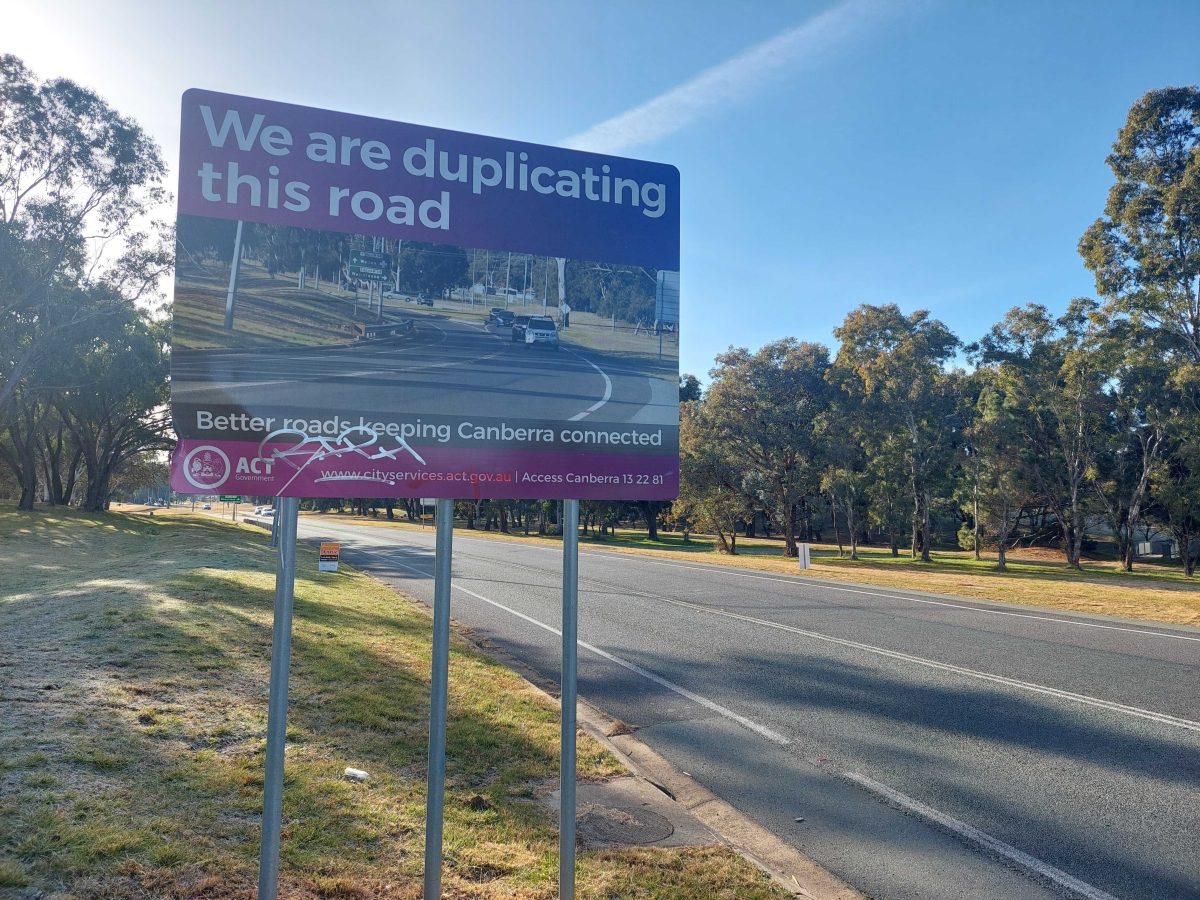
These signs were installed along Athllon Drive in 2020. Photo: David Murtagh.
National Transport Research Organisation CEO Michael Caltabiano said decade-long waits for major road projects were not normal.
“No, it’s not normal to be waiting a decade or more for the delivery of really important infrastructure to keep Canberra connected,” he told Region.
“What the community’s also saying is that you can’t just put a sign up on Athllon Drive and leave it there for six years and say it’s coming. You actually need to deliver.”
So, what’s happening?
Mr Caltabiano rejected suggestions that environmental protections or industry-wide issues were primarily responsible for the delays.
“No, not to my knowledge,” he said when asked whether additional regulations were slowing projects down.
Instead, he said governments were making conscious funding and priority decisions.
“It’s purely a policy position of governments,” he said.
“These are really important upgrades for the ACT. They’ve been long overdue and it’s government that must decide where to prioritise the funding for them.”
He said Canberra’s rapid population growth made projects like William Hovell and Athllon drives increasingly important.
“We must have Athlon Drive duplicated. We must have William Hovel Drive duplicated. We must have these really important links in the transport system functional.”
At the same time, the delays are making projects more expensive.
“There’s been massive cost escalation across the infrastructure sector over the last decade,” Mr Caltabiano said, pointing to labour shortages, productivity issues and rising material costs.
“The longer these pieces of infrastructure take to deliver, the more expensive they become per lineal meter, per lane, per kilometre.”
Is duplication really the answer to congestion?
The projects also sit at the centre of a broader debate over whether duplicating roads actually fixes congestion.
Transport experts such as Institute for Sensible Transport director Elliot Fishman have previously argued road widening creates “induced demand”, where extra capacity simply attracts more traffic.
“You end up getting four lanes of congested traffic instead of two,” Dr Fishman recently told ABC Canberra.

An artist’s impression of the Atkins Street/Langdon Avenue intersection on Athllon Drive. Photo: ACT Government.
But Mr Caltabiano strongly disagrees.
“You can’t clog the arteries of the system and then expect the city and the territory to function,” he said.
“The planning’s been long completed for these key linkages and they’ve been deemed to be required to ensure that communities are connected in an efficient way.”
He said comparisons with massive 23-lane American-style freeways missed the mark in Canberra’s case.
“These analogies are predominantly coming out of the US when they’re widening freeways that are already 23 lanes wide, instead of reimagining how people and freight move.
“But arguments about how the more lanes you build, the more traffic you get, are completely nonsensical in this environment.”


