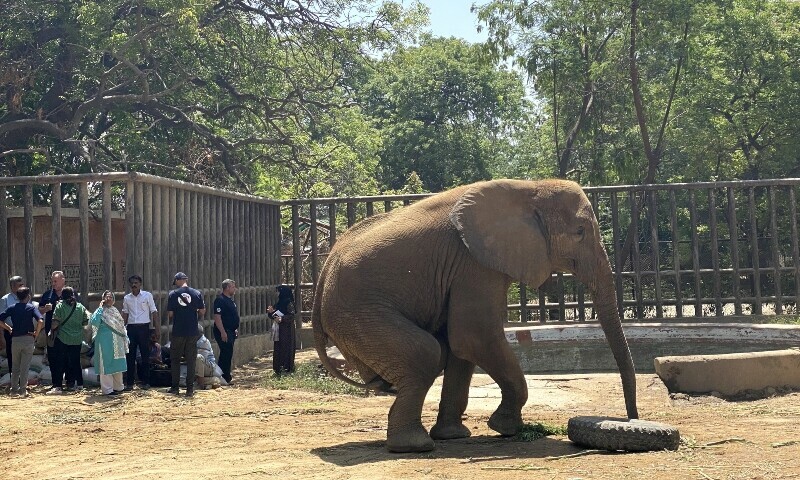
“Noor Jehan’s recovery, her future, and survival now depend on the zoo,” says a member of the Four Paws team.
Noor Jehan was gazing out of a barren enclosure at the Karachi Zoo when a doctor walked up to her and offered some freshly cut grass. Initially reluctant, the elephant slowly extended her trunk towards him and within minutes gulped down the greens.
The exchange showed the 17-year-old elephant’s distrust of humans, but also her generosity to give them another chance.
“Noor Jehan has hope. She has a chance at living, for a long, long time,” said Dr Amir Khalil, who is leading a seven-member team of international experts working for Four Paws, told Dawn.com.
The animal, one of four African elephants in Karachi, developed a condition earlier this year which left her limping and partially immobilised. Zoo officials’ nonchalance resulted in authorities concerned seeking help from Four Paws — an international animal welfare group.
A day earlier, the team — led by Dr Khalil and including Dr Marina Ivanova from Bulgaria, Dr Frank Göritz, Prof Thomas Hildebrandt and Mathias Otto from Germany, and Pia Einheimler from Austria — visited the Karachi Zoo and conducted a five-hour-long examination of the elephant, which included several complicated medical procedures.
A trip to the Karachi Zoo on Thursday showed that Noor Jehan was doing relatively better. Her mahouts said the usual twinkle in her eyes, which had dimmed, was almost back.
Throughout the day, foreign veterinarians helped the elephant move back and forth, applied medication, fed her vitamins and painkillers, and gave her hydrotherapy.
They massaged her joints and also chalked out a map for her enclosure at the zoo, which could provide the elephant with both physical and mental enrichment.
Dr Khalil told Dawn.com that Noor Jehan’s condition — which was 50-50 until yesterday — had now improved to 70 per cent. However, he also warned that the elephant needed dedicated care over the next few weeks, adding that if it was not provided, the elephant could die.
“Noor Jehan needs a lot of movement to activate and train the muscles in her legs again, which will improve the mobility of her digestive tract,” Dr Khalil said.
He explained that the elephant needed to be given a special diet along with the other treatments, and warned against chaining her at any time of the day.
Dr Khalil stressed that Noor Jehan’s swift recovery was key for herself and her companion Madhubala’s — the second elephant at the zoo — relocation to a more species-appropriate home.
“We gave recommendations and guidelines for Noor Jehan’s recovery; her future and survival now depend on the zoo,” the vet added.
For their part, the zoo administration has promised to follow all the recommendations given by the vets.
The diagnosis
Elaborating on Noor Jehan’s diagnosis, Dr Khalil told Dawn.com that the team conducted an endoscopy, ultrasound and blood tests on Wednesday. “During the sedation, Noor Jehan fell down which was very risky […] we nearly lost her yesterday.
“But luckily, as a precaution, we had a crane which was used to lift the elephant and bring her back into a standing position […] we then gave her reverse medication [to wake her up] and succeeded in completing the procedure,” he said.
The vet shared that in the last few months, the elephant suffered either trauma or injury, the reasons of which are yet unknown, leading to internal bleeding and a hematoma — a collection of blood within a confined tissue space — inside the abdomen.
“Other organs in Noor Jehan’s body have also been impacted because of this.”
Dr Khalil said that the team has started administering medication to the elephant, but at the same time contended that this was not the only thing the animal needed.
He regretted that Noor Jehan had lost a lot of weight and muscle mass in the last few months, recommending that the elephant required more movement, exercises, and high-pressure water massages.
The vet further stated that the elephant could not be moved to the Safari Park until her health improved. “Noor Jehan is very sick and weak. If moved now, she will die on the way.”
Elephants are known for their size and strength, but those who have seen Noor Jehan in recent days have seen her health deteriorate rapidly. The elephant’s mass has shrunk, her spine appears disfigured while her legs appear crooked.
Physical and mental enrichment
Apart from medication, there was a lot more the ailing elephant needed. For one, a good night’s sleep.
“Just like humans, animals too have instincts […] Noor Jehan knows her legs do not have sufficient strength […] she knows that if she sits down she might not be able to get back up,” Dr Shehla, a private veterinarian closely working with the Four Paws team, told Dawn.com.
For the medication to work, she explained, Noor Jehan needed proper rest. “But in all these days, until the team arrived, she was leaning against the bars of her enclosure while still on all fours and this has tired her out.”
For this purpose, the vets have asked the zoo staff to place a mound of sand inside Noor Jehan’s enclosure to provide her with support while resting.
Mathias Otto, a member of the Four Paws team and an elephant trainer, told Dawn.com that elephants were intelligent animals and needed to be taken care of in the same way.
“In the wild, they travel for kilometres searching for food and water. At the zoo, we don’t understand what elephants see […] they see how can they play with the keeper, they think about ways through which they could get rewards from their keepers, and they learn every day […] for an elephant, the whole day is an exertion.
“This is why, as much as physical enrichment, an elephant also needs mental enrichment,” Otto said.
To put it precisely, elephants should never feel bored, otherwise, they become irritated and isolate themselves, and could even get depressed.
In Noor Jehan’s case, Otto suggested that tyres and wooden planks be placed inside her enclosure so that she keeps herself moving and occupied. He also recommended that mahouts come up with new ways of feeding her, which would provide her brain the enrichment it needed.
The enclosure Noor Jehan is presently residing in is barren and has a lone tree inside. It houses a pond lined with cement which is mostly empty. At night, the elephants are moved to an even smaller space, which too is made of desolate cement, and are kept chained until dawn.
Creating bonds
During the last two days, while Noor Jehan underwent treatment, her only roommate and long-time best friend Madhubala remained anxious and uneasy.
From a separate enclosure, Madhubala kept sliding her trunk towards Noor Jehan, trying to reach out to her friend. Her mahout Samiullah told Dawn.com that the two have been living together for over a decade now.
All four African elephants in Karachi — Malika, Noor Jehan, Madhubala, and Sonu — were brought to Pakistan from Tanzania in 2009. They were captured from the wild when they were merely two-years-old.
All four elephants lived together at Safari Park for a year before Noor Jehan and Madhubala were separated and brought to the Karachi Zoo.
Dr Khalil of Four Paws said elephants are social animals who live in herds. In the wild, these animals travel in groups, make deep bonds, cry at the deaths of their loved ones and bury them.
Explaining Madhubala and Noor Jehan’s bond, the vet explained that the former had taken over the position of the matriarch and considered the latter to be her child.
“When we came yesterday, after the procedure, Madhubala came to touch through her trunk the swelling on Noor Jehan to see if we had hurt her friend,” Dr Khalil recalled, adding that this was the reason the two elephants could not be separated.
“They also need to be reunited with other elephants … this psychological factor is also very important for the health of these animals.”
Zoo life
With all the other factors, one thing that remains the same is that elephants are animals not meant to be domesticated or kept in cages.
According to a 2008 study, zoo life can be deadly for elephants. It states that elephants born and raised in zoos live less than half as long as elephants living in native areas.
Scientists link most of these deaths to obesity because even though the animals are well-fed, they get a very little exercise. Moreover, the blame also goes to the high-stress levels the animals suffer, primarily because of being separated from their mothers — which is exactly what happened with Noor Jehan.
Dr Khalil concurred. “Elephants need a lot of environment. Normally, elephants spend 80pc of their time walking and eating […] this is their hobby.
“They need a special diet, a special place to move, they need enrichment and social interactions. But all these requirements of the jungle cannot be fulfilled in the zoo,” the vet explained.
He highlighted that the Karachi Zoo was located in the centre of the city. It did not have sufficient space, it did not have the smell of the jungle or the sounds of the wild.
“This environment here is a lot more stressful for the elephant and gives rise to a number of diseases,” Dr Khalil said. “Noor Jehan is still young, she is just a teenager right now. For the next 20 years, she deserves to live in a better place.”
Header: Ailing elephant Noor Jehan tries to move around her enclosure as vets come to her aid. — Photo by author