Opinion
You have reached your maximum number of saved items.
Remove items from your saved list to add more.
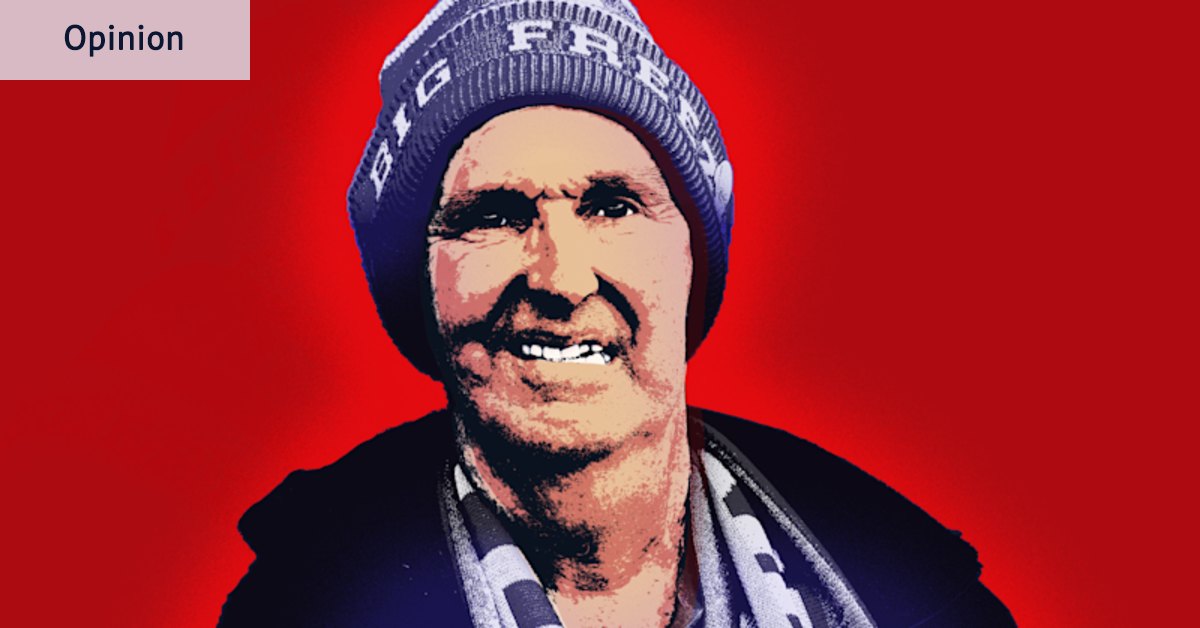
When my husband was dying of motor neurone disease, a tradie turned up at our house to carry out a minor repair. He was a big guy, stocky, and on his head was a grubby Big Freeze beanie. I started seeing beanies at the supermarket, on people going for a walk on a cold day. It raised our spirits just a little to know that people had bought something as ordinary as a beanie to raise funds to research this disease, that they even knew about MND.
That was because of Neale Daniher, a talented footballer and later AFL coach who was diagnosed with MND in 2013. He died on Monday, aged 65. There was much that was remarkable about Daniher, including that he lived with this disease for 13 years. Average life expectancy is two to three years. It is 100 per cent fatal – there are no survivors to be its champions; few around long enough to raise awareness. But when my husband David was ill, Daniher was there, and somehow we felt he would always be there, fighting “the beast”, reminding us that “life doesn’t promise to be fair” but it could continue to be worthwhile. Everyone knew MND would take Daniher, but when it happened, many of us still felt heartbroken.
When you’re diagnosed with a terminal disease, or caring for someone who is, it is inevitable that you review your own life and choices, that you wonder about what any of it meant. Daniher’s diagnosis led him to make his greatest contribution, far beyond his playing days cut short by injury, or his coaching Melbourne to play in the grand final in 2000. I have spoken to scientists who say the charity he co-founded in 2014, FightMND, has been the game-changer in research, raising close to $120 million, unheard of in Australia.
There are other wonderful organisations such as MND Victoria that care for patients living with what is a devilishly complicated disease. There are neurologists, physios, dietitians, occupational therapists and more. Wheelchairs turn up when needed, equipment is provided to enable you to communicate when dying muscles mean you can no longer talk. There are experts letting you know it’s time for a feeding tube.
What FightMND did was different. Its goal is to find a cure for MND, a disease that still baffles. It was first identified in 1874 and today, while we know far more, we still don’t understand what causes it, let alone how to cure it. We don’t know why Daniher’s motor neurones – nerve cells in the brain and spinal cord that control voluntary muscle movement, such as swallowing, walking and talking – began to die, showing up first in a weak handshake. Why my husband, a fit and healthy defence barrister, found he couldn’t get his words out properly in court. About 10 per cent of cases are familial, which means it runs in the family, but 90 per cent are called sporadic, coming out of nowhere. It’s still considered a rare disease, but it’s increasing, and we don’t know why. Some combination, perhaps, of genetics, toxins in the environment, even extreme exercise or concussions. It is confounding.
David and I watched the Big Freeze on television in 2023, a few months before he died. Daniher was there at the MCG, unable to speak, his smile crooked as celebrities took the plunge into freezing water to raise funds for MND. That the AFL took up this cause is to its credit and that everyday people saw something in Daniher that inspired them was moving for those of us coping with this disease. Even being there must have been hard for Daniher – dying muscles make you weak, tired, beyond exhaustion. But how stubborn he was, publishing a book last year called The Power of Choice for his young grandchildren.
Daniher was known as an inspirational speaker, even if his speech was slurred, or eventually created by “eye gaze” technology through an app. His speech was plain, but not less profound because of it. He reminded me of Viktor Frankl, a psychiatrist who spent three years in concentration camps during World War II and wrote about his experience in Man’s Search for Meaning. Daniher’s experience was not the same, but his approach to life was similar.
“Everything can be taken from a man but one thing,” wrote Frankl, “the last of the human freedoms – to choose one’s attitude in any given set of circumstances, to choose one’s own way.” Wrote Daniher: “To many I must look like a man with no choices left. But let me tell you something: I still have a choice. Every day, I choose how I show up. Simply acknowledging that I can still control my attitude is liberating.”
He liked to quote the proverb, “When all is said and done, more is said than done.” There’s a clip of him addressing young footballers. “The mark of a person is not what they say, it’s what they do. The question I’m going to leave you with is, ‘What are you going to do?’”
We live in times when such notions can seem old-fashioned. We are stressed, distracted. Bigotry flares, as do tempers. I am not a sentimental person, but it gives me hope that millions of people responded so strongly to one person doing good things, not for himself, but for others.
Daniher will be honoured with a state funeral, which is entirely fitting. There will be speeches and photographs of famous people. On that day, I will think of his wife Jan, and his children Bec, Ben, Lauren and Luke. MND is constant grief, watching someone you love lose every bit of what they enjoyed in life, piece by piece.
But they don’t lose their essence, and Neale Daniher maintained his until the end. Vale. We will have to play on without you.
Gay Alcorn is a senior writer with Good Weekend magazine and a former editor of The Age. She is writing a book on motor neurone disease.
The Opinion newsletter is a weekly wrap of views that will challenge, champion and inform your own. Sign up here.
You have reached your maximum number of saved items.
Remove items from your saved list to add more.