

Subscribe to listen
- Share this article
- Copy Link
- Twitter/X
Reminder, this is a Premium article and requires a subscription to read.
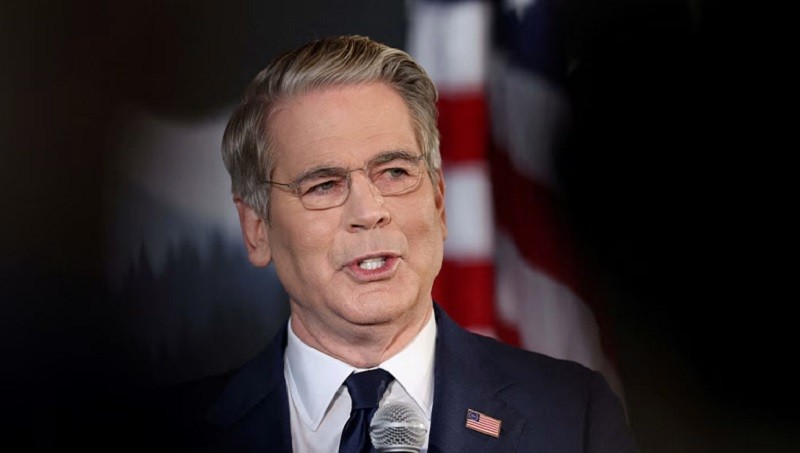
President Trump during an impromptu press briefing at the White House on Monday. Photo / Doug Mills, The New York Times
As he braces for Democrats to assume legislative control in Washington, President Trump has sought to take back centre stage with some discordant manoeuvres.
Coping with loss looks different for everyone, and President Donald Trump has processed the country’s nearly wholesale rejection of the Republican Party in the mid-term elections
in his own way.
The last week has seen the President renew false claims about rigged elections, float a mixed martial arts executive as his new press secretary, muse about the beams in the White House ballroom, oust his chief of staff and call unannounced into C-SPAN.
In other words, this is all unfolding exactly as expected. The news has been bad, and Trump knows it. Cue the mayhem.
“We were having a very bad press day,” Trump told reporters Monday about why he suggested on social media that the CEO of the UFC should turn the briefing room into his personal octagon. “I said, you know, I think I’m going to get Dana White to be my new press secretary.”
Trump loves to change an unflattering headline by whipping out a diversion. But his usual tricks seem particularly discordant in the face of the urgent challenges facing the White House. There is an effort to impeach Defence Secretary Pete Hegseth, wars in Ukraine and Iran that the President promised to resolve months or years ago, and an incoming Congress whose Democratic majority is hungry to hold administration officials to account.
But so far, Trump’s answer to the pressure has been to take an unserious approach to some of the most serious topics. In recent days, he has left the country guessing what he may do, what he may say, or even when he may show up in public.
His advisers say the President thrives on chaos. The problem is that the public may not.
“We always talk about Donald Trump as the executive producer in chief,” said Doug Heye, a Republican strategist. “TV shows sort of run out of steam before they get to Season 6. That’s a big part of where voters are. They’re just exhausted.”
This extends to Trump repeating his baseless claims about election fraud. “It’s just not a credible argument, to the point that nobody’s paying attention,” Heye added.
Indeed, after the President on Monday revived claims that the midterm vote had been manipulated, conservative commentator Megyn Kelly had a two-word retort: “Just stop.”
Beni Rae Harmony, a White House spokesperson, defended the President’s focus and productivity.
“President Trump never stops working, and his momentum has only increased in the past week,” she said in a statement, adding that he had held seven policy meetings, met with the Qatari Prime Minister and signed several bills into law, including one that designated a museum in Missouri as a national historic landmark and one that changes the bankruptcy threshold for small businesses.
One adviser, who spoke on condition of anonymity to describe the environment in the White House, called this moment a “natural transition phase”.
This is a sanguine descriptor, given the abrupt departure of Susie Wiles, the chief of staff Trump replaced with Stephen Miller, a hardline loyalist who has driven many of the policies voters rejected last week. A Republican fratricide has also been playing out on social media, where current and former Trump officials have spent the past several days blaming one another for the midterm failures, trading accusations of corruption and grift and threatening lawsuits.
It is the Republican version of the scene in the 2004 movie “Mean Girls” in which the main antagonist makes public a book full of private insults, unleashing bedlam inside a high school.
After spending a weekend at his Florida estate Mar-a-Lago golfing and delivering impromptu remarks at a conservative gathering there, Trump sought to distract from the bad headlines and the mounting congressional support for the impeachment of his defence secretary. On Monday, he startled reporters with an appearance in the White House briefing room.
Trump riffed about his gambit of offering the press secretary gig to White, who accompanied him to greet reporters, and then began fielding questions of national and international import.
Asked about the admission by Jensen Huang, the CEO of Nvidia, of an affair with a Chinese businessperson US officials concluded was an intelligence operative for Beijing, the President seemed unconcerned, saying he bought Huang’s explanation.
“He said, ‘I had no idea that she was a spy,’ and I really believe him,” Trump said.
The President also discussed the death toll in the Russia-Ukraine war, framing his assessment of the carnage in terms he understood: crowd sizes.
“I just think that Ukraine and Russia are tired of fighting. They’re tired of seeing dead young soldiers, mostly soldiers. Most of the people are soldiers. Think of it. They’re losing 25,000 – Dana, can you imagine 25,000? That’s like a stadium, Madison Square Garden. You have your fights, 25,000. That’s what it holds, and they’re losing that every single month – dead, young, beautiful people, and it’s, it’s got to stop.”
The fun and games continued later Monday when Trump called into the premiere of a C-SPAN show, apparently without notice. A woman could be heard giggling in the background as the President’s call connected.
For eight minutes, Mimi Geerges, the host of the programme, tried to press Trump about news he had made in several other interviews since the midterm elections. What about that immigration deal he had suggested he could strike with Democrats? What about amnesty for some migrant workers, as he had suggested on “60 Minutes” over the weekend?
His responses were not clarifying.
“Frankly, a big problem we had is the mental institutions being dumped into our country. Some very dangerous people were released into our country, to put it mildly. So we have not put the same, uh, pressure, obviously, and, you know, the, uh, we call them the worst of the worst,” Trump said, by way of an answer. “We haven’t put the same pressure on waitresses and, and on farmworkers, et cetera. Not even close.”
Natural transition phase or not, many Republicans are worried that the White House will not be able to deliver on the request made by voters last week, which was to get serious about addressing economic concerns, an unchecked war and accusations of rampant corruption among those in Trump’s orbit.
The best-case scenario, said GOP strategist Whit Ayres, would be if the Administration followed through “on Trump’s initial instinct to do something with the Democrats who are going to be running the place shortly”.
But, he added, “I think the chances of that happening are somewhere between slim and none”.
This article originally appeared in the New York Times.
Written by: Katie Rogers
Photographs by: Doug Mills
©2026 THE NEW YORK TIMES
- Share this article
- Copy Link
- Twitter/X
Reminder, this is a Premium article and requires a subscription to read.